

You’re quitting your gig. You need to write a “Performer Resignation Letter.” This letter formally informs your employer of your decision. It marks the end of your employment as a performer.
This letter is important. It outlines your intentions professionally. It usually includes your last day of work. It is a vital step in the process.
Feeling stuck on how to word it? Don’t worry. We’ve got you covered. We’ll share several templates. You will find examples here. Use them to craft your perfect goodbye.
Performer Resignation Letter
Below is a sample of a Performer Resignation Letter:
[Your Name]
[Your Address]
[Your Phone Number]
[Your Email Address]
[Date]
[Employer’s Name]
[Employer’s Title]
[Company Name]
[Company Address]
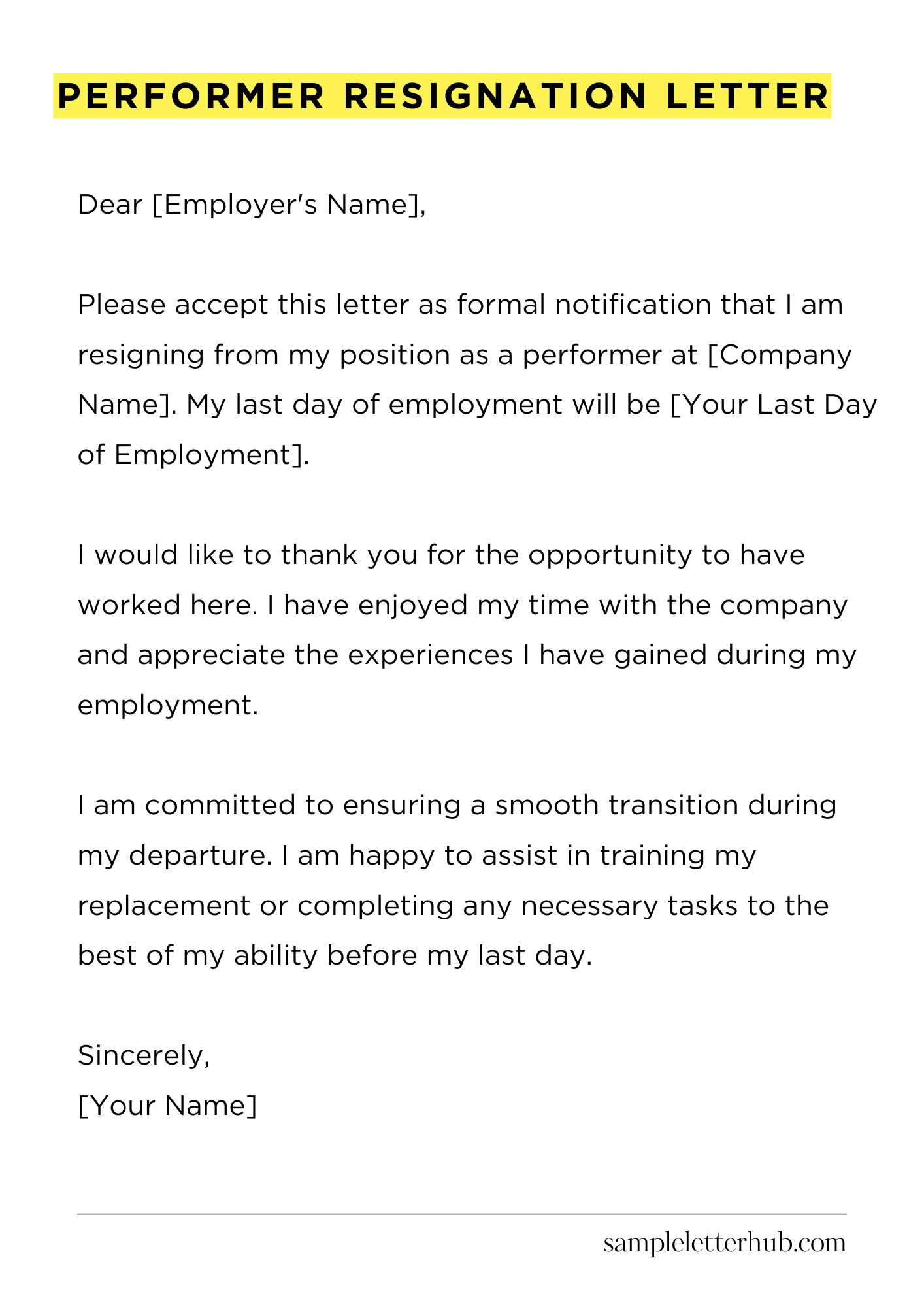
Dear [Employer’s Name],
Please accept this letter as formal notification that I am resigning from my position as a performer at [Company Name]. My last day of employment will be [Your Last Day of Employment].
I would like to thank you for the opportunity to have worked here. I have enjoyed my time with the company and appreciate the experiences I have gained during my employment.
I am committed to ensuring a smooth transition during my departure. I am happy to assist in training my replacement or completing any necessary tasks to the best of my ability before my last day.
I wish the company continued success in the future.
Sincerely,
[Your Name]
How to Write Performer Resignation Letter
So, you’re ready to move on. Maybe you’ve landed a new role, or perhaps you’re seeking a change of scenery. Whatever the reason, if you’re a performer, knowing how to craft a professional resignation letter is essential. This crucial document is your formal farewell to your current employer.
1. Prepare Before You Start
Before putting pen to paper (or fingers to keyboard), take some time to reflect. You need to consider a few critical points. First and foremost, determine your official last day. This date needs to align with your contract or any company policies. Then, review your employment agreement; this is crucial.
It might have specific requirements for your resignation, like how much notice to give. Finally, have a positive mindset. Remember, leaving on good terms is usually beneficial.
Next, decide on your tone. Keep it professional. Avoid venting frustrations or complaints, even if you have them. Focus on expressing gratitude and keeping it brief.
2. Formatting the Letter
A well-formatted letter speaks volumes. Start with your contact information (name, address, phone, email) at the top, followed by the date. Then, address the letter to the appropriate person, usually your direct manager or the human resources department. Ensure you use a professional salutation like “Dear [Manager’s Name]”.
Now, to the important part: the body of your letter!
3. Writing the Body of Your Letter
The body is where you get down to business. Start by clearly stating your intention to resign and the date of your last day of employment. Keep it simple and straightforward.
You should also briefly express your gratitude for the opportunity to work there. Mention something positive about your experience, even if it was just learning new skills. Avoid rambling or including a long list of grievances.
After your thank you, include a sentence or two about your willingness to assist with the transition. Offer to help train a replacement or complete any ongoing projects. This demonstrates professionalism and a positive attitude. Finally, end your letter with a professional closing, such as “Sincerely” or “Best Regards,” followed by your full name.
4. Review and Refine
Before hitting “send,” proofread your letter carefully. Check for any typos, grammatical errors, and clarity issues. Read it aloud to ensure the flow is smooth and that your tone is appropriate. Having a second pair of eyes to review it is always a good idea. Ask a trusted friend or colleague to read it for feedback. Does it sound respectful? Does it clearly state your intentions?
Remember that this letter is a reflection of you. Make sure it is the best it can be.
5. Delivery and Follow-Up
Once you’re completely satisfied, it’s time to deliver your resignation letter. It is generally better to hand deliver it in person or send it via email. If you’re handing it in person, schedule a meeting with your manager. This allows you to discuss your departure and answer any questions. If sending by email, consider using a formal subject line like “Resignation – [Your Name].”
After submitting your letter, be prepared to discuss your departure with your manager. They may ask about your reasons for leaving or express their disappointment. Remain professional and positive in your responses.
Follow through on any offers to assist with the transition. Finally, remember to collect any personal items and ensure you have completed all necessary exit procedures. Your departure should be as smooth as possible.
FAQs about Performer Resignation Letter
What is the primary purpose of a performer resignation letter?
The primary purpose of a performer resignation letter is to formally notify an employer of an employee’s intent to leave their position. It serves as an official record of the resignation, providing a clear date of departure and allowing for a smooth transition. It also allows the performer to state their reason to leave their position in a professional manner.
What essential information should be included in a performer resignation letter?
An effective performer resignation letter should include: the employee’s official name, the date of the letter, the intended last day of employment, a clear statement of resignation, and a professional closing. It may also include a brief expression of gratitude for the opportunity or a short explanation of the reason for leaving, though this is not required.
How much notice should a performer give when resigning?
The amount of notice a performer should give depends on the terms of their employment contract or company policy. However, as a general rule, providing at least two weeks’ notice is standard practice in many industries. Checking the employment contract or employee handbook is essential to understand the specific requirements.
Should a performer state the reason for their resignation in the letter?
While not mandatory, performers can choose to briefly state the reason for their resignation in the letter. Keeping it concise and professional is recommended. Reasons might include accepting another job, pursuing further education, or personal reasons. However, there is no obligation to provide detailed explanations, especially if the performer is uncomfortable doing so.
How should a performer handle the delivery of their resignation letter?
Ideally, the performer should deliver the resignation letter to their immediate supervisor or the appropriate HR representative. It can be delivered in person, or via email, or as per the company’s guidelines. It is important to retain a copy for personal records. Following up with a verbal conversation is also a common courtesy to ensure the resignation is acknowledged.
Related:
Resignation letter due to rude boss
Resignation letter moving to another state
Resignation letter due to illness of family member
Resignation letter due to study