

A Peer Advisor resignation letter is a formal document. It informs your supervisor of your decision to leave. The letter also states the effective date of your departure. Its purpose is to officially end your role.
Thinking about stepping down from your Peer Advisor position? We understand it can be tough. Crafting the right words can be tricky. Don’t worry, we’ve got you covered.
Here, you’ll find various letter templates. We’ll provide diverse examples. These will help you compose your own resignation letter. They are simple. They are easy to adapt. Let’s make this process smoother.
Peer Advisor Resignation Letter
Below is a sample of a Peer Advisor Resignation Letter:
[Your Name]
[Your Address]
[Your Phone Number]
[Your Email Address]
[Date]
[Peer Advisor Supervisor’s Name]
[Peer Advisor Supervisor’s Title]
[Department Name]
[University/Organization Name]
[Supervisor’s Address]
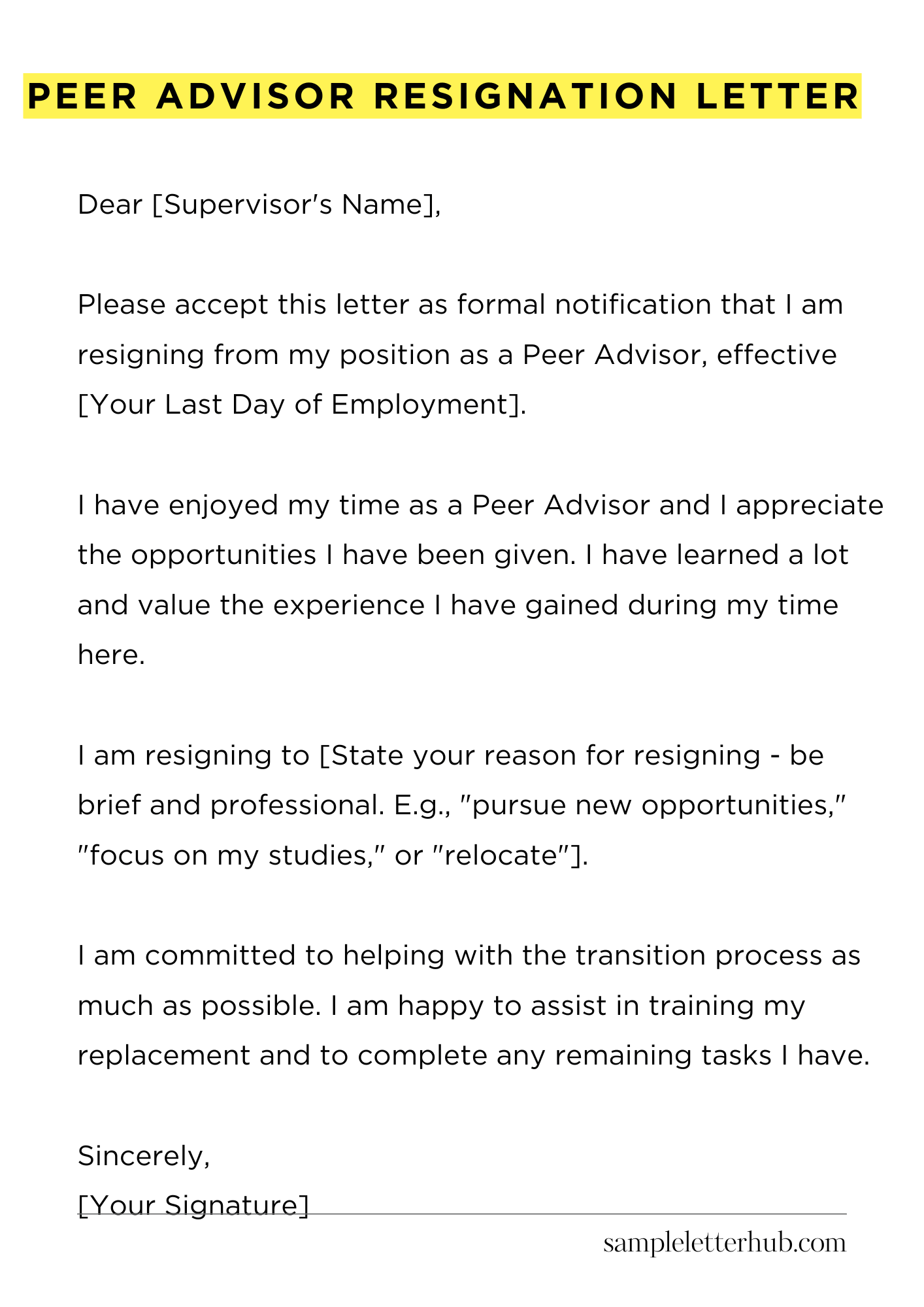
Dear [Supervisor’s Name],
Please accept this letter as formal notification that I am resigning from my position as a Peer Advisor, effective [Your Last Day of Employment].
I have enjoyed my time as a Peer Advisor and I appreciate the opportunities I have been given. I have learned a lot and value the experience I have gained during my time here.
I am resigning to [State your reason for resigning – be brief and professional. E.g., “pursue new opportunities,” “focus on my studies,” or “relocate”].
I am committed to helping with the transition process as much as possible. I am happy to assist in training my replacement and to complete any remaining tasks I have.
Thank you for the support and guidance you have provided me. I wish you and the department all the best in the future.
Sincerely,
[Your Signature]
How to Write a Peer Advisor Resignation Letter
Resigning from a peer advisor position requires a touch of professionalism. You want to leave on good terms, ensuring a smooth transition for both you and the program. A well-crafted resignation letter is your first step. It is the perfect way to communicate your departure clearly and respectfully.
1. Start with a Clear and Concise Greeting
Your opening sets the tone. Keep it simple and direct. Address the letter to your supervisor or the person you directly report to. A simple “Dear [Supervisor’s Name],” is perfectly acceptable. Avoid overly casual greetings. Now, you’ve set the scene.
2. State Your Intention and Effective Date
This is the most crucial part. Clearly state that you are resigning from your position as a peer advisor. Be specific! Include your last day of employment. This removes any ambiguity. This also gives your supervisor time to make arrangements. For example, “This letter is to formally notify you of my resignation from the Peer Advisor position, effective [Date].” The key is precision.
3. Express Your Gratitude (Optional, but Recommended)
Taking the time to express gratitude shows appreciation for the opportunity. Mention the valuable experience and skills you’ve gained. This adds a positive element to your letter. A brief sentence or two can go a long way.
Consider something like, “I am grateful for the opportunity to have served as a Peer Advisor and for the experiences I have gained.” This makes you look nice.
4. Offer to Help with the Transition
Demonstrate your commitment to a smooth handover. Offer to assist in training a replacement or completing any outstanding tasks. This reflects positively on your work ethic.
Your supervisor will appreciate your cooperation during the transition. For instance, you could write, “I am happy to assist in any way possible to ensure a seamless transition during my departure.” This is definitely a good idea.
5. Close with a Professional Closing and Contact Information
Wrap up with a professional closing, such as “Sincerely” or “Respectfully.” Sign your letter and type your full name. Include your contact information. This ensures your supervisor can reach you if needed. Remember to proofread your letter for any errors before submitting it. You did a good job!
FAQs about Peer Advisor resignation letter
How do I start a Peer Advisor resignation letter?
Begin your letter by clearly stating your intention to resign from your position as a Peer Advisor. Include the date of your resignation and the date your last day of employment will be. Address the letter to your supervisor or the appropriate authority within your institution.
What key information should be included in a Peer Advisor resignation letter?
Besides the resignation date and your last day, you should state your position title, express gratitude for the opportunity, and briefly explain your reason for leaving (if you choose to). It is also important to include any relevant details, such as outstanding tasks, and offer assistance with the transition process. It’s usually a good practice to express your contact information, if any.
Is it necessary to provide a reason for resigning in the letter?
Providing a reason for your resignation is optional. While it’s customary to state your reason, you are not obligated to disclose private matters. Keep it professional and concise, such as “to pursue other opportunities,” “to focus on academic studies,” or “for personal reasons.”
What is the proper format for a Peer Advisor resignation letter?
Maintain a professional and polite tone throughout. Use a formal business letter format. Include your contact information (name, address, email, phone number) and the date at the top. Use a clear and concise language. Keep the body of the letter brief and to the point, avoiding unnecessary details. End with a professional closing, such as “Sincerely” or “Respectfully,” followed by your name and signature.
How should I handle outstanding tasks or responsibilities in my resignation letter?
If you have any unfinished tasks, briefly mention them and offer to assist with their completion or provide a handover to another advisor. You can state that you’re willing to help in the transition process to your successor. This shows professionalism and consideration for your colleagues and the institution.
Related:
Resignation letter due to rude boss
Resignation letter moving to another state
Resignation letter due to illness of family member
Resignation letter due to study