

You’ve decided to move on. A “Payroll Supervisor resignation letter” is your official goodbye. It formally notifies your employer of your departure. This document outlines your last day of employment.
Writing this letter can feel daunting. Don’t worry, we’re here to help. We’ve compiled various templates and examples. These samples cover different scenarios.
Use these as your guide. Tailor them to your specific situation. Craft a professional and polished resignation. Make the process smoother.
Payroll Supervisor Resignation Letter
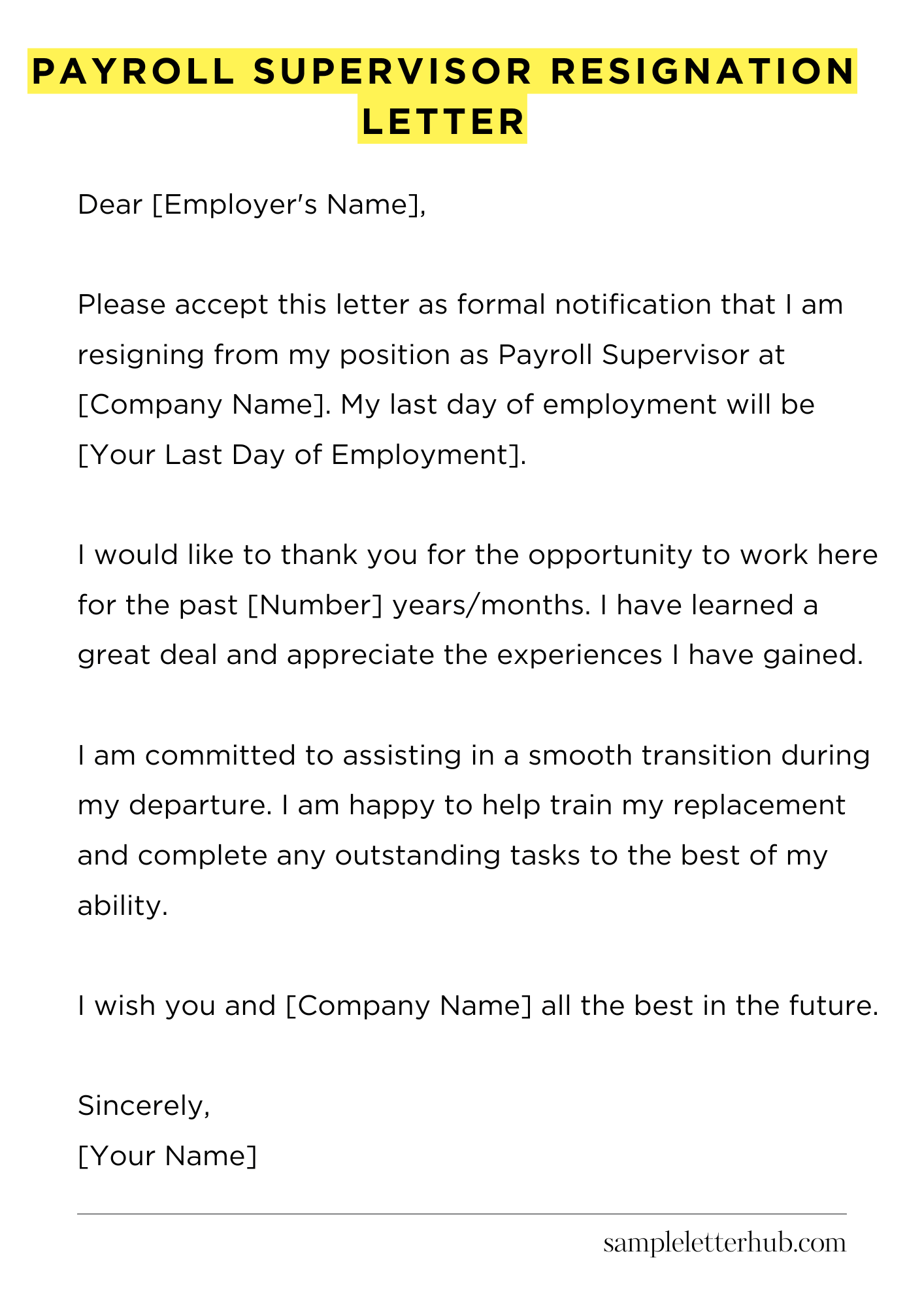
Below is a sample of a Payroll Supervisor Resignation Letter:
[Your Name]
[Your Address]
[Your Phone Number]
[Your Email Address]
[Date]
[Employer’s Name]
[Company Name]
[Company Address]
Dear [Employer’s Name],
Please accept this letter as formal notification that I am resigning from my position as Payroll Supervisor at [Company Name]. My last day of employment will be [Your Last Day of Employment].
I would like to thank you for the opportunity to work here for the past [Number] years/months. I have learned a great deal and appreciate the experiences I have gained.
I am committed to assisting in a smooth transition during my departure. I am happy to help train my replacement and complete any outstanding tasks to the best of my ability.
I wish you and [Company Name] all the best in the future.
Sincerely,
[Your Name]
How to Write a Payroll Supervisor Resignation Letter
Resigning from a job is a significant step. It requires careful consideration and a professional approach. Especially when you’re a Payroll Supervisor, you need to handle it with extra care, given the sensitive nature of your responsibilities. You’ll be dealing with confidential information up to the very end. Let’s break down how to craft a resignation letter that reflects this.
1. The Foundation: Start with Clarity and Respect
Your resignation letter’s primary purpose is straightforward: to formally announce your departure. Begin with a clear and concise statement of your intent to resign.
Always address the letter to your direct supervisor or the appropriate HR representative. Keep the tone respectful, even if you’re leaving due to negative reasons. Avoid unnecessary negativity or personal attacks. Remember, you want to leave a positive lasting impression.
For example, you might start with something like, “Dear [Supervisor’s Name], please accept this letter as formal notification that I am resigning from my position as Payroll Supervisor at [Company Name], effective [Your Last Day of Employment].”
2. State the Effective Date and Duration of Notice
One of the most crucial parts of your letter is specifying your last day of employment. This is where you clarify when your resignation becomes official. Be sure to provide the date.
Be certain you understand your company’s policy on the notice period. Usually, a minimum of two weeks is standard, but check your employment contract or employee handbook. Stick to that duration unless otherwise agreed upon with your employer.
If you’re unsure, ask HR beforehand to prevent any problems. Giving sufficient notice allows for a smooth transition and ensures all payroll tasks are covered.
3. Briefly Acknowledge Your Time and Offer Assistance
This section allows you to express your appreciation for the opportunity. Keep it brief. If you had a positive experience, you can mention it here. It’s also a good practice to offer assistance during the transition.
Offer to help train your replacement, answer questions, or provide any necessary documentation. This demonstrates professionalism and a willingness to facilitate a smooth handover.
An example would be: “I would like to thank you for the opportunities I’ve had at [Company Name]. I am prepared to assist in the training of my successor to ensure a seamless transition of my duties.”
4. Formalities, Formatting and Proofreading is important
Payroll is important, as is this letter. Ensure your letter adheres to proper business letter format. Use a professional font like Times New Roman or Arial, with a standard font size. Keep it concise, aiming for one page. Avoid excessive jargon. Proofread carefully. Double-check for any grammatical errors, typos, and formatting inconsistencies.
Use a professional tone and avoid slang or informal language. Always include your name, address, and contact information at the top, along with the date. At the end, sign the letter above your typed name. This is crucial.
5. Deliver It Properly and Keep a Copy
The method of delivery matters. Submit your letter in person to your supervisor, if possible. Obtain a written acknowledgement of receipt. If in person isn’t possible, send the letter via certified mail or email, with a read receipt requested. This provides proof of delivery.
Make sure you retain a copy of your resignation letter for your records. This can be useful for future reference, should any questions arise regarding your employment. By following these steps, you can create a resignation letter that is clear, professional, and reflects well on your abilities.
FAQs about Payroll Supervisor resignation letter
Here are some of the most common questions surrounding a Payroll Supervisor resignation letter, along with their respective answers:
What is the primary purpose of a Payroll Supervisor resignation letter?
The primary purpose of a Payroll Supervisor resignation letter is to formally notify an employer of an employee’s intent to leave their position. It serves as a written record of the resignation, the effective date of departure, and often expresses gratitude or provides reasons for leaving. It is a crucial document for initiating the separation process and ensuring a smooth transition.
What key information should be included in a Payroll Supervisor resignation letter?
A well-crafted resignation letter should include: a clear statement of resignation, the specific job title (Payroll Supervisor), the effective date of resignation, a brief and professional expression of gratitude for the opportunity to have worked in the company.
It may also optionally include a reason for leaving, although this is not mandatory. The letter should conclude with a professional closing and your signature.
Is it necessary to provide a reason for resigning in the letter?
While not strictly mandatory, providing a reason for resignation can be beneficial. It helps your employer understand your decision and may provide valuable feedback. The reason should be kept brief, professional, and truthful.
Examples include: pursuing a new opportunity, relocating, personal reasons, or seeking career advancement. However, if you are uncomfortable sharing a reason, it’s perfectly acceptable to state your resignation without explanation.
How much notice should a Payroll Supervisor give when resigning?
The amount of notice required varies based on company policy and employment contracts, it is typically between two weeks (minimum) and a month.
Review your employment contract or company handbook to understand the standard notice period. When in doubt, providing more notice is always preferable, as it allows for a smoother transition and demonstrates professionalism.
What is the proper format for a Payroll Supervisor resignation letter?
A resignation letter should be written in a professional business letter format. This typically includes your contact information (name, address, phone number, email) at the top, the date, the recipient’s contact information (employer’s name, title, company address), a formal salutation (e.g., “Dear [Manager’s Name]”).
Related:
Resignation letter due to rude boss
Resignation letter moving to another state
Resignation letter due to illness of family member
Resignation letter due to study