

A Patient Access Representative resignation letter is a formal document. It informs your employer that you’re leaving your job. The letter officially ends your employment. It’s a crucial step in the resignation process.
Finding the right words can be tricky. We understand the importance of clear communication. That’s why we’re here to help. This article provides helpful resources. We’ll share various templates and examples.
Get ready to craft your perfect letter. We’ve got different scenarios covered. Whether you need a short notice or a graceful exit, we can help. Writing this letter should be easy.
Patient Access Representative Resignation Letter
Below is a sample of a Patient Access Representative Resignation Letter:
[Your Name]
[Your Address]
[Your Phone Number]
[Your Email Address]
[Date]
[Hiring Manager Name] (If known, otherwise use title)
[Hiring Manager Title]
[Hospital/Clinic Name]
[Hospital/Clinic Address]
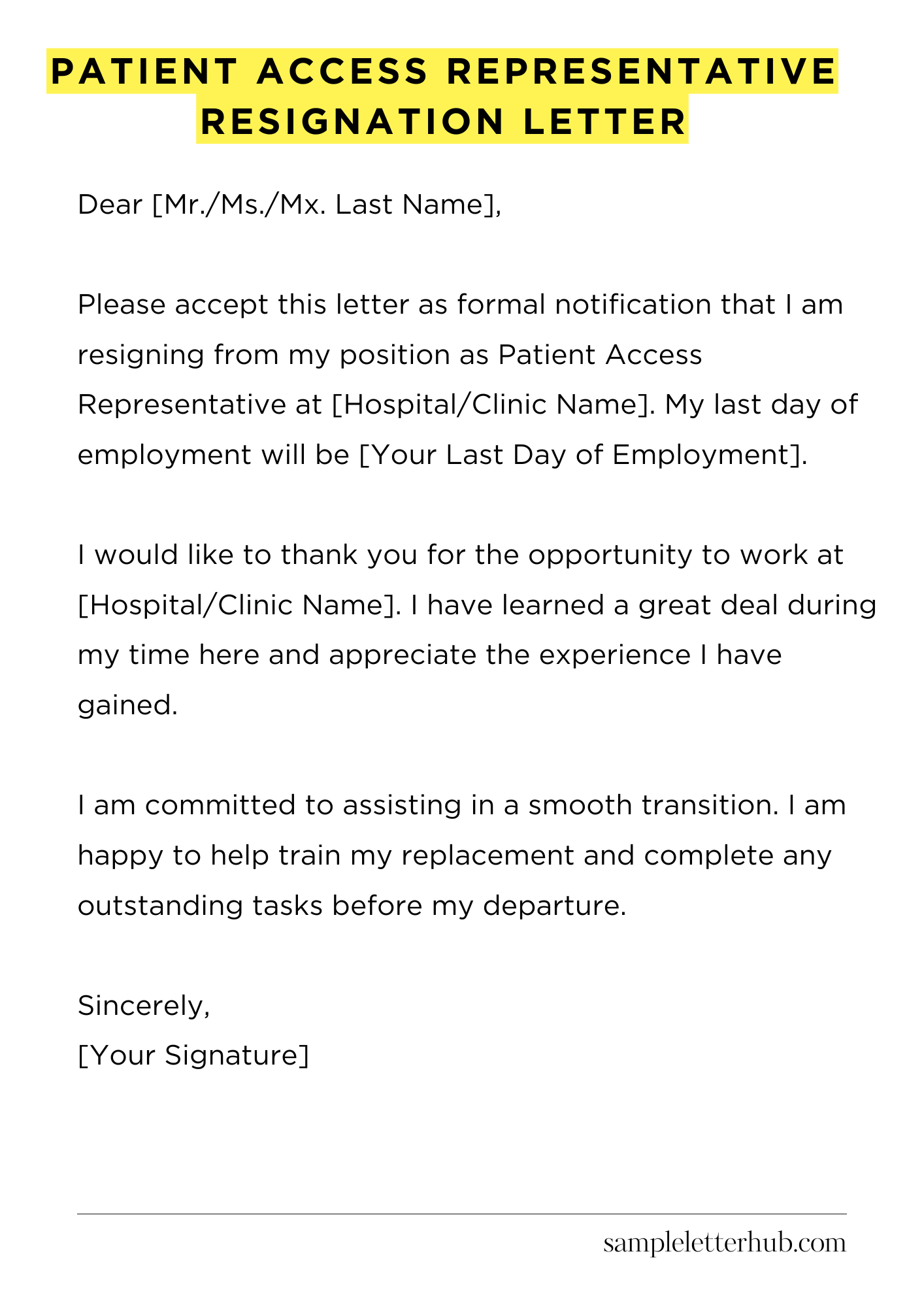
Dear [Mr./Ms./Mx. Last Name],
Please accept this letter as formal notification that I am resigning from my position as Patient Access Representative at [Hospital/Clinic Name]. My last day of employment will be [Your Last Day of Employment].
I would like to thank you for the opportunity to work at [Hospital/Clinic Name]. I have learned a great deal during my time here and appreciate the experience I have gained.
I am committed to assisting in a smooth transition. I am happy to help train my replacement and complete any outstanding tasks before my departure.
I wish you and the organization continued success in the future.
Sincerely,
[Your Signature]
How to Write a Patient Access Representative Resignation Letter
1. Why Resign, And Why a Letter Matters?
So, you’ve decided to move on. That’s a big step. Maybe you’ve found a better opportunity, or perhaps you’re seeking a career change. Whatever the reason, leaving your position as a Patient Access Representative requires a formal resignation. Why a letter? It’s simple: It’s professional.
A written resignation is a documented record of your departure, protecting both you and your employer. It’s also respectful. Giving notice through a written document signals that you value the relationships you’ve built. Think of it as a bridge, a way to maintain a positive professional connection even as you move on.
2. Essential Elements: What to Include.
Your letter should be clear, concise, and courteous. First, state your intention to resign. Explicitly mention the role you hold, “Patient Access Representative,” and the date your resignation takes effect. Next, include the effective date of your resignation. This is the last day you will be employed.
Then, a brief, positive statement of gratitude is beneficial. Thank your employer for the opportunity, even if your reasons for leaving are less than ideal. Finally, a short closing, such as “Sincerely” or “Respectfully,” followed by your full name, is a must. If appropriate, you could offer to assist with the transition.
3. Crafting the Perfect Tone.
Keep your tone professional. Avoid negativity, even if you’re leaving due to challenging circumstances. The goal is to leave on good terms. Be brief and to the point.
No need to go into a long explanation of your reasons; a simple statement is sufficient. Proofread your letter meticulously. Errors can undermine your professionalism. Double-check the dates, names, and any specific details. Remember, this letter reflects you.
4. Sample Resignation Letter.
Here’s a template to get you started:
    [Your Name]
    [Your Address]
    [Your Phone Number]
    [Your Email Address]

    [Date]

    [Employer's Name]
    [Employer's Title]
    [Company Name]
    [Company Address]

    Dear [Employer's Name],

    Please accept this letter as formal notification that I am resigning from my position as Patient Access Representative at [Company Name]. My last day of employment will be [Date].

    Thank you for the opportunities I have been given during my time here.

    I am available to assist with the transition of my responsibilities, if needed.

    Sincerely,

    [Your Signature]
    [Your Typed Name]
5. After the Letter: Next Steps.
Once you’ve written and proofread your letter, deliver it to your supervisor or HR department. Make sure you adhere to any company policies regarding resignation submissions. Keep a copy of your letter for your records. Be prepared to answer any questions or participate in an exit interview.
Now, focus on finishing your last few weeks strong. This is a chance to show your dedication and leave a lasting positive impression. Good luck with your next endeavor!
FAQs about Patient Access Representative resignation letter
How do I start a Patient Access Representative resignation letter?
Begin your resignation letter by clearly stating your intent to resign from your position as a Patient Access Representative. Include your name, the date, and the recipient’s name (typically your supervisor or HR representative) and their title. You should also mention the effective date of your resignation.
What key information should be included in a Patient Access Representative resignation letter?
The most important information includes your formal resignation, the date of your last day of employment, and a brief and professional expression of gratitude for the opportunity to have worked at the organization. While not required, you may also offer assistance with the transition or training your replacement. Avoid including negative comments about your experience.
Should I provide a reason for my resignation in the letter?
Providing a reason for your resignation is optional. You are not obligated to disclose your reasons. If you choose to, keep it brief and professional. Common acceptable reasons include pursuing other opportunities, seeking career advancement, or personal reasons. Avoid going into excessive detail.
What is the proper format for a Patient Access Representative resignation letter?
Maintain a professional and formal tone throughout the letter. Use a business letter format, including a clear heading with your contact information, the recipient’s information, a formal salutation (e.g., “Dear [Name]”), the body of the letter (where you state your resignation and other relevant information), a closing (e.g., “Sincerely,” or “Regards,”), and your typed name.
Is it necessary to hand in a resignation letter, or can I resign verbally?
While you may verbally inform your supervisor of your resignation, it is generally considered standard practice, and often a requirement, to submit a formal written resignation letter. A written letter provides a clear record of your resignation, the date, and helps ensure a smooth transition. It also serves as official documentation for HR and your employment records.
Related:
Resignation letter due to rude boss
Resignation letter moving to another state
Resignation letter due to illness of family member
Resignation letter due to study