

A paraprofessional resignation letter is a formal document. It informs your employer of your intention to leave your job. The letter officially ends your employment. It’s a crucial step in the job-leaving process.
You’re probably thinking about writing a resignation letter right now. That can be tough. We’ve got you covered. We’re sharing helpful templates and examples. These samples will guide you. They’ll make writing your letter simple.
Choose the best fit for your situation. Adapt the examples to your needs. This article provides everything you need to resign with ease. You’ve got this!
Paraprofessional Resignation Letter
Below is a sample of a Paraprofessional Resignation Letter:
[Your Name]
[Your Address]
[Your Phone Number]
[Your Email Address]
[Date]
[Hiring Manager Name] (If known, otherwise use title)
[Hiring Manager Title]
[School/Organization Name]
[School/Organization Address]
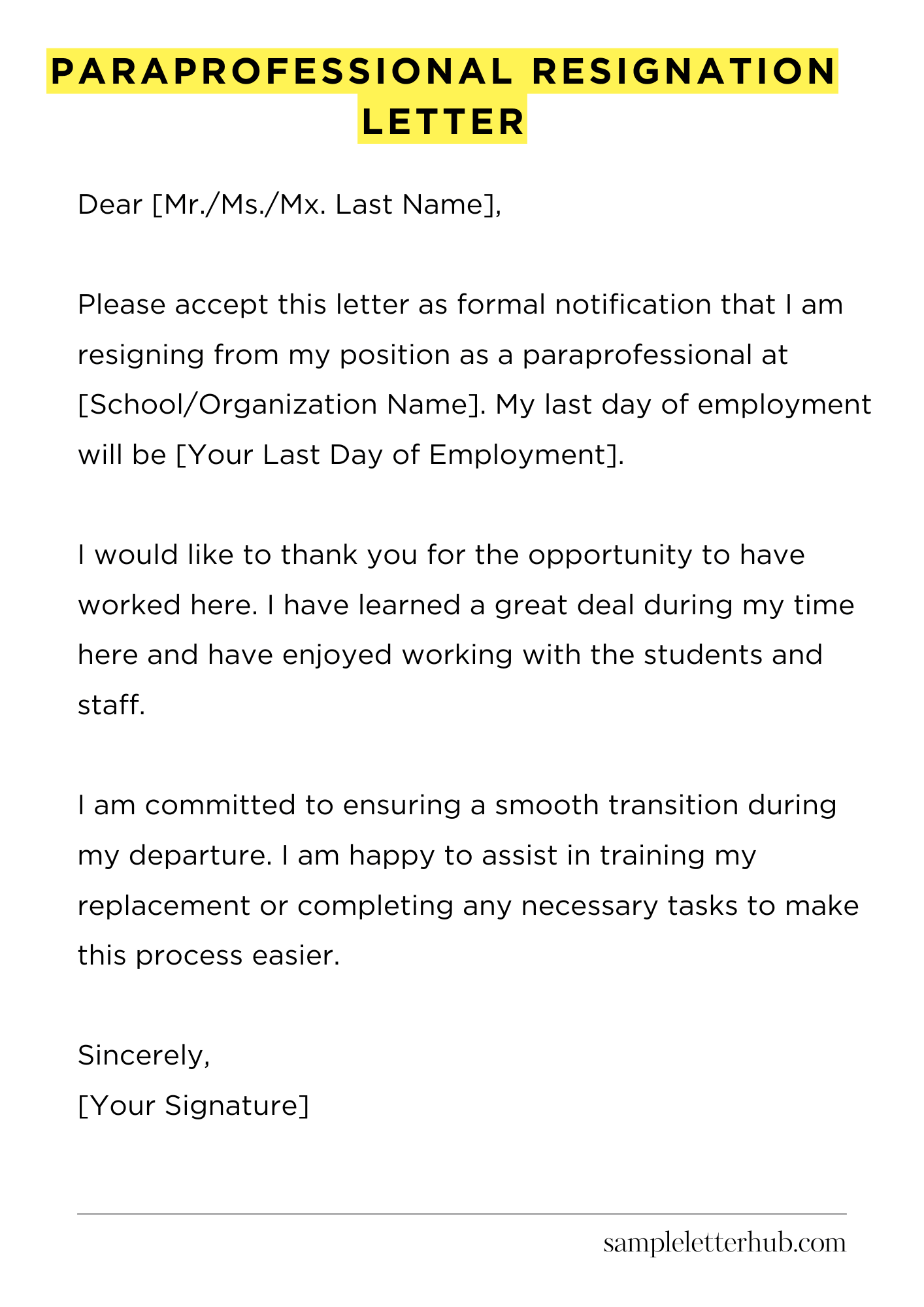
Dear [Mr./Ms./Mx. Last Name],
Please accept this letter as formal notification that I am resigning from my position as a paraprofessional at [School/Organization Name]. My last day of employment will be [Your Last Day of Employment].
I would like to thank you for the opportunity to have worked here. I have learned a great deal during my time here and have enjoyed working with the students and staff.
I am committed to ensuring a smooth transition during my departure. I am happy to assist in training my replacement or completing any necessary tasks to make this process easier.
I wish you and [School/Organization Name] all the best in the future.
Sincerely,
[Your Signature]
How to Write a Paraprofessional Resignation Letter
Leaving a job is a big decision. It can be even more complicated when you’re in a role that involves helping others. As a paraprofessional, you play a vital role in education, healthcare, or other fields. If you’ve decided to move on, crafting a professional and respectful resignation letter is crucial.
It’s your final chance to make a good impression. Consider this a guide to ensure you leave on a positive note, setting the stage for future opportunities.
1. Start with a Clear and Concise Statement
Your opening paragraph needs to be direct. Begin by stating your intention to resign. Keep it simple and to the point. Avoid any ambiguity. Use a formal tone. This is not the time for casual language.
Here’s an example: “Please accept this letter as formal notification that I am resigning from my position as a Paraprofessional at [School/Organization Name], effective [Your Last Day of Employment].”
See? It’s easy, right? This clearly states your purpose, your role, and the date you’ll be gone. That’s all you need initially.
2. Express Gratitude and Positive Memories
This is where you show your appreciation. Even if you’re not thrilled about leaving, it’s professional to acknowledge the positive aspects of your time at the job. This helps maintain a positive relationship. Mention something specific, if possible. Don’t be too generic. Think about what you enjoyed or learned. This gives it a more personal touch.
For example: “I am grateful for the opportunities I have been given during my time here and for the support I received from my colleagues, and teachers” Or “I am especially thankful for the chance to work alongside [Name of colleague or teacher] and learn from their dedication to [Specific aspect of your work].” This adds a touch of warmth and sincerity.
3. Provide a Reason (Optional, but Often Recommended)
You don’t have to explain your reasons for leaving, but providing a brief, professional explanation is often a good idea. It shows you’ve put thought into the decision. Keep it brief. Keep it positive. Avoid negativity and complaints about your role. Stick to neutral statements.
Common, acceptable reasons include:
- “I am pursuing another opportunity that aligns with my long-term career goals.”
- “I am relocating to [City/State] to be closer to family.”
- “I will be focusing on my education and completing my degree.”
Never ever give negative information.
4. Offer Assistance with the Transition
This section is vital for maintaining a good professional relationship. Offering to assist with the transition demonstrates your commitment to the organization. Be specific about what you can offer. This can be things like training your replacement, completing outstanding tasks, or providing any relevant documentation. This is where you show you care.
Here’s an example: “I am happy to assist in any way possible to ensure a smooth transition. I am available to train my replacement and complete any outstanding tasks before my last day.” This shows your commitment and reliability.
5. Conclude and Show Professionalism
End your letter with a polite closing and your contact information. Reiterate your gratitude. Thank them for the opportunity. Include your phone number and email address, in case they need to contact you after you leave.
Here’s how to wrap things up: “Thank you again for the opportunity to work here. I wish you and the organization continued success. Sincerely, [Your Name] [Your Phone Number] [Your Email Address].”
Review the letter before you send it! Make sure you correct the spelling and grammar. Proofread everything. You are now prepared to submit your resignation.
FAQs about Paraprofessional resignation letter
How do I write a paraprofessional resignation letter?
When composing a resignation letter as a paraprofessional, it’s essential to maintain a professional and respectful tone. Begin by clearly stating your intent to resign, followed by your official job title.
Specify your last day of employment. Express your gratitude for the opportunity to work in the role and, if possible, mention something specific you appreciated about the experience. Briefly explain your reason for leaving, if you wish, though this isn’t mandatory. Keep it concise, professional, and proofread carefully before submitting.
What information should be included in a paraprofessional resignation letter?
A well-structured paraprofessional resignation letter should include: your name and contact information, the date, the recipient’s name and title (e.g., your principal or supervisor), a clear statement of resignation, your official job title, the last day of your employment, a brief expression of gratitude for the opportunity, and your signature.
Optional additions include a brief, non-obligatory reason for leaving and a polite offer to assist with the transition, if feasible.
What is the proper format for a paraprofessional resignation letter?
The proper format of a resignation letter is a formal business letter. Start with your contact information (name, address, phone number, and email address), followed by the date. Then, include the recipient’s name, title, and address. Begin with a formal salutation (e.g., “Dear Mr./Ms./Mx. [Last Name]”).
The body should state your intent to resign, job title, last day, express gratitude, and optionally a brief reason for leaving. Close with a professional closing (e.g., “Sincerely” or “Respectfully”) and your signature above your typed name.
How much notice should a paraprofessional give when resigning?
The standard practice is to provide at least two weeks’ notice, unless your contract or school district policy specifies otherwise. Providing more notice is always appreciated and can help maintain positive relationships with your colleagues and supervisor.
Confirm the required notice period outlined in your employment contract or school district’s employee handbook to ensure compliance.
Can I provide a reason for resigning in my paraprofessional resignation letter?
While providing a reason for leaving is optional, it can be included if you feel comfortable doing so. The reason should be brief, factual, and stated professionally. You can simply state that you are pursuing another opportunity, relocating, or that it is a personal decision.
Avoid negative comments or complaints about your job or employer. If you choose not to provide a reason, that’s perfectly acceptable.
Related:
Resignation letter due to rude boss
Resignation letter moving to another state
Resignation letter due to illness of family member
Resignation letter due to study