

A paramedic resignation letter is a formal document. Its purpose is to officially inform an employer of your departure. It outlines your intention to leave your position. This allows for a smooth transition.
Leaving a job can be tricky. It requires professionalism. You also need to meet your obligations. We understand this. We’re here to help.
This article offers several templates. They are samples of paramedic resignation letters. You can use them as a starting point. Tailor them to fit your specific needs. Writing a letter just got easier.
Paramedic Resignation Letter
Below is a sample of a Paramedic Resignation Letter:
[Your Name]
[Your Address]
[Your Phone Number]
[Your Email Address]
[Date]
[Recipient’s Name] (e.g., Chief of Paramedics)
[Recipient’s Title]
[Department Name]
[Address of Department]
Dear [Mr./Ms./Mx. Recipient’s Last Name],
Please accept this letter as formal notification that I am resigning from my position as a Paramedic with [Department Name], effective [Your Last Day of Employment].
I am grateful for the opportunities I have been given during my time here. I have learned a great deal and appreciate the experience I have gained working alongside my colleagues.
I wish the department and all its staff the very best in the future.
I am happy to assist with the transition process in any way I can, including training or handover of any outstanding responsibilities. Please let me know how I can be of assistance.
Sincerely,
[Your Signature]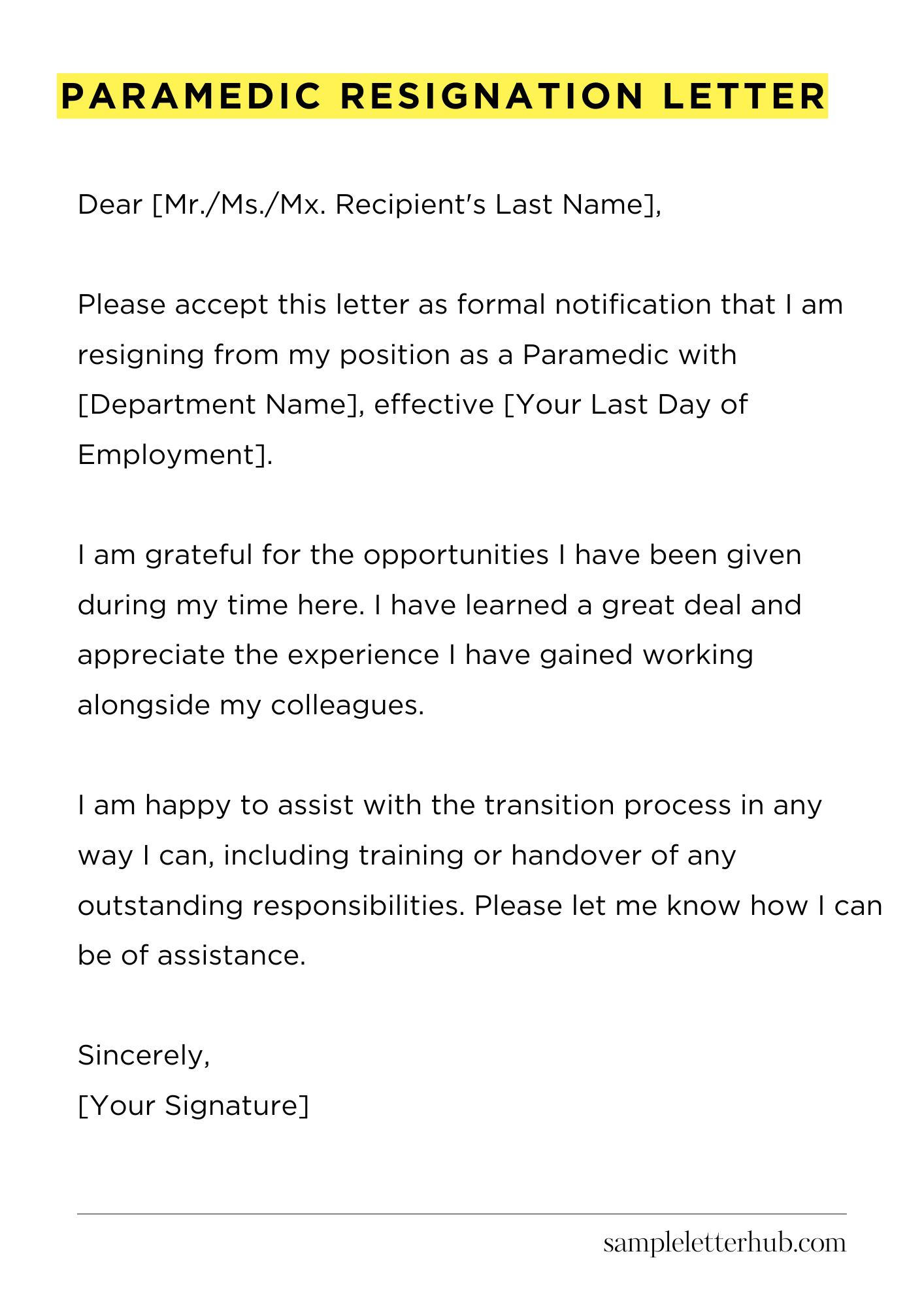
How to Write a Paramedic Resignation Letter
Why a Good Resignation Letter Matters
So, you’ve decided to hang up your stethoscope, at least for the current gig. Stepping away from the demanding world of paramedicine is a big decision. You’ve likely poured your heart and soul into saving lives, dealing with tough situations, and working long hours. Now it’s time to move on.
A well-written resignation letter is crucial. It’s more than just a formality. It’s about leaving a good impression. It’s a professional courtesy, a bridge to future opportunities, and sometimes, it’s even legally important. This letter serves as your formal notice, your last communication with the department. Think of it as a final, professional act.
Key Elements of Your Letter
Every resignation letter needs specific components. Let’s break it down, step by step. First, start with the date, followed by the recipient’s name and title. Then, use a clear and concise salutation, like “Dear [Recipient’s Name].” Next, state your intention to resign. This should be direct and unambiguous.
“I am writing to formally resign from my position as Paramedic, effective [Your Last Day of Employment]” works perfectly. Be precise. Don’t leave any room for confusion. Following this, you might express gratitude for the experience you gained while working with the company. Keep this section brief, and sincere.
Addressing the Details: Dates, Reasons, and Thank You’s
After declaring your resignation, always reiterate your last day of employment. This helps avoid any misunderstandings. Next, you could mention a brief reason, though this is optional. You’re not required to go into great detail about why you’re leaving. A simple, “I am pursuing other opportunities” or “I am seeking a career change” is perfectly acceptable.
Keep it professional. Avoid negative comments or complaints. Finally, finish with a sincere thank you. Acknowledge the opportunities you’ve been given, and express gratitude for the relationships you’ve built. End with a professional closing, such as “Sincerely,” or “Respectfully,” followed by your full name and signature.
Formatting and Delivery Tips
Presentation matters. Keep your letter concise; aim for one page, if possible. Use a standard font like Times New Roman or Arial, with a 12-point size for readability. Proofread, proofread, proofread! Errors in grammar or spelling undermine your professionalism. Double-check everything before sending it.
Make sure the language you use is clear, and the tone is respectful. In terms of delivery, it’s often best to hand your letter to your supervisor in person, and follow up with an email confirmation, or provide a hard copy. That way, there’s a clear record. Also, make sure you keep a copy for your records.
The Aftermath and Next Steps
After submitting your letter, be prepared for a response. Your supervisor may want to discuss your resignation. Be polite, and professional during any exit interviews.
Now, you’ve taken the first step toward moving on. During your notice period, ensure all your duties are handled smoothly. You’ll likely be required to complete an exit interview.
That’s your chance to give any constructive feedback. It’s important to leave on good terms. The professional world is small. Your reputation follows you. Remember, a well-written resignation letter opens doors for you. It’s your final professional gesture. It can pave the way for a smooth transition and new beginnings.
FAQs about Paramedic Resignation Letter
What is the primary purpose of a paramedic resignation letter?
The primary purpose of a paramedic resignation letter is to formally notify an employer of an intention to leave their position. It serves as an official record of the resignation, sets the effective date of departure, and provides an opportunity to express gratitude or provide any necessary information regarding the transition.
What key information should be included in a paramedic resignation letter?
A paramedic resignation letter should include the following key information: a clear statement of resignation, the effective date of resignation, the paramedic’s name and contact information, a brief statement of gratitude for the opportunity to work there, and any relevant information regarding the handover of responsibilities.
It may also include details regarding the return of equipment or uniforms.
How much notice should a paramedic provide when resigning?
The amount of notice a paramedic should provide varies depending on their employment contract, company policy, and any applicable state or local laws. It is common to provide at least two weeks’ notice, but some positions may require more. It’s crucial to review the employment contract or employee handbook to determine the required notice period.
Should a paramedic explain the reason for resignation in the letter?
While not mandatory, a paramedic can briefly state the reason for their resignation if they wish. This could be to pursue other opportunities, relocate, or for personal reasons. However, the level of detail is optional. Keep the reason concise and professional; there’s no need to go into excessive detail.
What are some common mistakes to avoid when writing a paramedic resignation letter?
Some common mistakes to avoid include: not providing sufficient notice, making negative comments about the employer or colleagues, being unprofessional or informal in tone, failing to return company property, and neglecting to confirm the effective date with the employer. Always maintain a professional and courteous tone.
Related:
Resignation letter due to rude boss
Resignation letter moving to another state
Resignation letter due to illness of family member
Resignation letter due to study