

An operator resignation letter is a formal document. It informs your employer that you’re leaving your job. Its primary goal is to officially communicate your departure. It should be clear and concise.
Crafting the perfect resignation letter can be tricky. This article provides various templates. We’ll offer different examples. You’ll find samples suitable for various situations.
Consider this your go-to guide. We make writing your letter simple. Choose the template that suits you. Adapt it to your specific needs. Let’s get started on your path to a smooth transition!
Operator Resignation Letter
Below is a sample of a Operator Resignation Letter:
[Your Name]
[Your Address]
[Your Phone Number]
[Your Email Address]
[Date]
[Employer’s Name]
[Company Name]
[Company Address]
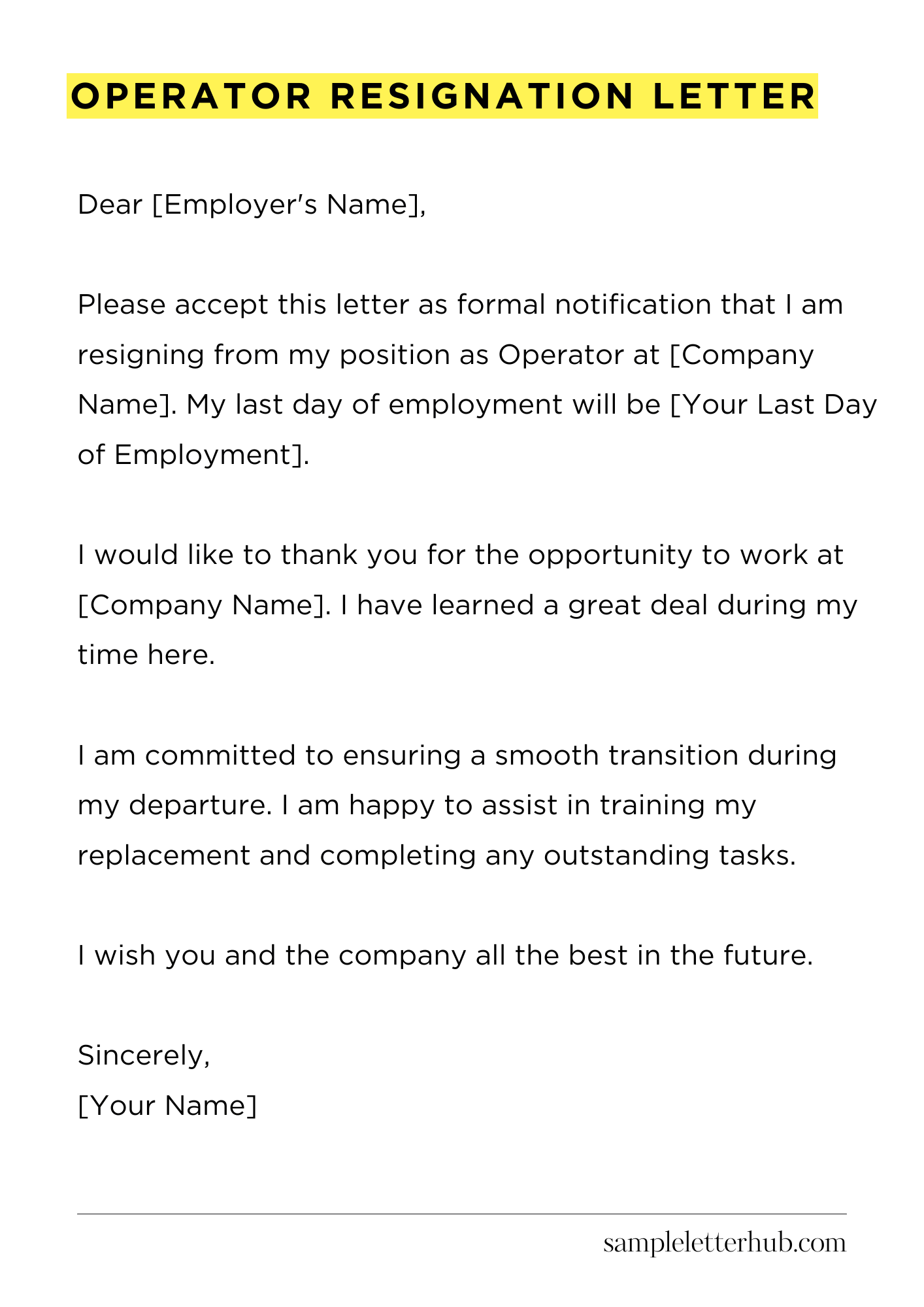
Dear [Employer’s Name],
Please accept this letter as formal notification that I am resigning from my position as Operator at [Company Name]. My last day of employment will be [Your Last Day of Employment].
I would like to thank you for the opportunity to work at [Company Name]. I have learned a great deal during my time here.
I am committed to ensuring a smooth transition during my departure. I am happy to assist in training my replacement and completing any outstanding tasks.
I wish you and the company all the best in the future.
Sincerely,
[Your Name]
How to Write an Operator Resignation Letter
Leaving a job is a significant decision. When you’re ready to move on from your role as an operator, crafting a professional and clear resignation letter is essential. This document serves as your official notice to your employer, starting the process of your departure. Here’s how to write a resignation letter that reflects well on you and ensures a smooth transition.
1. Start with the Basics: Your Contact Information and the Date
Your letter needs a proper heading. Begin by including your full name, address, phone number, and email address. You will put this in the top left or right corner of the document. Underneath your contact details, include the date.
This establishes a clear record of when you formally notified your employer. Keep it straightforward, like this: “October 26, 2023.” It will look more professional that way.
2. The Salutation and Your Intent: A Clear Opening
Address your letter to the appropriate person. Generally, this is your direct supervisor or the Human Resources department. Use a formal greeting like “Dear [Manager’s Name]” or “Dear Hiring Manager.” Now, state your intention directly and concisely in the first paragraph. State you are resigning.
Be polite and avoid any unnecessary embellishments or negativity. For example: “Please accept this letter as formal notification that I am resigning from my position as Operator, effective [Your Last Day of Employment].”
3. Briefly Acknowledge Your Time and Express Gratitude
Even if the job wasn’t perfect, it’s good practice to express appreciation. Take a moment to acknowledge your time with the company.
Briefly mention anything you valued, such as skills learned or opportunities gained. Keep it brief. Showing gratitude is about professionalism. You might say: “I have appreciated the opportunity to work as an Operator at [Company Name] for the past [Number] years/months.”
4. The Details: Your Last Day and Transition Support
Clearly state your last day of employment. This is the date your employment will officially end. This should align with company policy and any employment agreements. It is crucial to offer assistance with the transition if possible. Offer help is not always needed, but it’s a classy move.
This will always improve your reputation! You could include a phrase like: “I am committed to assisting with the transition of my duties during my remaining time here.”
5. Final Touches and Closing
Conclude your letter with a professional closing. Use “Sincerely,” “Respectfully,” or a similar professional phrase. Then, sign your name (if it’s a physical letter) or type your name (for an email). Keep it clean. Proofread your entire letter carefully before submitting it. Ensure all information is accurate and that the tone is professional and positive. Always keep a copy for your records.
FAQs about Operator Resignation Letter
What is the primary purpose of an operator resignation letter?
The primary purpose of an operator resignation letter is to formally notify an employer of an employee’s intent to leave their position as an operator. It serves as an official record of the resignation, detailing the employee’s last day of employment and often including a brief reason for leaving and expressions of gratitude.
What key elements should be included in an operator resignation letter?
Essential elements include a clear statement of resignation (e.g., “I hereby resign from my position as Operator”), the employee’s name, the date of the letter, the effective date of resignation (last day of employment), and the name of the recipient (usually the supervisor or HR).
It’s also typical to include a brief, professional expression of gratitude for the opportunity and, optionally, a reason for leaving, though this is not always mandatory.
How much notice should an operator give when resigning?
The required notice period typically depends on the company’s policy, any existing employment contract, and local labor laws. Common notice periods are two weeks, although some positions or contracts may specify a longer duration. It’s crucial for the operator to review their employment agreement and company policies to determine the appropriate notice period.
Can an operator include reasons for resignation in the letter, and should they?
While not mandatory, an operator can include the reasons for their resignation. It’s often advisable to keep the reasons brief, positive, and professional. Reasons can range from seeking new opportunities to personal or family reasons. Avoiding negativity and focusing on future endeavors is generally recommended to maintain a professional tone.
How should an operator submit their resignation letter?
The resignation letter should be submitted according to the company’s established procedures. This usually involves submitting a physical copy or an electronic version (e.g., email) to the appropriate supervisor or Human Resources department. It’s often beneficial to retain a copy of the letter for personal records as proof of the resignation.
Related:
Resignation letter due to rude boss
Resignation letter moving to another state
Resignation letter due to illness of family member
Resignation letter due to study