

An Operations Director resignation letter is a formal document. It announces your departure from the role. The purpose is to officially inform your employer of your intention to leave. It also outlines your final day of employment.
Are you an Operations Director planning a career change? Perhaps you need to find the right words for your resignation. You are in luck! We’ve prepared several sample letters.
These examples will provide a helpful starting point. We’ll offer different formats and phrasing options. This will help you craft a professional and impactful resignation.
Operations Director Resignation Letter
Below is a sample of a Operations Director Resignation Letter:
[Your Name]
[Your Address]
[Your Phone Number]
[Your Email Address]
[Date]
[Recipient Name]
[Recipient Title]
[Company Name]
[Company Address]
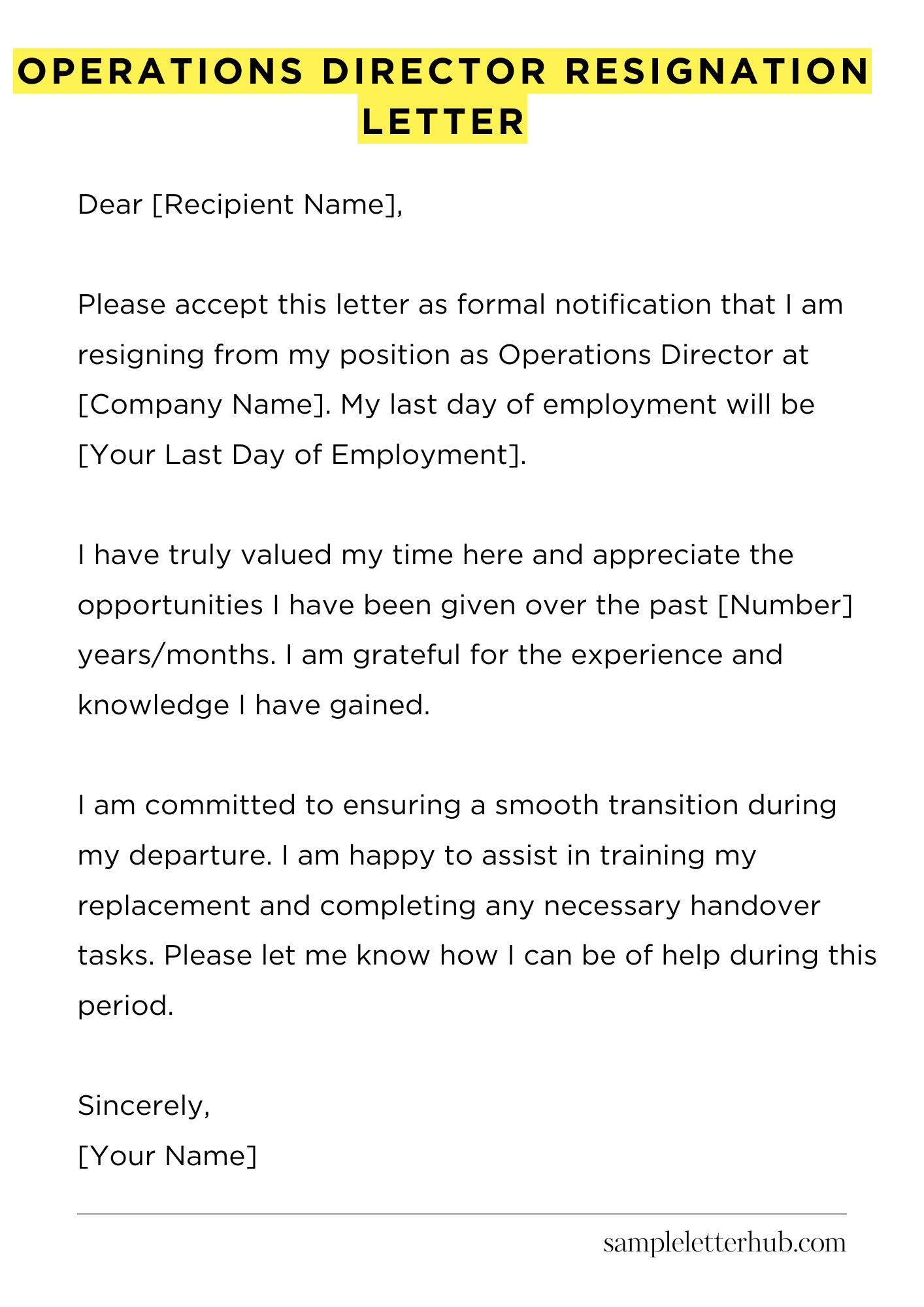
Dear [Recipient Name],
Please accept this letter as formal notification that I am resigning from my position as Operations Director at [Company Name]. My last day of employment will be [Your Last Day of Employment].
I have truly valued my time here and appreciate the opportunities I have been given over the past [Number] years/months. I am grateful for the experience and knowledge I have gained.
I am committed to ensuring a smooth transition during my departure. I am happy to assist in training my replacement and completing any necessary handover tasks. Please let me know how I can be of help during this period.
I wish you and [Company Name] all the best for the future.
Sincerely,
[Your Name]
How to Write Operations Director Resignation Letter
1. Get Ready to Say Goodbye (Properly!)
So, you’re moving on! That’s great! Maybe a new opportunity has presented itself, or perhaps you’re seeking a change of pace. Whatever the reason, resigning from your position as Operations Director is a big step. A well-crafted resignation letter is absolutely essential. Don’t underestimate its importance.
Think of it as your final professional statement. It’s your last impression on your colleagues and the company. Remember, you want to leave on good terms, paving the way for positive references and future opportunities. You are not just quitting; you are crafting a narrative. Before you even begin to write, think carefully.
Consider your final day. Plan your handover process. This preliminary groundwork is going to save you headaches later.
2. The Essential Ingredients: What to Include
Your Operations Director resignation letter needs a few key components. Firstly, begin with a formal salutation. Address the letter to the appropriate person, usually your direct supervisor or the Human Resources department.
Next, state your intention to resign clearly and concisely. Specify the date of your last day of employment. This is a critical piece of information. Following this, express your gratitude for the opportunity to have worked at the company.
Acknowledge your experience and the skills you’ve developed. Briefly mention any contributions you are proud of. Keep this section positive. It’s about appreciation, not criticism. Acknowledge the people you’ve worked with and their efforts. Finally, offer assistance with the transition. Suggest your willingness to help with the handover process.
End with a professional closing, such as “Sincerely” or “Best Regards.” This provides a clear structure to your letter and avoids misunderstandings. These are crucial components; you simply cannot leave them out.
3. Structure and Tone: Keep it Professional
The tone of your letter should remain professional and positive throughout. Avoid negativity, even if you’ve had a less-than-ideal experience.
It’s not the place to air grievances. Maintain a respectful and polite approach. The letter should be easy to read and understand. Structure your letter with clear paragraphs. Use short sentences for directness and longer sentences to add nuance. Proofread carefully.
Check for any grammatical errors or typos. You want to appear polished and professional. Your goal is to leave a lasting, favorable impression. Remember, your written communication reflects your personal brand. Keep this in mind. Make it represent you in the best way possible.
4. What to Avoid: Common Pitfalls
Several common pitfalls can undermine a resignation letter. Avoid being overly emotional or dramatic. Do not include personal attacks or criticism of colleagues or the company. Steer clear of vague language; be clear and concise. Don’t burn bridges. Resist the temptation to share confidential information.
The resignation letter isn’t for discussing salary or benefits, unless it is a negotiation for your last day. Make sure you stick to the point and remain professional. Also, do not make any accusations or complaints about past situations, regardless of the cause. Focus on the future and your positive experience.
These are not only avoidable but should be outright avoided.
5. Sample Letter and Next Steps
Here is a simple example:
[Your Name]
[Your Address]
[Your Phone Number]
[Your Email]
[Date]
[Recipient’s Name]
[Recipient’s Title]
[Company Name]
[Company Address]
Dear [Recipient’s Name],
Please accept this letter as formal notification that I am resigning from my position as Operations Director at [Company Name]. My last day of employment will be [Your Last Day].
I am grateful for the opportunities I have been given during my time here. I have enjoyed the experience and value my time working with the team. I wish the company the best in its future endeavors.
I am committed to making this transition as smooth as possible and am available to assist with the handover process. Please let me know how I can be of assistance.
Sincerely,
[Your Signature]
[Your Typed Name]
After you have written your letter, give it a final read-through and get another person to read it over. Once it’s finalized, submit it according to your company’s policy. Keep a copy for your records. The resignation letter is just the first step. Now, it’s time to focus on the handover process. Communicate your departure to your team. Prepare your documentation. Prepare your successor to succeed. This will ensure a seamless transition for all involved.
FAQs about Operations Director Resignation Letter
What is the primary purpose of an Operations Director resignation letter?
The primary purpose is to formally notify the employer of the Operations Director’s intent to leave the position. It serves as an official record of the resignation, the effective date of departure, and often includes expressions of gratitude and offers of assistance during the transition period.
A well-crafted letter ensures a professional departure and protects the individual from potential misunderstandings.
What key elements should be included in an Operations Director resignation letter?
A comprehensive resignation letter should include: a clear statement of resignation, the specific effective date of resignation, a concise statement of gratitude for the opportunity to have worked at the company, mention of any assistance you will provide during the transition (e.g., training a replacement, finishing ongoing projects), and a professional closing with your signature.
It is important to keep the letter concise, professional, and positive.
How much notice should an Operations Director provide in their resignation letter?
The notice period depends on the employment contract or company policy. However, a common standard is two to four weeks. Reviewing your employment contract is critical to determine the required notice period. Providing more notice, if possible, can be beneficial in terms of maintaining a positive relationship with the employer and ensuring a smoother transition for the team.
Should an Operations Director provide a reason for leaving in their resignation letter?
While not mandatory, you may choose to briefly state your reason for leaving. This is often done to maintain a degree of transparency.
It is advisable to keep the explanation brief and positive, focusing on future career goals or personal circumstances. Avoid negativity or making complaints. If you wish to provide more detailed feedback, consider doing so separately during an exit interview.
How should an Operations Director handle the delivery of the resignation letter?
Typically, the resignation letter should be delivered in writing, either physically or electronically (e.g., email), to the appropriate supervisor or HR representative.
It is also good practice to schedule a face-to-face meeting with your supervisor to discuss the resignation before officially submitting the letter. Ensure you keep a copy of the letter for your records.
Related:
Resignation letter due to rude boss
Resignation letter moving to another state
Resignation letter due to illness of family member
Resignation letter due to study