

Need to move on from your current role as a nutritionist? You’ll likely need a resignation letter. This letter formally informs your employer of your decision to leave. It also states your last day of employment.
Crafting the perfect letter can feel daunting. It’s important to be professional. It should also be clear.
We’re here to help! We’ll provide you with various letter templates. You’ll find different examples. These samples will ease the writing process.
Nutritionist Resignation Letter
Below is a sample of a Nutritionist Resignation Letter:
[Your Name]
[Your Address]
[Your Phone Number]
[Your Email Address]
[Date]
[Employer’s Name]
[Employer’s Title]
[Clinic/Company Name]
[Company Address]
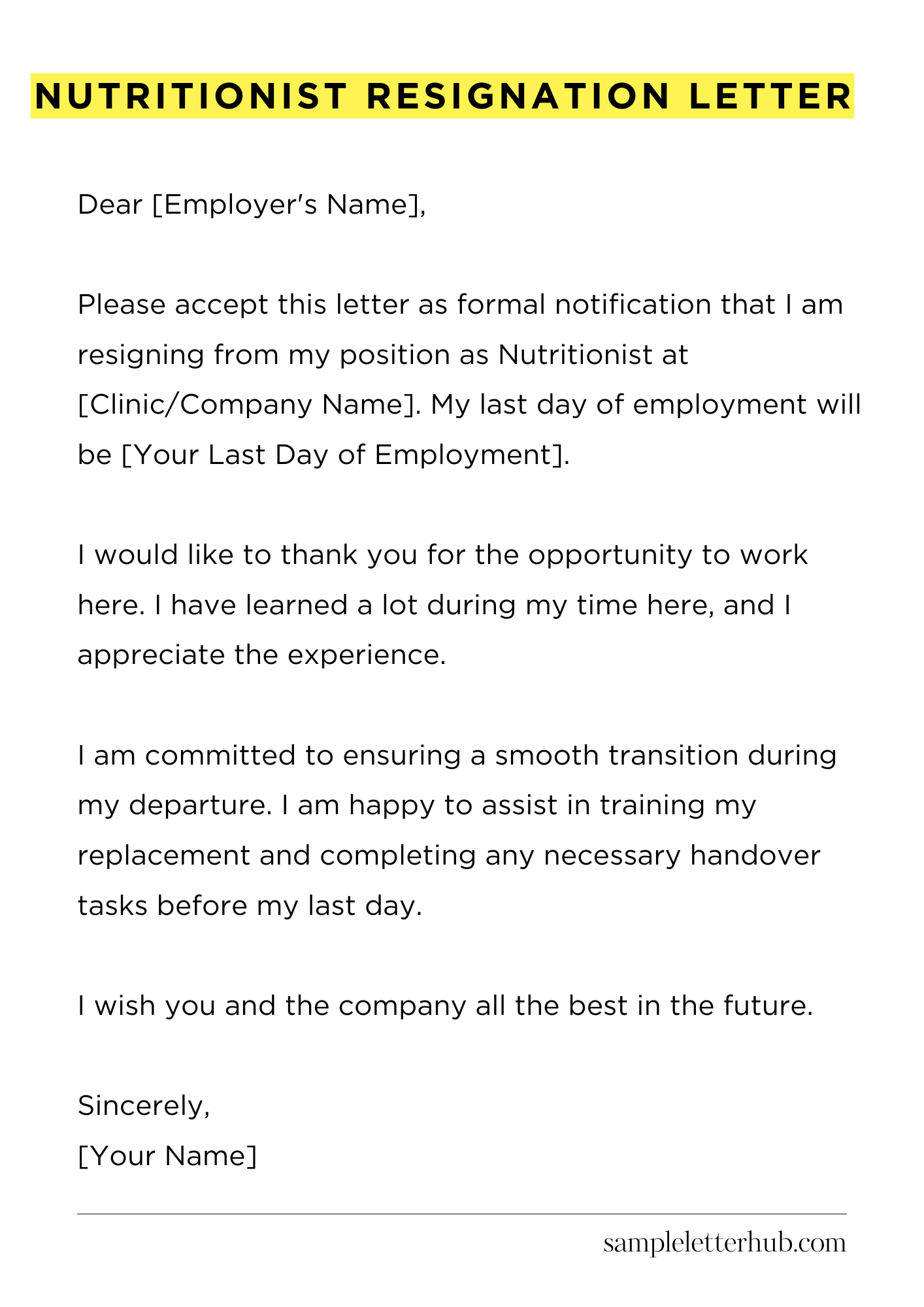
Dear [Employer’s Name],
Please accept this letter as formal notification that I am resigning from my position as Nutritionist at [Clinic/Company Name]. My last day of employment will be [Your Last Day of Employment].
I would like to thank you for the opportunity to work here. I have learned a lot during my time here, and I appreciate the experience.
I am committed to ensuring a smooth transition during my departure. I am happy to assist in training my replacement and completing any necessary handover tasks before my last day.
I wish you and the company all the best in the future.
Sincerely,
[Your Name]
How to Write a Nutritionist Resignation Letter
So, you’ve made the decision. You’re moving on. The next step is crafting that all-important resignation letter. Don’t worry; it’s simpler than calculating a complex metabolic rate. A well-written letter is crucial for maintaining a positive professional image. It also ensures a smooth transition.
1. Keep it Concise and Clear
This isn’t the time for a novel. Get straight to the point. Your first paragraph should explicitly state your intention to resign. Include the date your resignation will be effective.
Think of it like a quick nutrition label: essential information upfront. For example: “Please accept this letter as formal notification that I am resigning from my position as Nutritionist, effective [Date].” Keep it short and easy to understand.
Avoid unnecessary details. No need to launch into a long story about why you’re leaving (unless you feel legally obligated to do so, like in case of workplace harassment). Clarity is key here. Stick to the facts. This helps avoid potential misunderstandings.
2. Express Your Gratitude (and Professionalism)
Even if the job wasn’t your dream gig, showing gratitude is important. Acknowledge the experience you’ve gained and any opportunities you were given.
This can be a simple sentence or two. For instance: “I am grateful for the opportunities I’ve had during my time here and for the experience I’ve gained working alongside such a dedicated team.” It’s about building bridges, not burning them. Your professional reputation matters.
Thanking your superiors and colleagues is a sign of respect. They may be the ones to hire you later. Remember, the nutrition world can be a small one. Being professional ensures a positive reference, which is always useful!
3. Offer Assistance with the Transition
This is where you show you’re a team player. Offering assistance in the transition process demonstrates commitment and professionalism.
State your willingness to help train your replacement, complete outstanding tasks, or transfer knowledge. Something like: “I am committed to ensuring a smooth transition and am happy to assist in training my replacement or completing any outstanding projects before my departure.” It’s a thoughtful move.
Consider whether you’d be happy to share your patient records with another team member. This ensures continuity of care. The organization will appreciate your dedication.
4. Formal Closing and Contact Information
End the letter with a formal closing and your contact information. Use a professional closing such as “Sincerely,” or “Respectfully,” followed by your full name. Below your signature, include your phone number and email address. You may be needed to tie up loose ends. This is also important for providing a reference.
This simple act makes it easy for your employer to contact you if needed. Ensure your contact details are up-to-date.
5. Proofread and Edit, Then Proofread Again!
Before hitting “send,” meticulously proofread your letter. Check for any grammatical errors, typos, or inconsistencies. Poorly written communication reflects badly on you. Take the time to make sure your letter is polished and professional.
Read it aloud to catch any awkward phrasing. Ask a friend or colleague to review it as well. A second pair of eyes can often catch mistakes you missed. Your resignation letter is a reflection of your professionalism. Make sure it accurately reflects the dedicated professional that you are.
FAQs about Nutritionist Resignation Letter
Here are some of the most common questions regarding the creation and use of a resignation letter for nutritionists.
What should be included in a nutritionist’s resignation letter?
A nutritionist’s resignation letter should contain a clear and concise statement of resignation, the effective date of departure, a brief expression of gratitude for the opportunity (optional but recommended), and any necessary information regarding the handover of responsibilities. It is also wise to include your contact information for any follow-up.
What is the proper format for a nutritionist resignation letter?
The standard format is a business letter format. This includes your contact information (name, address, phone number, email) at the top or in the letterhead, followed by the date, then the recipient’s information (name, title, and company address). The body of the letter contains the resignation statement, and a closing with a professional sign-off (e.g., “Sincerely”).
How much notice should a nutritionist give when resigning?
The amount of notice typically depends on the employment contract or company policy. However, as a general guideline, giving at least two weeks’ notice is considered professional in most settings. In some cases, a longer notice period (e.g., a month) might be customary, especially in senior roles or if contractual obligations are present.
Should I provide a reason for resigning in my letter?
Providing a reason for your resignation is optional. It is not generally necessary. If you choose to offer a reason, keep it brief and professional. You can simply state that you are seeking a new opportunity, pursuing other interests, or that the role is no longer a good fit. Avoid negativity or providing detailed complaints.
How should I deliver my resignation letter?
The preferred method of delivering your resignation letter is usually in writing. Typically, you would give a physical copy to your direct supervisor or HR, while also sending an electronic version (e.g., an email) is common practice for documentation. Ensure you keep a copy for your records.
Related:
Resignation letter due to rude boss
Resignation letter moving to another state
Resignation letter due to illness of family member
Resignation letter due to study