

Sometimes, you need to leave a job without giving any reason. A “None Resignation Letter” allows you to do just that. It’s a simple, straightforward way to inform your employer of your departure. The purpose? To keep things brief and private.
Need to draft this type of letter? You’re in the right place. We’ve got you covered. Here, you’ll find templates and examples. These samples will guide you. They’ll help you craft the perfect letter.
Ready to make your exit? Let’s get started. We’ll show you how to write the letter. It’s easy to adapt them to your specific needs. Say goodbye to guesswork.
None Resignation Letter
Below is a sample of a None Resignation Letter:
[Your Name]
[Your Address]
[Your Phone Number]
[Your Email Address]
[Date]
[Recipient’s Name]
[Recipient’s Title]
[Company Name]
[Company Address]
Dear [Recipient’s Name],
I am writing to inform you that I am not resigning from my position as [Your Job Title] at [Company Name].
I have no intention of leaving my current role and wish to continue my employment with the company. I am happy in my position and committed to my responsibilities.
I hope this clarifies my intentions.
Sincerely,
[Your Name]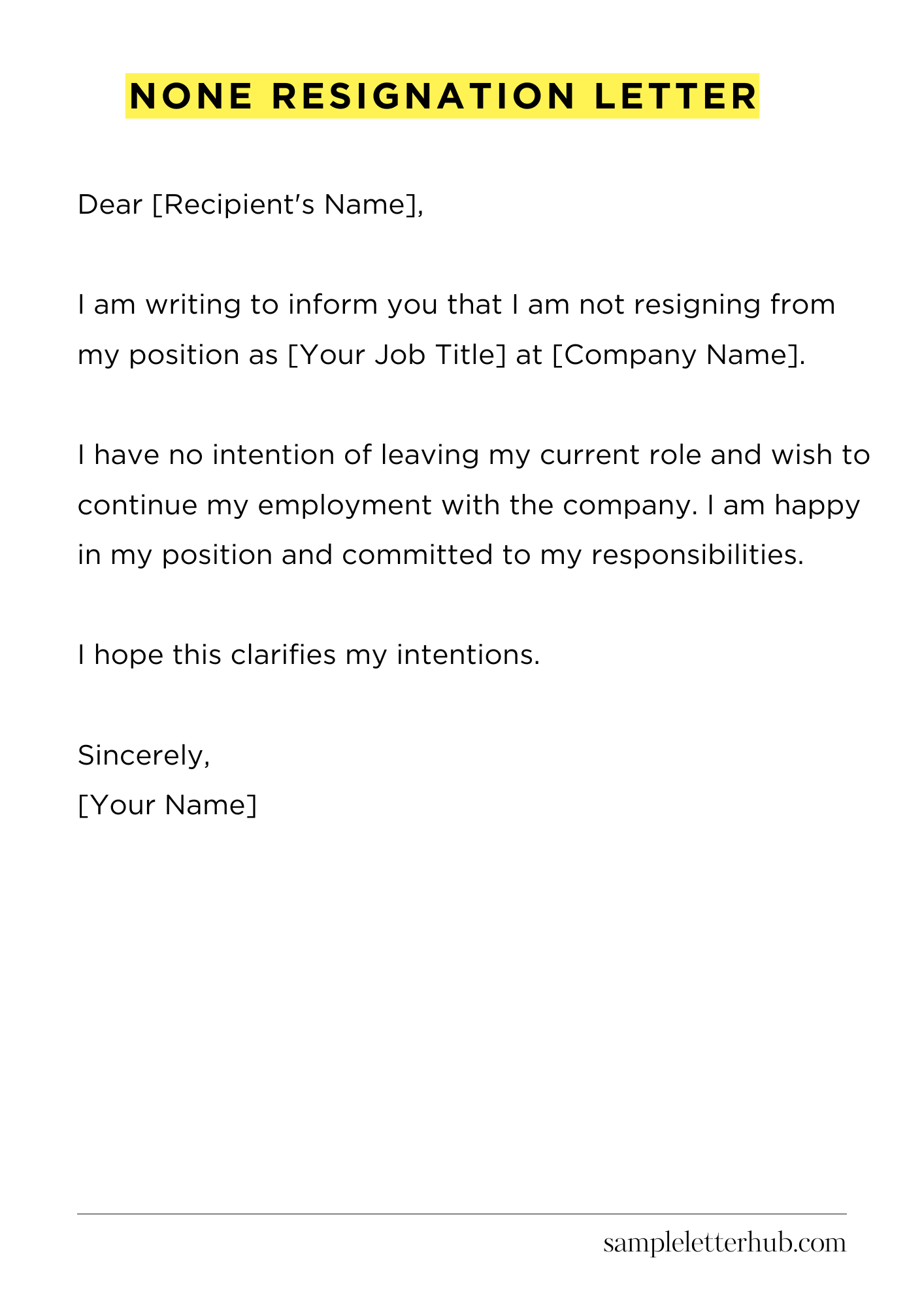
How to Write a Non-Resignation Letter
Understanding the “Non-Resignation” Concept
You might be asking, what exactly is a non-resignation letter? Essentially, it’s a formal written communication to your employer where you state that you are *not* resigning from your position.
This can be used in a few different scenarios. Perhaps there was a misunderstanding, or maybe you’ve been asked to consider leaving, but you want to reaffirm your commitment.
The key is to be clear and concise. A well-crafted non-resignation letter can clarify your intent and potentially salvage your job. It’s a proactive measure to ensure your employment status is understood.
Key Elements to Include
There are several crucial elements that need to be present in any effective non-resignation letter. First and foremost, you’ll need to clearly state that you are not resigning. Immediately get to the point. Start with a professional salutation, like “Dear [Manager’s Name]”.
After that, follow up with your intention; do this upfront. Express your continued commitment to your role and the company. Mention specific accomplishments or contributions you’ve made.
This demonstrates your value and involvement. Show that you are willing to continue your work with the firm. Finally, end with a professional closing, such as “Sincerely” or “Best Regards.”
Addressing the Reason for Clarification
Why are you writing this letter? Be honest and as specific as necessary, without being overly defensive. Were there rumors? Did you have a meeting about your performance? Acknowledge the reason that prompted you to write this letter. If the reason is a misunderstanding, briefly explain what happened.
Focus on rectifying the miscommunication rather than dwelling on blame. If you’ve been asked to consider leaving, address the concerns raised and explain why you believe those concerns are either inaccurate or can be mitigated. Your goal is to reassure and clarify your intentions and to show that you are valuable to the firm.
Maintaining a Professional Tone
Even if you’re upset or confused, maintain a professional tone throughout the letter. This is very important. Avoid sounding angry, defensive, or accusatory. Use polite and respectful language. Your writing needs to be clear, concise, and easy to understand. Proofread your letter carefully for any grammatical errors or typos.
Correct writing shows that you care. Remember, you want to convey a sense of professionalism, dedication, and a desire to continue working for the company. This is a formal communication, so stick to the rules and use business English.
Example Non-Resignation Letter Template
Here is a basic template to give you some idea about how to structure a non-resignation letter. Tailor it to your specific situation, of course.
[Your Name]
[Your Address]
[Your Phone Number]
[Your Email Address]

[Date]

[Manager's Name]
[Manager's Title]
[Company Name]
[Company Address]

Dear [Manager's Name],

I am writing to clarify my employment status. This letter confirms that I am NOT resigning from my position as [Your Job Title] at [Company Name].

[If applicable, briefly address the reason for clarification – e.g., "I understand there might have been some confusion regarding…", or "Following our recent conversation, I would like to reiterate…"].

I am fully committed to my role and to the continued success of the company. I am eager to continue contributing to [mention specific projects, goals, or accomplishments].

I am available to discuss this further at your convenience.

Sincerely,

[Your Signature]

[Your Typed Name]
Use this template as a guideline. A good letter can make the difference.
FAQs about None Resignation Letter
What is a “None” resignation letter?
A “None” resignation letter, sometimes referred to as a “no reason” or “no explanation” resignation, is a concise letter where the employee resigns without providing a specific reason for leaving. It simply states the intention to resign and the effective date of departure.
When should I use a “None” resignation letter?
You might consider using a “None” resignation letter in several situations. These include: If you wish to keep the details of your departure private. When you are leaving due to personal reasons that you’re not comfortable sharing.
If you want to maintain a professional relationship with your employer or simply desire a clean break. If you’re concerned that detailing the reason could lead to conflict or unwanted discussion.
What should be included in a “None” resignation letter?
A basic “None” resignation letter should include: Your name, the date, the name of your supervisor or the appropriate recipient, a clear statement of your resignation (e.g., “I am writing to inform you that I am resigning from my position as…”), the effective date of your resignation, and a professional closing (e.g., “Sincerely,” or “Respectfully,” followed by your signature and printed name).
Is a “None” resignation letter legally binding?
Yes, a “None” resignation letter, like any formal resignation, is legally binding. Once submitted and acknowledged by the employer, it signifies your intention to leave the company on the specified date, regardless of the reasons stated (or not stated) within the letter. Both you and your employer are bound by the terms.
Are there any potential downsides to using a “None” resignation letter?
Yes, while brevity is a benefit, a “None” resignation letter might not give you the opportunity to address any issues or provide feedback. If you’re hoping for a good reference or assistance from your employer (e.g., regarding future employment), a concise letter may not create that opportunity.
Additionally, leaving without explanation may sometimes leave your employer unsure of the situation, which could affect how your departure is perceived.
Related:
Resignation letter due to rude boss
Resignation letter moving to another state
Resignation letter due to illness of family member
Resignation letter due to study