

A .NET Developer resignation letter is a formal document. It is used to inform your employer that you are leaving your job. The letter should state your last day of employment. It also provides a reason for your departure.
Knowing how to craft this letter can be tricky. It can be stressful. We’ve got you covered. We’ll share ready-to-use examples. These are easy-to-customize templates. Use them to write your own letter with ease.
Consider this your quick guide. You’ll find different styles. Choose the one that suits your situation best. Say goodbye with grace and professionalism.
Net Developer Resignation Letter
Below is a sample of a Net Developer Resignation Letter:
[Your Name]
[Your Address]
[Your Phone Number]
[Your Email Address]
[Date]
[Employer’s Name]
[Employer’s Title]
[Company Name]
[Company Address]
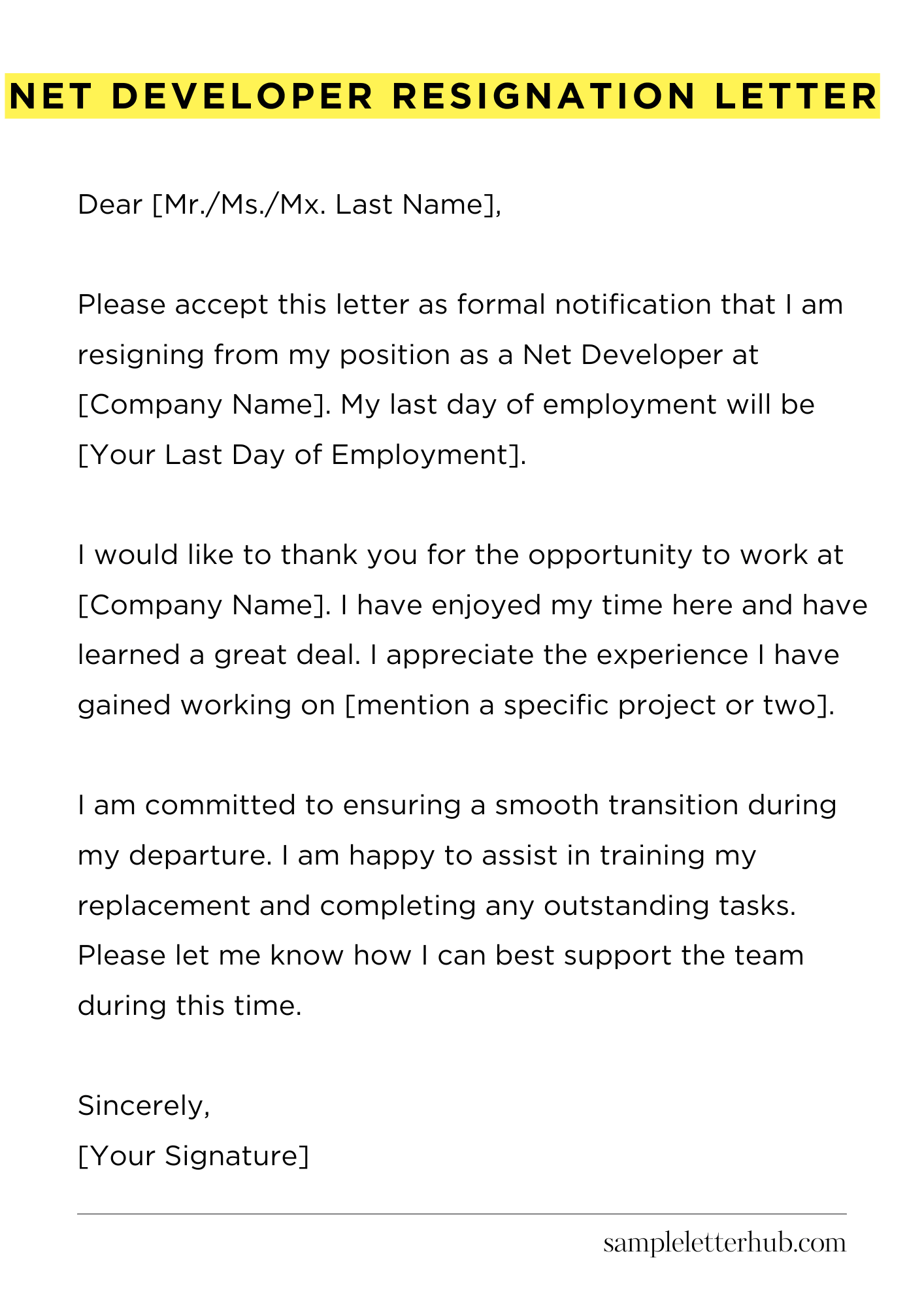
Dear [Mr./Ms./Mx. Last Name],
Please accept this letter as formal notification that I am resigning from my position as a Net Developer at [Company Name]. My last day of employment will be [Your Last Day of Employment].
I would like to thank you for the opportunity to work at [Company Name]. I have enjoyed my time here and have learned a great deal. I appreciate the experience I have gained working on [mention a specific project or two].
I am committed to ensuring a smooth transition during my departure. I am happy to assist in training my replacement and completing any outstanding tasks. Please let me know how I can best support the team during this time.
I wish you and [Company Name] all the best in the future.
Sincerely,
[Your Signature]
How to Write a .Net Developer Resignation Letter
Why You Need a Good Resignation Letter
Leaving a job is a big step, no doubt. It’s important to do it right, even when you’re moving on. A well-crafted .Net developer resignation letter is more than just a formality; it’s a professional courtesy and serves several crucial purposes. First off, it officially informs your employer of your departure.
Secondly, it documents your intention, providing a clear record of your resignation date. Finally, and very importantly, it can help you maintain positive relationships with your former colleagues and employer. You never know when you might cross paths again. It’s a small world.
Key Elements to Include
Okay, let’s get down to the nitty-gritty of what should be in your letter. You’ll want to keep it clear and concise, which is always a good idea. Start with a formal salutation. Address the letter to your direct supervisor or the appropriate HR representative. Next, clearly state your intention to resign.
Include your last day of employment. This is where you specify the date you’ll no longer be working for the company. Briefly express your gratitude for the opportunity to work there.
Perhaps mention a skill you gained or a positive experience. Keep it genuine. Don’t go overboard, though. Finally, offer assistance with the transition. Mention you’re willing to help with the handover process to ensure a smooth transition. Include your contact information.
Structuring Your Letter
Structure matters. A well-organized letter is easy to read. And a confused reader is a bad reader. Begin with a clear and concise opening paragraph, stating your intent and the date of your departure. Next, include a short paragraph expressing your gratitude. Keep it focused and sincere.
Follow this with a brief paragraph offering assistance with the handover. This shows professionalism. Always close with a formal closing and your signature. Use a professional font like Times New Roman or Arial.
Keep the font size between 10 and 12 points. Make sure to proofread your letter carefully for any typos or grammatical errors before sending it.
Avoiding Common Mistakes
Let’s talk about what not to do. It is really important to avoid negativity. Resist the urge to include complaints about your job, colleagues, or management. Resignations are not the place for that kind of feedback. Keep it positive and professional. Avoid burning bridges.
Don’t badmouth the company or anyone in it. It’s always best to leave on good terms. Do not go into excessive detail about your reasons for leaving, unless specifically requested.
A brief and professional explanation is sufficient. Don’t make unrealistic promises about your availability after your last day. Also, don’t forget to keep a copy of your letter for your records. It’s always a good idea to have documentation.
Finalizing and Sending Your Letter
Once you’ve written and proofread your letter, it’s time to send it. Consider your company’s policy for submitting resignation letters. Some companies prefer a physical copy, while others accept email. If submitting via email, save your letter as a PDF to maintain the formatting. Always send a copy to your supervisor and HR.
Check if there are any specific guidelines for delivery. Make sure to keep the tone professional throughout your interactions. After submitting, you might want to consider arranging a meeting with your supervisor to discuss your departure and transition plan in person. This shows respect.
Remember, a well-written resignation letter is a valuable tool for maintaining a positive professional reputation. It’s more than just a letter. It’s your exit strategy.
FAQs about .Net Developer Resignation Letter
What is the essential information to include in a .Net Developer resignation letter?
A .Net Developer resignation letter should include: your full name and contact information, the date of the letter, the name of your manager or the appropriate recipient, a clear and concise statement of your resignation, the effective date of your resignation, a brief expression of gratitude for the opportunity, and any necessary details about the handover of your responsibilities.
How much notice should a .Net Developer give when resigning?
The standard notice period is typically two weeks, as outlined in most employment contracts. However, this can vary based on your employment agreement or company policy. It’s best to review your contract and company handbook.
In some cases, more notice might be appropriate, particularly for senior roles or projects with critical deadlines. Always aim to provide the agreed-upon notice to maintain a professional relationship.
Should I provide a reason for leaving in my .Net Developer resignation letter?
While not mandatory, it’s generally a good idea to provide a brief and professional reason for leaving. You can keep it simple, such as “pursuing a new opportunity” or “seeking career advancement.”
Avoid being overly negative or going into excessive detail about your dissatisfaction. A positive and neutral tone is usually the most appropriate. If you are comfortable, you can briefly touch upon things you liked about the role or company.
What should I do about the handover of my responsibilities as a .Net Developer?
Your resignation letter should briefly mention your willingness to assist with the handover process. This includes cooperating with the company to train new people or preparing documentation.
Be prepared to create documentation and knowledge transfers. Before your last day, you should ensure all your active code and tasks are properly documented and easily accessible to whoever takes over your position, or follow company guidelines. Offer to assist in any way you can. This will make the transition smoother and reflects well on your professionalism.
Can I use a template for my .Net Developer resignation letter?
Yes, using a template is perfectly acceptable and can be a great starting point. Numerous templates are available online and can be customized to fit your specific situation.
Ensure you personalize the template with your information, the specific details of your role, and any relevant dates. You should avoid simply copying and pasting from a generic template, it is always recommended to tailor it to your individual situation. Remember to proofread the letter carefully before submitting it.
Related:
Resignation letter due to rude boss
Resignation letter moving to another state
Resignation letter due to illness of family member
Resignation letter due to study