

A National Account Manager resignation letter is a formal document. It informs your employer of your decision to leave your position. The letter also outlines your last day of employment. It’s an important step in the process of leaving a job.
You’re probably thinking, “Where do I even begin?” Well, breathe easy! We’ve got you covered. We’ve compiled some helpful templates and examples for your National Account Manager resignation letter. They are designed to streamline the process.
Think of it as your secret weapon! You can easily adapt these samples to fit your situation. No more staring blankly at a screen. Let’s get you ready to move on.
National Account Manager Resignation Letter
Below is a sample of a National Account Manager Resignation Letter:
[Your Name]
[Your Address]
[Your Phone Number]
[Your Email Address]
[Date]
[Hiring Manager Name] (If known, otherwise use title)
[Hiring Manager Title]
[Company Name]
[Company Address]
Dear [Mr./Ms./Mx. Last Name],
Please accept this letter as formal notification that I am resigning from my position as National Account Manager at [Company Name], effective [Your Last Day of Employment].
I have enjoyed my time at [Company Name] and appreciate the opportunities I have been given. I am grateful for the experience and knowledge I have gained during my employment.
I am committed to ensuring a smooth transition during my departure. I am willing to assist in training my replacement and completing any outstanding tasks to the best of my ability. I will be available to discuss the handover process and answer any questions you may have.
I wish you and [Company Name] all the best in the future.
Sincerely,
[Your Signature]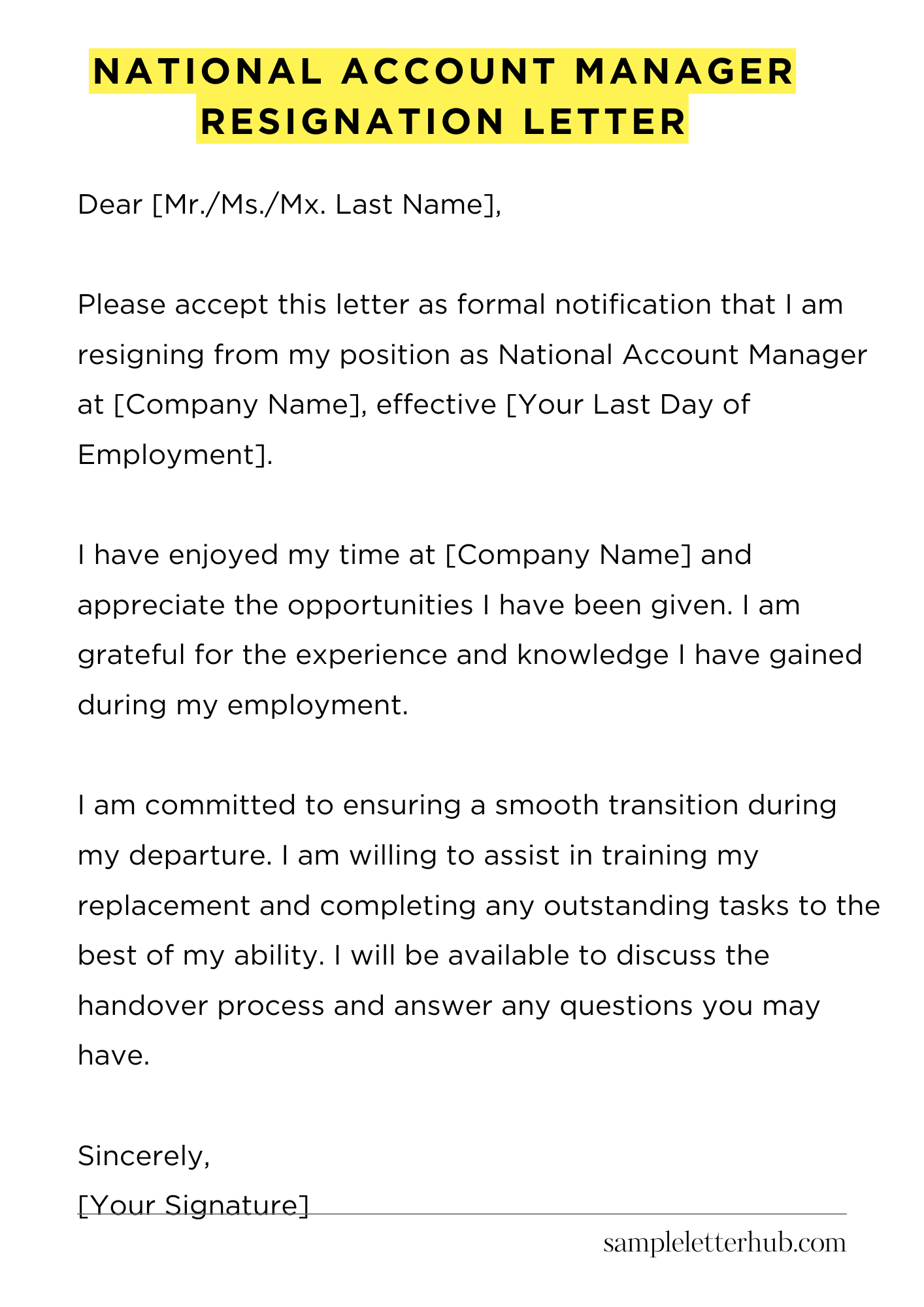
How to Write a National Account Manager Resignation Letter
1. Why Resign, Anyway? The Basics.
So, you’re thinking of moving on. That’s a big decision! Before you even think about the letter, take a moment. Reflect on your reasons for leaving your National Account Manager position. It’s crucial for you and your future employers. Are you seeking better pay, more challenging opportunities, or a more agreeable work environment?
Maybe a different industry altogether? Whatever the reasons, they should be clear in your mind. This clarity will help you articulate them professionally – or, in some cases, not at all – in your resignation letter. Remember, it’s about moving forward, so be honest with yourself about your goals.
2. Crafting the Core: The Essential Elements.
Now, let’s get down to the writing. First things first: your name, address, and contact information, and the date. Then, address the letter to your direct supervisor. Keep it simple and direct.
Open with a clear statement of your intention to resign. For example: “Please accept this letter as formal notification that I am resigning from my position as National Account Manager, effective [Your Last Day of Employment].”
Next, state your last day of employment. Be precise and adhere to company policy regarding the notice period. Usually, two weeks is the standard. Make sure your statement and date is easily understandable by the recipient. You’ll want to keep the process clear.
3. Expressing Gratitude (and Keeping it Positive).
This is important. Even if you’re leaving due to dissatisfaction, it’s always wise to express gratitude for the opportunities you’ve been given.
A simple “I would like to express my sincere gratitude for the opportunities I have been given during my time at [Company Name]” is effective. You can mention specific experiences or skills you’ve gained, if you like. Keeping the tone positive leaves a good impression and preserves professional relationships.
Do not be afraid to be specific. Remember that you are writing to people who you work with. This is not the time to be vague. Be professional, and let your gratitude shine.
4. Detailing the Handoff and Next Steps.
Your goal is to make the transition as smooth as possible. Indicate your willingness to assist with the handover process. Offer to train your replacement.
Offer to finish all incomplete assignments. This gesture will show you as a valuable, responsible employee. You can write something like: “I am committed to ensuring a smooth transition and am happy to assist in any way possible during the handover period. I am also happy to train my replacement.” Your supervisor and your coworkers will thank you.
This shows your commitment to the company. Be open to communication. Always have a contact ready and available.
5. The Final Touches: Polishing and Proofreading.
Before you send your resignation letter, take a moment to review it carefully. Proofread for any grammatical errors or typos. Ensure your tone is professional, respectful, and sincere.
Avoid any negative comments or complaints, even if you are unhappy. Keep your letter concise and to the point. Sign your letter with your name, either typed or handwritten. Make a copy for your records. Good luck!
Once you are completely satisfied with the result, send it. Make sure you will be satisfied when you read this later.
FAQs about National Account Manager Resignation Letter
What is the most important information to include in a National Account Manager resignation letter?
The core elements of a National Account Manager resignation letter are: a clear and direct statement of your intent to resign, the effective date of your resignation, and a brief expression of gratitude. It’s crucial to state your resignation plainly to avoid any confusion.
The effective date should be explicitly stated to set expectations for your final day. While optional, a sentence acknowledging your appreciation for the opportunity or experience can leave a positive impression.
How much notice should a National Account Manager give when resigning?
Typically, a National Account Manager should provide at least two weeks’ notice, as this is the standard in many professional settings. However, it’s wise to review your employment contract or company policy, which may specify a longer notice period.
Providing ample notice allows for a smoother transition, giving your employer time to find and train a replacement and minimizing disruption to client relationships.
Should I explain my reasons for leaving in my resignation letter?
While not mandatory, briefly stating your reason for leaving can be helpful, but be strategic. You are not obligated to provide detailed explanations for your departure in the letter itself.
You can generally keep the reason concise, such as “to pursue another opportunity” or “to focus on personal priorities.” If you have any formal exit interviews, those are more appropriate venues for in-depth discussions about your employment experience.
How should I handle client relationships in my resignation letter?
When resigning as a National Account Manager, it’s crucial to acknowledge your client relationships. You might express your commitment to ensure a smooth transition of your accounts.
You could offer to assist in the handover process to the new account manager. Maintaining professionalism and offering to provide any necessary support during this period can help preserve your professional reputation and ensure a seamless continuation of service to clients.
What is the best way to deliver my resignation letter as a National Account Manager?
The preferred method of delivering your resignation letter is often a combination of methods. Ideally, submit a physical copy of the letter to your direct supervisor or HR, as a formal, tangible record.
Simultaneously, you should also send an electronic version via email to maintain a digital record. Additionally, schedule a meeting to personally inform your manager of your decision before submitting the letter. This approach shows professionalism and respect, allowing for a face-to-face conversation.
Related:
Resignation letter due to rude boss
Resignation letter moving to another state
Resignation letter due to illness of family member
Resignation letter due to study