

A Medical Director resignation letter is a formal document. It announces your departure from a medical director role. The purpose is to officially inform your employer of your intention to leave. It also states your last day of employment.
Writing this letter can feel daunting. We understand. That’s why we’re here to help. We’ll provide you with various letter templates. You can use them to craft your own resignation letter.
These samples are designed to be easy to adapt. They cover different scenarios and situations. Our goal is to make the process smoother for you.
Medical Director Resignation Letter
Below is a sample of a Medical Director Resignation Letter:
[Your Name/Address]
[Your Phone Number]
[Your Email Address]
[Date]
[Medical Director’s Name]
[Hospital/Organization Name]
[Hospital/Organization Address]
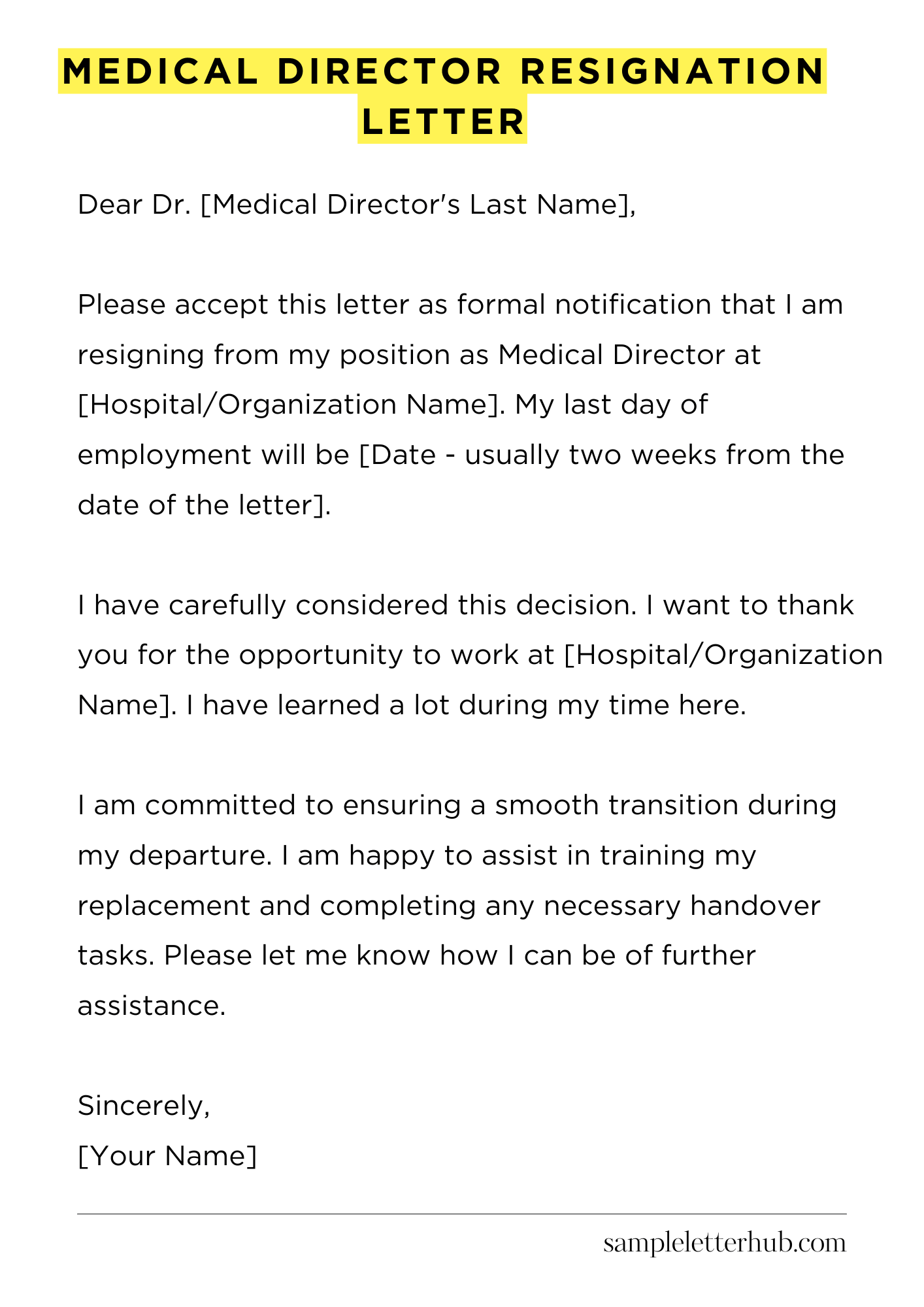
Dear Dr. [Medical Director’s Last Name],
Please accept this letter as formal notification that I am resigning from my position as Medical Director at [Hospital/Organization Name]. My last day of employment will be [Date – usually two weeks from the date of the letter].
I have carefully considered this decision. I want to thank you for the opportunity to work at [Hospital/Organization Name]. I have learned a lot during my time here.
I am committed to ensuring a smooth transition during my departure. I am happy to assist in training my replacement and completing any necessary handover tasks. Please let me know how I can be of further assistance.
I wish you and [Hospital/Organization Name] all the best in the future.
Sincerely,
[Your Name]
How to Write a Medical Director Resignation Letter
Resigning from any position requires careful consideration and professional execution. The role of Medical Director, carrying significant responsibility and ethical weight, demands even more diligence.
Your resignation letter is a critical document, a formal farewell, and potentially, a bridge to future opportunities. It sets the tone for your departure and can impact your professional reputation. Let’s explore how to navigate this process effectively.
1. Begin with a Direct and Clear Statement
This is not the time for ambiguity. Start your letter by stating your intention clearly and concisely. Avoid flowery language or vague expressions.
State your resignation explicitly and include the effective date of your departure. For example, “Please accept this letter as formal notification that I am resigning from my position as Medical Director, effective [Date].” This leaves no room for misinterpretation.
Keep it simple and direct. The recipients need to understand immediately what the letter is about.
2. Express Gratitude and Positive Sentiment
While you’re leaving, expressing appreciation is essential. Reflect on your time in the role and acknowledge any positive experiences or opportunities you’ve gained. Mention any specific individuals you’d like to thank.
This shows professionalism and goodwill. For instance, “I am grateful for the opportunities I’ve been given during my tenure at [Organization Name]. I especially appreciate the support of [Name(s) of individuals].” This maintains a positive tone, regardless of your reasons for leaving.
Remember, a little gratitude goes a long way!
3. Provide a Reason (If Necessary and Appropriate)
You are not always required to disclose your specific reasons for leaving. However, sometimes a brief, professional explanation is expected or can be helpful.
This is especially true if you are leaving for another opportunity. If you are comfortable sharing, provide a brief, professional reason. For example, “I am pursuing a new opportunity that aligns with my long-term career goals.” Avoid negative comments about the organization or individuals. Keep your response brief and to the point.
Consider your personal circumstances and the organization’s culture before deciding to provide a reason.
4. Offer Assistance with Transition
A smooth transition benefits everyone. Demonstrate your commitment to the organization by offering your assistance in the handover process. Offer to help with training your replacement, transferring your current duties, or any other tasks that could ensure a seamless transition.
A statement like, “I am committed to ensuring a smooth transition during my departure and am available to assist with training my replacement and transferring my responsibilities” is ideal. This reflects positively on your professionalism and work ethic.
The transition period is vital, and your support will be greatly appreciated.
5. Maintain Professionalism and Close Appropriately
Throughout the letter, maintain a professional tone. Avoid any negative comments, grievances, or personal issues. Proofread carefully for any errors in grammar or spelling.
End the letter with a professional closing, such as “Sincerely,” or “Respectfully,” followed by your typed name and signature. This final touch reinforces your professionalism and respect for the organization. Consider the long term. This letter, like all professional communications, contributes to the ongoing narrative of your career.
Your resignation letter is a final impression; make it a good one.
FAQs about Medical Director Resignation Letter
What is the primary purpose of a Medical Director resignation letter?
The primary purpose of a Medical Director resignation letter is to formally notify the employer of the intent to leave the position. It serves as a written record of the resignation, the effective date, and, often, a brief explanation for the departure.
What key elements should be included in a Medical Director resignation letter?
A well-crafted resignation letter should include: a clear statement of resignation, the effective date of departure, a brief and professional reason for leaving (optional but often included), expressions of gratitude for the opportunity, and an offer to assist with the transition. It should also include your contact information.
How much notice should a Medical Director give when resigning?
The amount of notice required varies based on the employment contract, company policy, and local regulations. However, it’s generally recommended that Medical Directors provide at least four weeks’ or a month’s notice, but more notice is preferred in some cases to allow for a smooth transition, especially in complex medical settings.
Is it necessary to provide a reason for resignation in the letter?
While not always mandatory, including a concise and professional reason for resignation can be beneficial. It helps provide context and can facilitate a more amicable departure. Common reasons might include pursuing new opportunities, personal or family reasons, or retirement. Avoid overly negative or critical language.
How should a Medical Director handle the transition process after submitting their resignation?
After submitting the resignation letter, the Medical Director should cooperate fully with the employer to ensure a smooth transition. This may involve assisting in the recruitment of a replacement, training the new director, handing over responsibilities, completing necessary documentation, and adhering to any exit procedures outlined by the organization.
Related:
Resignation letter due to rude boss
Resignation letter moving to another state
Resignation letter due to illness of family member
Resignation letter due to study