

Dealing with medical bills can be confusing. Sometimes, you need to write a medical claim request letter. This letter formally asks your insurance company to pay for your healthcare expenses. Its main job is to initiate the medical claims process. It ensures your bills are reviewed for coverage.
Are you struggling to write a medical claim request letter? Don’t worry! We understand it can be tricky. We’ve got you covered with various sample medical claim request letter templates.
These examples provide a starting point. They’ll help you craft the perfect letter. Use these medical claim request letter examples for different situations.
We aim to simplify the process. Our medical claim letter samples are ready-made. Just tweak them to fit your specific needs. You can easily adapt them to any situation. You’ll find templates for various scenarios. Writing a medical claim has never been easier!
[Your Name/Address]
[Your Phone Number]
[Your Email Address]
[Date]
[Insurance Company Name/Address]
Subject: Medical Claim Request
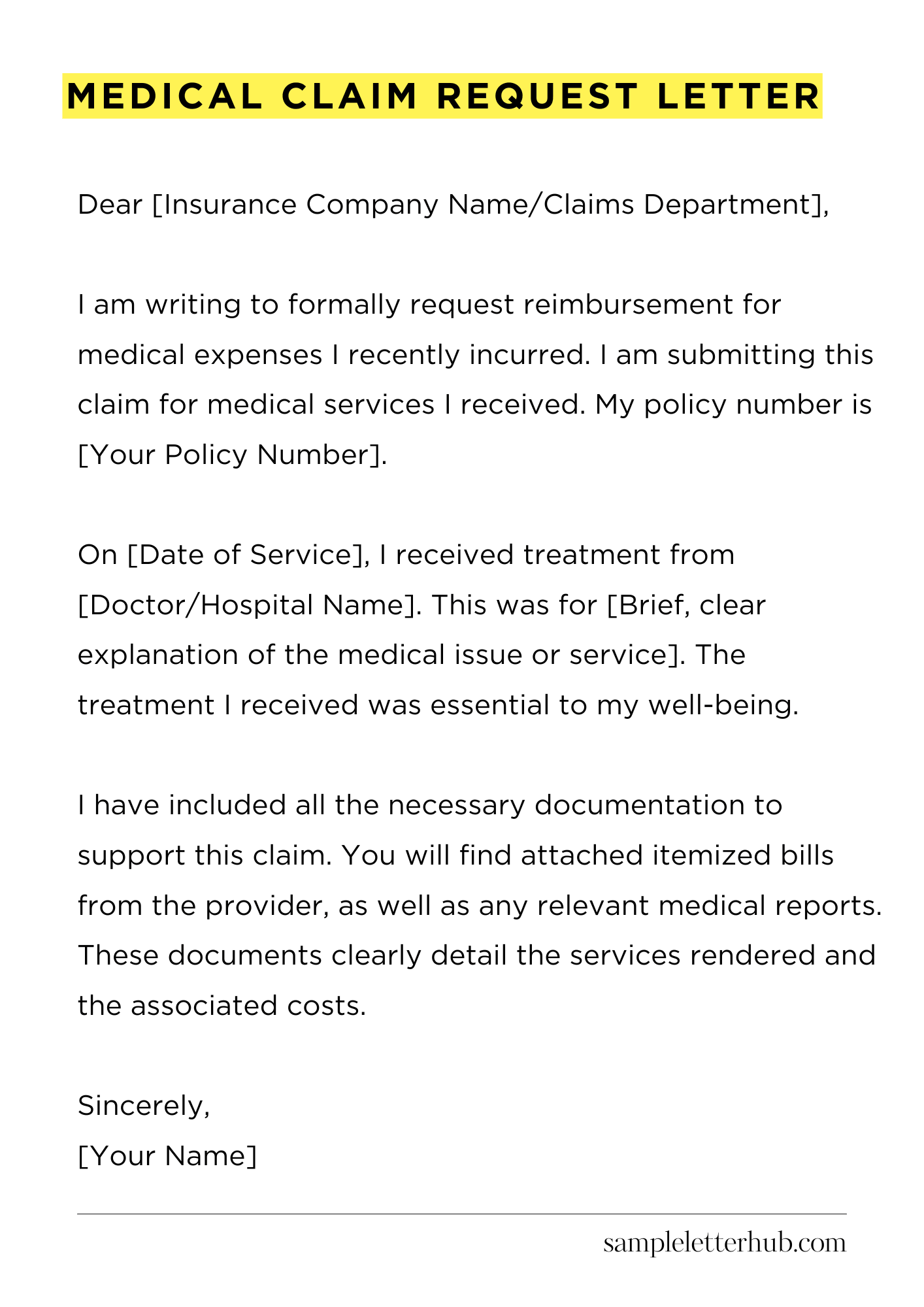
Dear [Insurance Company Name/Claims Department],
I am writing to formally request reimbursement for medical expenses I recently incurred. I am submitting this claim for medical services I received. My policy number is [Your Policy Number].
On [Date of Service], I received treatment from [Doctor/Hospital Name]. This was for [Brief, clear explanation of the medical issue or service]. The treatment I received was essential to my well-being.
I have included all the necessary documentation to support this claim. You will find attached itemized bills from the provider, as well as any relevant medical reports. These documents clearly detail the services rendered and the associated costs.
The total amount I am seeking reimbursement for is [Dollar Amount]. I trust that you will process this claim promptly. I have also attached a copy of my insurance card for easy reference.
Please let me know if you require any further information or documentation. I would appreciate it if you could inform me of the status of my claim within a reasonable timeframe. I look forward to your quick response.
Thank you for your time and attention to this matter. I appreciate your assistance in this process.
Sincerely,
[Your Name]
How to Write Medical Claim Request Letter
Navigating the labyrinthine world of medical billing can feel like deciphering an ancient scroll. One crucial tool in this process is the medical claim request letter.
It’s your official missive to the insurance provider, initiating the reimbursement process for medical expenses. This guide will provide a structured approach to ensure your letter is effective and improves the likelihood of a successful claim.
1. Begin with a Precise Salutation
The commencement of your letter is critical. Address your missive to the designated claims department or the specific individual if you have their details. Avoid generic salutations.
“To Whom It May Concern” is ineffectual and conveys a lack of meticulousness. Instead, opt for “Dear Claims Department” or, if applicable, “Dear [Insurance Adjuster’s Name].” This demonstrates you have done your due diligence.
2. Clearly State the Purpose and Provide Contextual Data
The initial paragraph should explicitly state your intent: to submit a medical claim. Immediately furnish essential information. Include your full name, policy number, and the patient’s name (if different from yours). Briefly describe the medical service or procedure for which you are seeking reimbursement. Succinctness is key here. Think of this section as your executive summary.
3. Itemize and Substantiate Medical Expenses
This is the crux of your letter. Meticulously enumerate all charges you are claiming. Use a clear, tabular format for optimal clarity. Include the date of service, description of the service (e.g., “Physician Consultation,” “Lab Test – Complete Blood Count”), the associated cost, and the relevant billing code (CPT or HCPCS code).
Attach copies of itemized bills, receipts, and any supporting medical documentation. Ensure all documents are legible. Failing this, your submission may be declared deficient.
4. Detail the Medical Circumstances
If applicable, briefly narrate the circumstances surrounding the medical service. This is particularly pertinent if the claim involves an unusual situation, such as an accident or emergency.
Provide pertinent information that illustrates the medical necessity of the procedures or treatments received. This demonstrates the rational need for services rendered.
5. Advocate for Prompt Adjudication
Express your desire for a prompt claim adjudication. Specify the timeframe you expect to receive a response. You might state, “I would appreciate a response within [number] business days” This adds to the gravity of your formal appeal. Do not threaten, but respectfully request expeditious processing.
6. Furnish Contact Information and Offer of Collaboration
Include your current mailing address, telephone number, and email address. This ensures the insurance company can readily contact you regarding the claim. Furthermore, explicitly state your willingness to provide any additional information required. Something like, “Please do not hesitate to contact me if further documentation is needed.” Such collaboration can streamline the claims procedure.
7. Finalize with a Professional Closing and Signature
Conclude your letter with a professional closing, such as “Sincerely,” “Respectfully,” or “Yours truly.” Print your full name below your signature. If you are sending the letter by mail, a handwritten signature is necessary. If submitting electronically, a digital signature or a typed signature is acceptable. Remember, attention to detail is paramount throughout the whole process.
FAQs about Medical Claim Request Letter
What is a medical claim request letter and when is it needed?
A medical claim request letter is a formal document used to request reimbursement for medical expenses from an insurance provider. It is typically required when submitting claims for services or treatments that were not pre-approved or when there is a dispute regarding the coverage of a particular medical service.
The letter serves as a written record of the claim, providing details of the services, the associated costs, and supporting documentation.
What information should be included in a medical claim request letter?
A comprehensive medical claim request letter should include the patient’s full name, date of birth, policy number, and contact information.
The letter should clearly state the purpose of the request, specifying the medical services or treatments for which reimbursement is sought.
It must also include the dates of service, detailed descriptions of the services rendered, and the total cost. Attachments such as itemized bills, receipts, and supporting medical records should be included to substantiate the claim.
How do I write a medical claim request letter?
When drafting a medical claim request letter, start by addressing it to the appropriate department within the insurance company. Clearly state the purpose of the letter in the opening paragraph.
Provide all relevant patient and policy information, followed by a detailed description of the services rendered, including dates, costs, and provider details. Be polite, professional, and concise in your writing.
Enclose copies of all supporting documentation. Conclude the letter with a request for a timely review of the claim and information on how to reach you.
What supporting documents are typically required with a medical claim request letter?
Supporting documents are critical to the successful processing of a medical claim. These typically include itemized bills from healthcare providers, which break down each service rendered and its associated cost.
Receipts for payments made should also be included. Medical records, such as doctor’s notes, lab results, and imaging reports, may be needed to demonstrate the medical necessity of the services.
Depending on the nature of the claim, other documents, such as explanation of benefits (EOB) statements, pre-authorization approvals, or prescriptions, might also be requested.
How long does it typically take to receive a response after submitting a medical claim request letter?
The processing time for a medical claim request letter varies depending on the insurance provider, the complexity of the claim, and the completeness of the documentation provided.
Most insurance companies aim to process claims within 30 to 60 days. However, in some cases, such as when further investigation is required or if additional information is needed, the processing time might be longer.
It is advisable to contact the insurance company to inquire about the status of the claim if you do not receive a response within a reasonable timeframe.
Related:
Resignation letter due to rude boss
Resignation letter moving to another state
Resignation letter due to illness of family member
Resignation letter due to study