

A Massage Therapist resignation letter is a formal document. It is used to inform an employer about leaving a job. The letter officially states the massage therapist’s departure date. It serves as a record of their intention to resign.
Crafting the perfect resignation letter can feel daunting. We’ve got you covered. We’ll provide a variety of templates. These will act as a starting point. Feel free to adapt them to fit individual needs.
Consider these letters as helpful guides. They simplify the process. Whether you need a simple notice or a more detailed letter, we have examples. Find the perfect fit for your specific situation.
Massage Therapist Resignation Letter
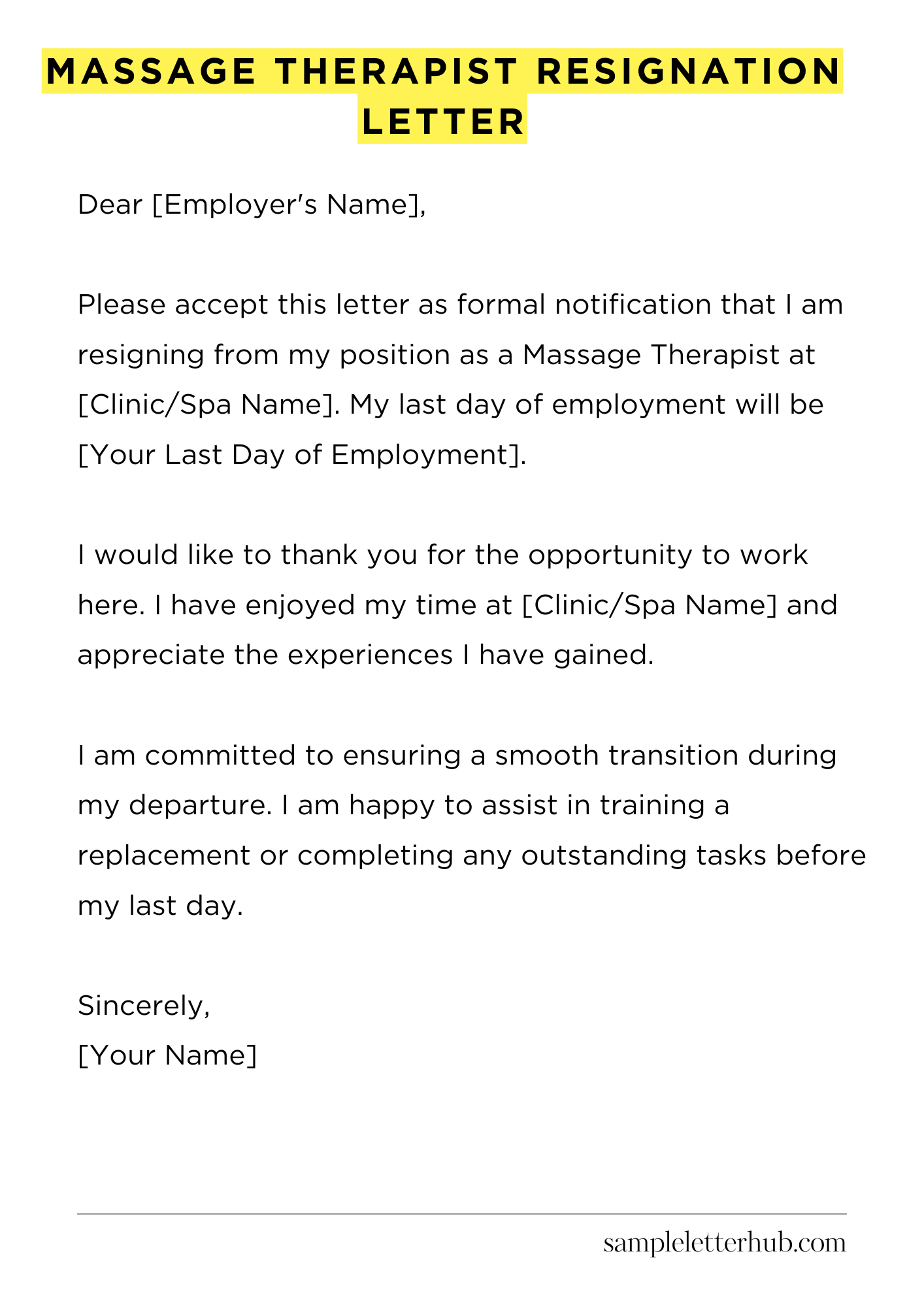
Below is a sample of a Massage Therapist Resignation Letter:
[Your Name]
[Your Address]
[Your Phone Number]
[Your Email Address]
[Date]
[Employer’s Name]
[Clinic/Spa Name]
[Clinic/Spa Address]
Dear [Employer’s Name],
Please accept this letter as formal notification that I am resigning from my position as a Massage Therapist at [Clinic/Spa Name]. My last day of employment will be [Your Last Day of Employment].
I would like to thank you for the opportunity to work here. I have enjoyed my time at [Clinic/Spa Name] and appreciate the experiences I have gained.
I am committed to ensuring a smooth transition during my departure. I am happy to assist in training a replacement or completing any outstanding tasks before my last day.
I wish you and the clinic all the best in the future.
Sincerely,
[Your Name]
How to Write a Massage Therapist Resignation Letter
Leaving a job, even one you may not love, can be tricky. It’s especially sensitive when you’re working in a profession where you build close relationships, like massage therapy.
You want to leave on good terms, and a well-crafted resignation letter is the key to achieving this. Don’t worry, it’s not as hard as it seems! Let’s break down how to write a professional and effective resignation letter for your massage therapy position.
Step 1: Keep It Concise and Professional
Your resignation letter is not the place for lengthy explanations or airing grievances. That’s a different conversation entirely! Keep it short, sweet, and professional. Start with a clear and direct statement of your intent to resign.
State your name, your position (Massage Therapist, etc.), and the date of your last day of employment. This is the core purpose of the letter. Focus on the facts. It is essential. Don’t get lost in flowery language or unnecessary details.
Step 2: Express Gratitude
Even if you’re not thrilled to be leaving, expressing gratitude goes a long way. This is very important. Thank your employer for the opportunity to work there.
Acknowledge any positive experiences or opportunities you’ve had. Briefly mention anything specific you learned or benefited from during your employment. This shows professionalism and leaves a positive final impression. This is a very good business practice.
Step 3: Provide a Reasonable Notice Period
Check your employment contract or company handbook to see what the required notice period is. Usually, it’s two weeks, but it could vary. Whatever the requirement, adhere to it. Include the date of your last day of employment in your letter. This helps your employer with scheduling and finding a replacement. Providing sufficient notice is a sign of respect and consideration.
Step 4: Offer Assistance with the Transition
Show you’re a team player, even as you’re heading out the door. Offer your assistance in training your replacement or completing any pending tasks. State your willingness to help ensure a smooth transition.
This demonstrates your commitment to your clients and the company. It’s a gracious gesture that will be remembered long after you’ve left. Your former employer will appreciate this.
Step 5: Review and Proofread Carefully
Before you send your letter, take a final look. Proofread for any typos or grammatical errors. Ensure that the tone is professional and positive. Double-check all dates and names. It’s a small detail, but it makes a big difference. Get a second pair of eyes to review it for you if possible.
Once you’re confident that your letter is perfect, print it out (or send a digital copy) and deliver it to your employer. Good luck with your next chapter!
FAQs about Massage Therapist resignation letter
How much notice should I give when resigning as a Massage Therapist?
The standard practice is to give two weeks’ notice. However, the exact amount may depend on your employment agreement or local labor laws. Review your contract for specific requirements. Giving ample notice allows your employer time to find a replacement and ensures a smoother transition for clients.
What should I include in my Massage Therapist resignation letter?
Your resignation letter should include a clear statement of your intent to resign, the effective date of your resignation, and a brief expression of gratitude for the opportunity. You may also mention your willingness to assist with the transition. Keep it concise, professional, and positive. Avoid including negative comments about your employer or colleagues.
Should I explain the reason for my resignation in the letter?
You are not obligated to provide a reason for your resignation. While it’s acceptable to briefly state that you are pursuing other opportunities, it’s generally best to keep the explanation brief and positive. Avoid getting into detailed explanations that could lead to unnecessary discussions or negativity. Your primary goal is to formally notify your employer of your departure.
How should I deliver my Massage Therapist resignation letter?
The most professional way is to provide a physical copy of the letter to your manager or supervisor. You may also send an electronic copy via email as a courtesy, especially if you have been communicating primarily online. Make sure you retain a copy for your records.
What if I have clients I’d like to maintain contact with after leaving?
Before considering this, review your employment agreement for any non-compete clauses or restrictions on client solicitation. If no such restrictions exist, you can inform clients that you are leaving and provide them with your contact information.
However, always be mindful of ethical considerations and avoid actions that could be interpreted as poaching clients from your former employer. It is a good practice to check with your employer about their policy on client contact during and after your employment.
Related:
Resignation letter due to rude boss
Resignation letter moving to another state
Resignation letter due to illness of family member
Resignation letter due to study