


Planning to move on from your role as a Market Research Analyst? You’ll need a resignation letter. This formal document officially communicates your decision to leave your current position. It’s an important step in maintaining a professional relationship with your employer.
Writing a resignation letter can feel daunting. But don’t worry. We’ve got you covered. This article offers several templates and examples. They’re designed to make the process as easy as possible.
We’ll share various letter samples. These will help you craft your own personalized resignation letter. Find a template that suits your needs. Adapt it to reflect your specific circumstances.
Market Research Analyst Resignation Letter
Below is a sample of a Market Research Analyst Resignation Letter:
[Your Name]
[Your Address]
[Your Phone Number]
[Your Email Address]
[Date]
[Hiring Manager Name] (If known, otherwise use title)
[Hiring Manager Title]
[Company Name]
[Company Address]
Dear [Mr./Ms./Mx. Last Name],
Please accept this letter as formal notification that I am resigning from my position as Market Research Analyst at [Company Name]. My last day of employment will be [Your Last Day of Employment].
I would like to thank you for the opportunity to work at [Company Name]. I have learned a great deal during my time here and appreciate the experiences I have gained.
I am committed to ensuring a smooth transition during my departure. I am happy to assist in training my replacement and completing any outstanding projects. Please let me know how I can best support the team during this time.
I wish you and [Company Name] all the best in the future.
Sincerely,
[Your Signature]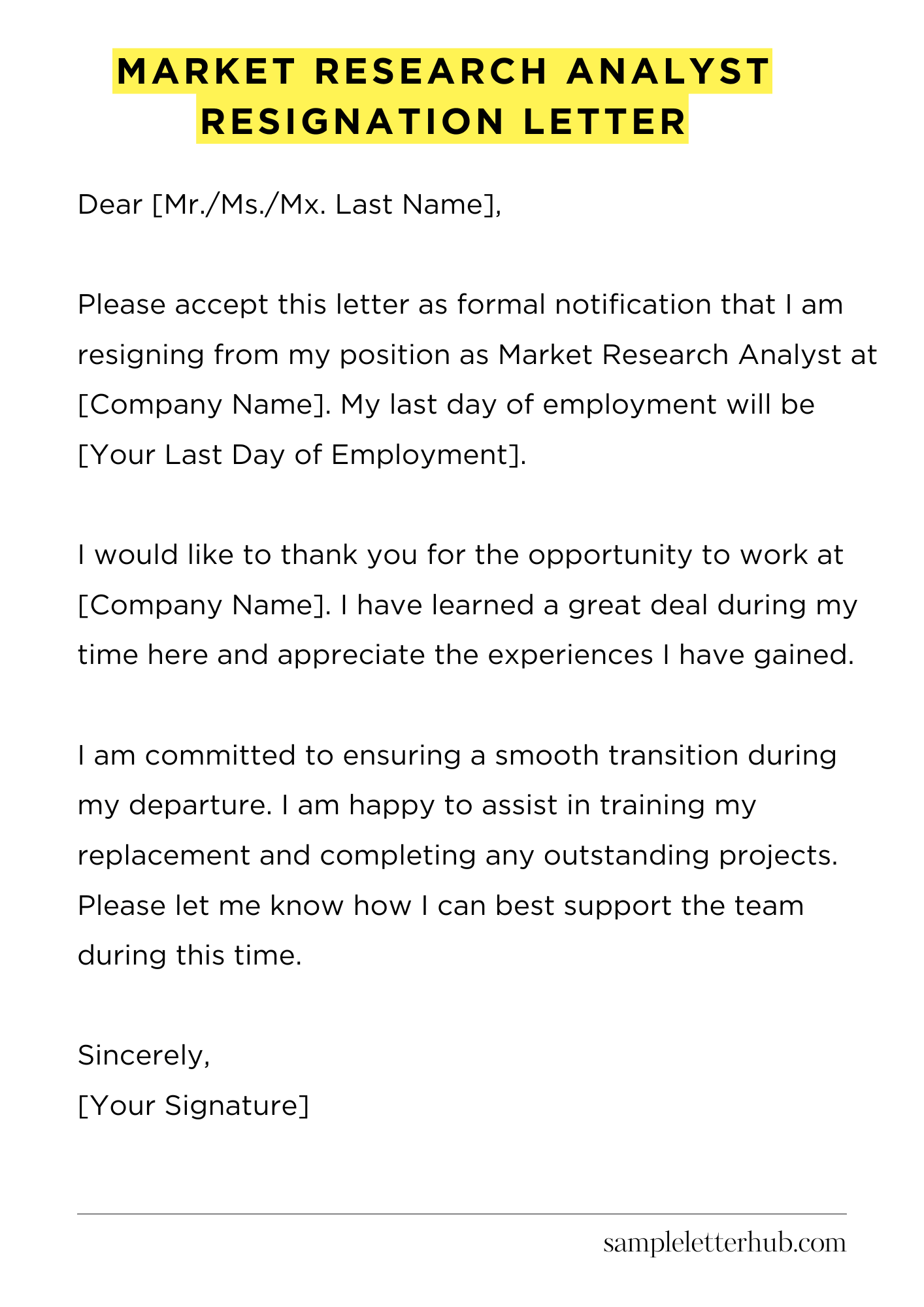
How to Write a Market Research Analyst Resignation Letter
1. Why Bother with a Resignation Letter?
Leaving a job is a big step, no matter the reason. But why do you even need a formal resignation letter? Well, think of it as a professional courtesy. It’s the standard practice! A well-crafted letter isn’t just about saying “I quit.” It serves several crucial purposes.
Firstly, a letter provides a written record of your departure. This protects both you and your employer. Secondly, it formally states your last day of employment.
This clears up any confusion and allows for a smooth transition. Finally, it allows you to express your gratitude and maintain a positive relationship. You never know when you might cross paths again. Therefore, it is important to follow this. Writing is a very crucial skill.
2. Essential Elements: What to Include
Now, let’s get down to the nitty-gritty. What exactly should you include in your resignation letter? There are a few key elements that are absolutely essential for any well-written resignation.
- Your Name and Contact Information: Always start with your full name, address, phone number, and email. This is basic, but necessary.
- Date: Include the current date.
- Recipient’s Name and Title: Address the letter to your direct supervisor or HR manager. Be specific.
- Formal Declaration of Resignation: State clearly that you are resigning from your position. Keep it concise.
- Last Day of Employment: Clearly state your last day. This is vital.
- Brief Statement of Gratitude: Express your thanks for the opportunity to have worked there. Keep it positive.
- Offer of Assistance (Optional): If you’re willing, offer to help with the transition.
- Closing and Signature: Use a professional closing, such as “Sincerely” or “Best regards,” and sign your name.
3. Crafting the Perfect Letter: A Step-by-Step Guide
Now that you know what to include, let’s put it all together. Here’s a basic framework to follow when writing your resignation letter:
- Start Strong: Begin with a clear and direct statement of your intent to resign.
- Be Concise: Avoid unnecessary details about why you’re leaving (unless you feel compelled to explain briefly).
- Keep it Positive: Even if you’re not happy, focus on the positive aspects of your experience.
- Be Professional: Maintain a formal and respectful tone throughout the letter.
- Proofread Carefully: Always proofread your letter for any errors in grammar or spelling before sending it. Errors can be unprofessional.
4. Tailoring Your Letter: Examples and Considerations
Your situation is unique. Therefore, your letter should reflect that. While the core elements remain the same, consider these variations:
- If you’re leaving for a better opportunity: Briefly mention the new opportunity, but don’t brag.
- If you’re leaving due to personal reasons: Keep it vague, such as “personal circumstances.” No need to overshare.
- If you have a good relationship with your employer: You can be slightly more personal in your expression of gratitude.
Here’s a basic example: (Please note: you’ll need to customize this with your specific details.)
[Your Name]
[Your Address]
[Your Phone Number]
[Your Email]
[Date]
[Recipient’s Name]
[Recipient’s Title]
[Company Name]
[Company Address]
Dear [Recipient’s Name],
Please accept this letter as formal notification that I am resigning from my position as Market Research Analyst at [Company Name]. My last day of employment will be [Your Last Day].
I am grateful for the opportunities I have been given during my time here. I wish you and the company all the best in the future. I am willing to assist in the transition of my responsibilities, if needed.
Sincerely,
[Your Signature]
[Your Typed Name]
5. After the Letter: What to Do Next
The letter is just the first step. Here’s what comes next:
- Submit Your Letter: Deliver your letter to your supervisor or HR department according to your company’s policies.
- Be Prepared for a Discussion: Your employer may want to discuss your resignation. Be prepared to answer questions.
- Complete Your Exit Tasks: Follow company procedures for exiting, such as returning company property and completing any necessary paperwork.
- Maintain Professionalism: Even after you’ve resigned, maintain a professional demeanor until your last day. This is really important!
Writing a resignation letter, especially as a Market Research Analyst, doesn’t have to be daunting. By following these steps and focusing on clear, concise, and professional communication, you can leave your job on a positive note and set yourself up for future success.
FAQs about Market Research Analyst resignation letter
Understanding the nuances of crafting a resignation letter as a Market Research Analyst is crucial for a smooth transition. Here are some frequently asked questions to guide you through the process:
What should I include in my Market Research Analyst resignation letter?
Your resignation letter should be concise and professional. Begin by stating your intent to resign, including your official last day of employment. Briefly express gratitude for the opportunity to work at the company.
Keep the reason for leaving brief and neutral, such as “pursuing other opportunities” or “seeking new challenges.” You should also offer to assist in the transition of your responsibilities and thank your employer and colleagues.
How much notice should I give when resigning from a Market Research Analyst position?
The standard notice period is typically two weeks, but it’s best to consult your employment contract or company policy. Some companies, especially for senior roles, may require a longer notice period. Always adhere to the requirements outlined in your employment agreement to avoid any potential issues.
Should I provide a reason for leaving in my Market Research Analyst resignation letter?
While you are not obligated to provide a detailed explanation, it is courteous to include a brief, neutral reason. Avoid negativity and focus on your professional growth or other opportunities. Common phrases include: “pursuing new opportunities,” “seeking a new challenge,” or “relocating.” Keep it brief and positive.
How can I make the transition of my duties as a Market Research Analyst as smooth as possible?
Offer your assistance in training your replacement or documenting your current projects. Prepare a detailed handover document that includes ongoing projects, key contacts, relevant data sources, and procedures. Be responsive to questions during your notice period, and prioritize completing any urgent tasks or deliverables.
What format should I use for my Market Research Analyst resignation letter?
Use a formal business letter format. Include your name, address, and the date. Address the letter to your immediate supervisor or the appropriate HR representative. Keep the letter concise, using clear and professional language. Ensure the letter is free of grammatical errors and typos. Proofread it carefully before sending.
Related:
Resignation letter due to rude boss
Resignation letter moving to another state
Resignation letter due to illness of family member
Resignation letter due to study