

A “Managing Editor resignation letter” is a formal document. It is written by a Managing Editor. The letter officially announces their departure from a company. It’s a crucial step in ending their employment professionally.
Leaving a role can be tricky. Writing the perfect resignation letter is essential. This article offers several templates. We’ll share examples to guide you. Use these to craft your own letter.
Need to say goodbye? We’ve got you covered. This is the place to find inspiration. We provide various samples. Each can be adapted to your unique situation.
Managing Editor Resignation Letter
Below is a sample of a Managing Editor Resignation Letter:
[Your Name]
[Your Address]
[Your Phone Number]
[Your Email Address]
[Date]
[Hiring Manager Name] (If known, otherwise use title)
Managing Editor
[Publication Name]
[Publication Address]
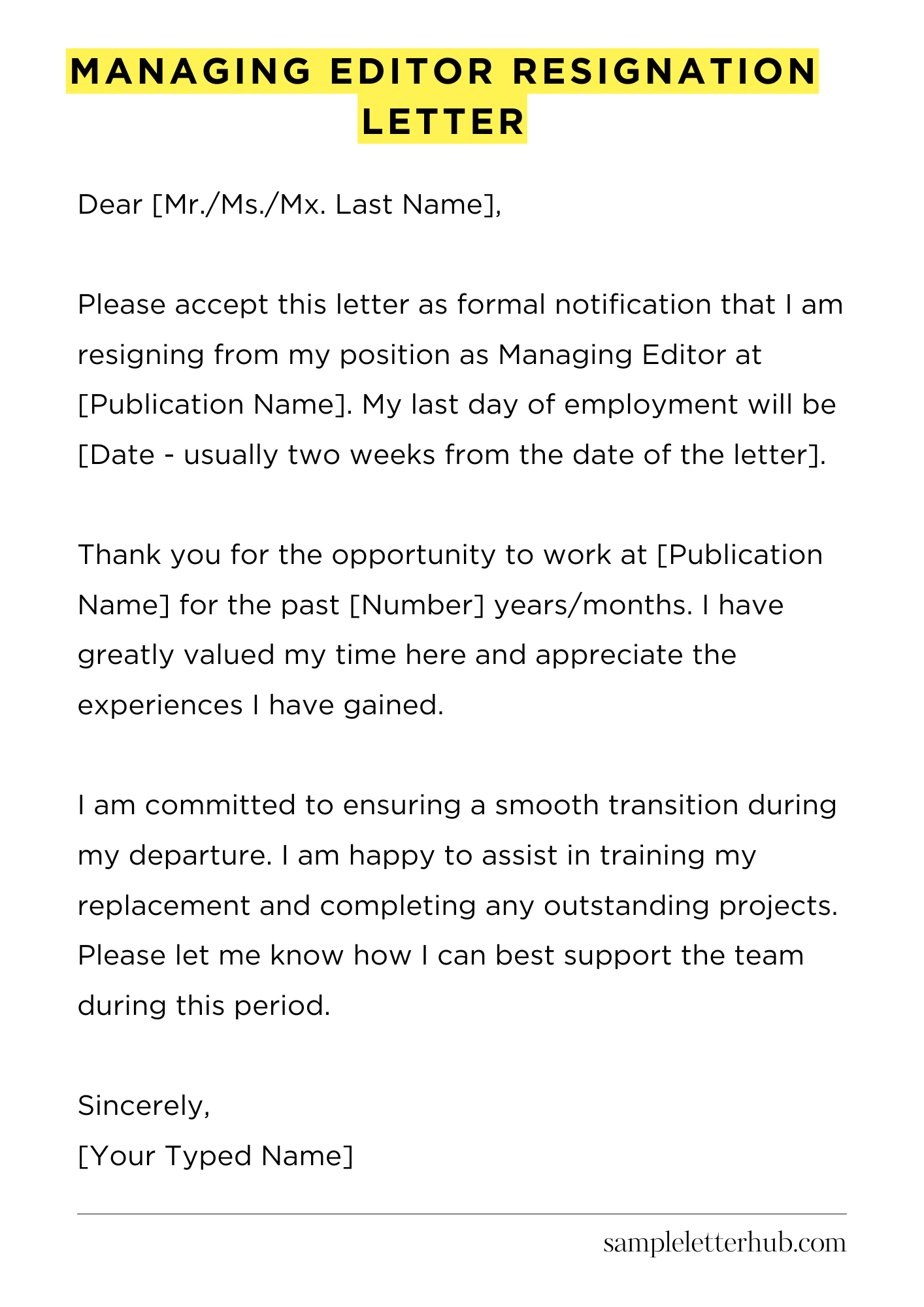
Dear [Mr./Ms./Mx. Last Name],
Please accept this letter as formal notification that I am resigning from my position as Managing Editor at [Publication Name]. My last day of employment will be [Date – usually two weeks from the date of the letter].
Thank you for the opportunity to work at [Publication Name] for the past [Number] years/months. I have greatly valued my time here and appreciate the experiences I have gained.
I am committed to ensuring a smooth transition during my departure. I am happy to assist in training my replacement and completing any outstanding projects. Please let me know how I can best support the team during this period.
I wish you and [Publication Name] all the best in the future.
Sincerely,
[Your Typed Name]
How to Write a Managing Editor Resignation Letter
Resigning from a job is never easy. It requires planning, courage, and a whole lot of tact. If you’re a Managing Editor looking to move on, crafting a professional resignation letter is absolutely essential. This letter isn’t just a formality; it’s a reflection of your professionalism and a key step in leaving a positive impression. Here’s how to do it right.
1. Start with a Clear and Concise Statement
The first paragraph is where you state the obvious. Be direct. Avoid beating around the bush. Your letter should begin with a straightforward declaration of your intent to resign.
State your position and your effective date. Keep it simple and to the point. For instance, “Please accept this letter as formal notification that I am resigning from my position as Managing Editor, effective [Date].” This leaves no room for confusion.
2. Express Gratitude and Acknowledge Your Time
Even if the job wasn’t perfect, expressing gratitude is always a good move. Consider how much time you’ve spent with the company. Take the opportunity to thank your employer for the opportunity and the experiences you’ve gained. Mention any specific experiences, skills, or relationships you value.
A brief, genuine statement of appreciation can go a long way. Something like, “I am grateful for the opportunities I’ve been given during my time here and for the experience I’ve gained managing various projects.” Remember, you are building bridges, not burning them.
3. Provide Necessary Information and Offer Assistance
Transitioning out of a role requires some planning. Next, you need to offer assistance with the handover process. This is crucial for leaving on good terms. Outline your willingness to help with the transition.
Be specific about what you can do to ensure a smooth handover. Mention your availability to train your replacement or complete ongoing tasks. You might include, “I am committed to ensuring a smooth transition and am happy to assist in training my replacement or completing any ongoing projects before my departure.” The key is to be proactive.
4. Keep it Professional and Avoid Negativity
This is not the time to air grievances. Keep your tone positive and professional. Focus on your future, not the past. Avoid negative comments about colleagues, the company, or your reasons for leaving.
Even if you have criticisms, save them for an exit interview (if one is offered). Your resignation letter is a formal document; therefore, maintain a respectful and courteous tone. Your future prospects will appreciate it.
5. Proofread and Sign Off Correctly
Before you send it, proofread, proofread, proofread! Check for any spelling or grammatical errors. Ensure your contact information is correct and present. Sign the letter, and, if you’re delivering it physically, make sure it is on company letterhead (if applicable). It is imperative that you keep a copy for your records.
Consider a closing like “Sincerely,” or “Best regards,” followed by your signature and your typed name below it. These small details show attention to detail and a commitment to professionalism even on your way out.
FAQs about Managing Editor resignation letter
Resigning from a position as a Managing Editor requires a well-crafted resignation letter. Here are some of the most common questions regarding this process:
What essential information should be included in a Managing Editor resignation letter?
A Managing Editor resignation letter should include your formal announcement of resignation, the effective date of your departure, a concise statement of gratitude for the opportunity, and any necessary information for a smooth transition. Be sure to also state your willingness to assist in the handover process. The letter should be professional and reflect positively on your time at the organization.
How far in advance should I submit my Managing Editor resignation letter?
Ideally, you should submit your resignation letter at least two weeks before your intended last day. However, consider your company’s policy and your employment contract, which may specify a longer notice period. Providing ample notice allows for a more seamless transition and demonstrates professional courtesy.
What is the appropriate tone for a Managing Editor resignation letter?
The tone should be professional, respectful, and appreciative. Avoid negativity or complaints. Focus on the future and express gratitude for the opportunities you’ve been given. Maintain a positive and amicable tone, leaving a good impression for future references.
Should I explain the reason for my resignation in the letter?
It’s generally not required to provide a detailed explanation for your departure. A simple statement, such as “to pursue other opportunities” or “to focus on new challenges,” is often sufficient. If you wish to provide more detail, keep it brief and positive. Avoid going into exhaustive details.
What should I do after submitting my Managing Editor resignation letter?
After submitting your letter, be prepared to assist in the transition process. This may involve training your replacement, documenting your key responsibilities, and ensuring all ongoing projects are properly managed before your departure. Follow through on any commitments made in your letter and maintain a professional demeanor until your last day.
Related:
Resignation letter due to rude boss
Resignation letter moving to another state
Resignation letter due to illness of family member
Resignation letter due to study