

A Managing Director resignation letter is a formal document. It announces your departure from the role. The letter informs the company of your decision. It also states the effective date of your resignation.
Thinking about stepping down? Writing this letter can feel daunting. Don’t worry, we’ve got you covered. We’ve compiled a collection of templates and examples. These samples will guide you through the process.
This article provides various resignation letter samples. They are designed to simplify your writing. You can adapt them to your specific situation. Craft a professional and impactful resignation.
Managing Director Resignation Letter
Below is a sample of a Managing Director Resignation Letter:
[Your Name]
[Your Address]
[Your Phone Number]
[Your Email Address]
[Date]
[Managing Director’s Name]
[Company Name]
[Company Address]
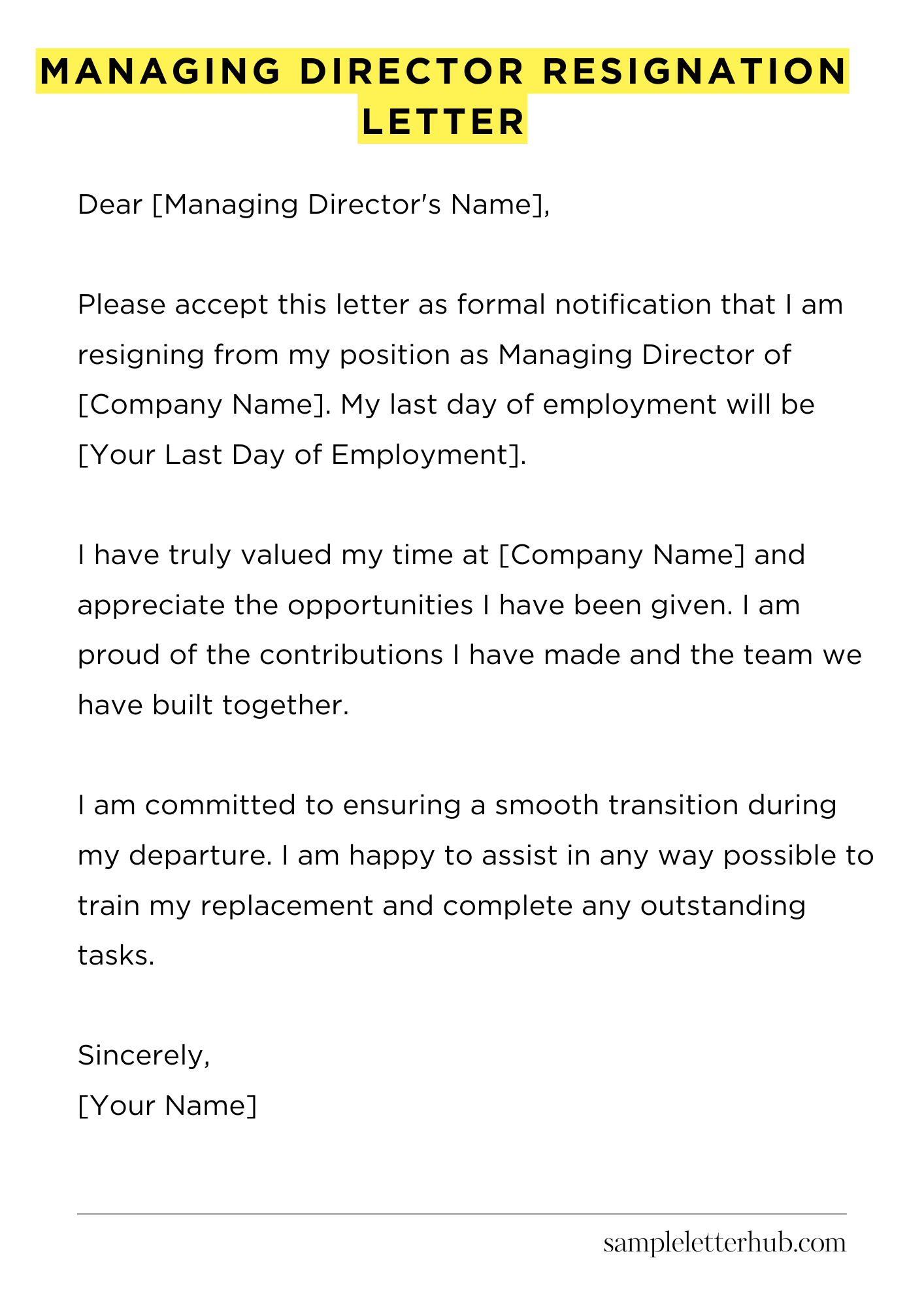
Dear [Managing Director’s Name],
Please accept this letter as formal notification that I am resigning from my position as Managing Director of [Company Name]. My last day of employment will be [Your Last Day of Employment].
I have truly valued my time at [Company Name] and appreciate the opportunities I have been given. I am proud of the contributions I have made and the team we have built together.
I am committed to ensuring a smooth transition during my departure. I am happy to assist in any way possible to train my replacement and complete any outstanding tasks. Please let me know how I can be of assistance during this period.
I wish you and the company continued success in the future.
Sincerely,
[Your Name]
How to Write a Managing Director Resignation Letter
1. Preparation is Key: Before You Put Pen to Paper (or Fingers to Keyboard)
Resigning from a Managing Director position is a big deal. You are likely stepping down from a leadership role. Before you even think about drafting your resignation letter, take a moment to consider a few things. First, carefully review your employment contract. Understand the specifics surrounding your departure.
This includes the required notice period and any potential clauses about non-compete agreements or confidentiality. Next, make sure you’ve discussed your intentions, if possible, with the relevant people. A heads-up, even a brief one, can smooth the transition.
Think about the reasons for your departure. Be clear in your own mind why you’re leaving. This will help you articulate your reasons professionally in your letter. Finally, have a plan for the handover process. This will help you transition smoothly.
2. Structure Matters: Crafting a Clear and Concise Letter
A well-structured resignation letter is essential. Start with a formal salutation, addressing the appropriate person, usually the Chairman or Board of Directors.
Then, clearly state your intention to resign from your role as Managing Director. This should be direct and unambiguous. Immediately follow that up by indicating your last day of employment. This allows the company time to find a replacement.
The body of your letter should be divided into sections, clearly presented and organized. Keep it concise.
3. Content Counts: What to Include and How to Say It
The content is where your message truly takes shape. First, express your gratitude for the opportunity to have served as Managing Director. Highlight any positive experiences or accomplishments during your tenure. This demonstrates professionalism. Then, briefly, and professionally, state your reason for leaving.
Avoid any negativity or blame. Instead, focus on your future plans or broader professional objectives. Include an offer to assist with the transition. This is crucial for maintaining a positive relationship.
Be specific about what you’re willing to do, such as training your replacement or completing any unfinished tasks. Conclude your letter with a polite closing and your signature.
4. Keeping it Professional: Dos and Don’ts of Resignation
Professionalism is paramount. Here are some critical points. DO keep your tone positive and respectful, even if you’re unhappy. DO proofread your letter meticulously for any grammatical errors or typos. DO maintain confidentiality regarding your reasons for leaving.
DON’T burn bridges. Avoid making disparaging remarks about the company or its employees. DON’T share confidential information. DON’T expect your resignation to be immediately accepted without discussion.
5. After the Letter: The Follow-Up and the Transition
Once you’ve submitted your letter, be prepared for a response. The company may want to discuss your resignation in further detail. Be ready to answer any questions or concerns. Your willingness to engage constructively will leave a lasting positive impression. After the acceptance of your resignation, focus on facilitating a smooth transition.
This includes transferring knowledge, handing over responsibilities, and assisting with the training of your successor. A professional and helpful departure will enhance your reputation. Leaving on good terms can open doors for future collaborations or professional opportunities down the road.
FAQs about Managing Director resignation letter
How much notice should a Managing Director give when resigning?
The notice period for a Managing Director’s resignation typically depends on their employment contract. This period can vary significantly, ranging from a few months to a year, and is determined by the specific terms agreed upon.
It’s crucial to carefully review the employment contract to ascertain the legally binding notice period. Additionally, any company policies on resignation will apply.
What are the essential elements to include in a Managing Director resignation letter?
A Managing Director’s resignation letter should include: a formal statement of resignation, the effective date of resignation, a brief statement of the reason for leaving (optional but often included), expressions of gratitude for the opportunity to serve, a handover plan description, and acknowledgment of any outstanding obligations.
Contact details for future correspondence may also be included, and it is usually addressed to the Board of Directors or the Chairman.
Should a Managing Director explain the reasons for leaving in the resignation letter?
While not mandatory, a brief explanation for resigning can be beneficial. It allows the company to understand the reasons and potentially address underlying issues. However, the level of detail is at the discretion of the resigning Managing Director.
It’s often advisable to keep the explanation concise and professional, and avoid negativity, ensuring clarity and maintaining a positive tone to protect professional reputation. Sometimes, more detailed feedback can be provided in a separate exit interview.
What are the legal considerations for a Managing Director resigning?
Legal considerations encompass several aspects. First, ensure compliance with the employment contract and applicable labor laws regarding notice periods and termination clauses. Second, review any restrictive covenants, such as non-compete agreements, and ensure adherence to these terms to avoid legal repercussions.
Third, a Managing Director should also address any potential conflicts of interest and seek legal counsel if necessary to navigate complex legal situations.
How should a Managing Director prepare for the handover process?
Preparing for the handover process involves several key steps. The Managing Director should meticulously document their current responsibilities and ongoing projects. They should then identify and train a successor or a team member.
They should also create a comprehensive handover plan that includes key contacts, current projects, ongoing strategic initiatives and any relevant documents. Finally, they should collaborate with the company to ensure a smooth transition, facilitating meetings, and providing support to the incoming management to minimise disruption.
Related:
Resignation letter due to rude boss
Resignation letter moving to another state
Resignation letter due to illness of family member
Resignation letter due to study