

A management resignation letter is a formal document. It is written by a manager to announce their departure. The main purpose is to officially inform the employer of the resignation. It also outlines the last day of employment.
Leaving a management role requires a well-crafted letter. This article will help you. We have prepared several templates for you. They will guide you through the process.
You will find a range of examples. They cover different situations and styles. Use these samples to create your own effective resignation letter. Writing a letter just became easier.
Management Resignation Letter
Below is a sample of a Management Resignation Letter:
[Your Name]
[Your Address]
[Your Phone Number]
[Your Email Address]
[Date]
[Recipient’s Name]
[Recipient’s Title]
[Company Name]
[Company Address]
Dear [Recipient’s Name],
Please accept this letter as formal notification that I am resigning from my position as [Your Job Title] at [Company Name]. My last day of employment will be [Your Last Day of Employment].
I have truly valued my time here and appreciate the opportunities I have been given during my employment. I have learned a great deal and am grateful for the experiences.
I am committed to ensuring a smooth transition during my departure. I am happy to assist in training my replacement and completing any outstanding tasks. Please let me know how I can be of assistance.
I wish you and the company all the best in the future.
Sincerely,
[Your Signature]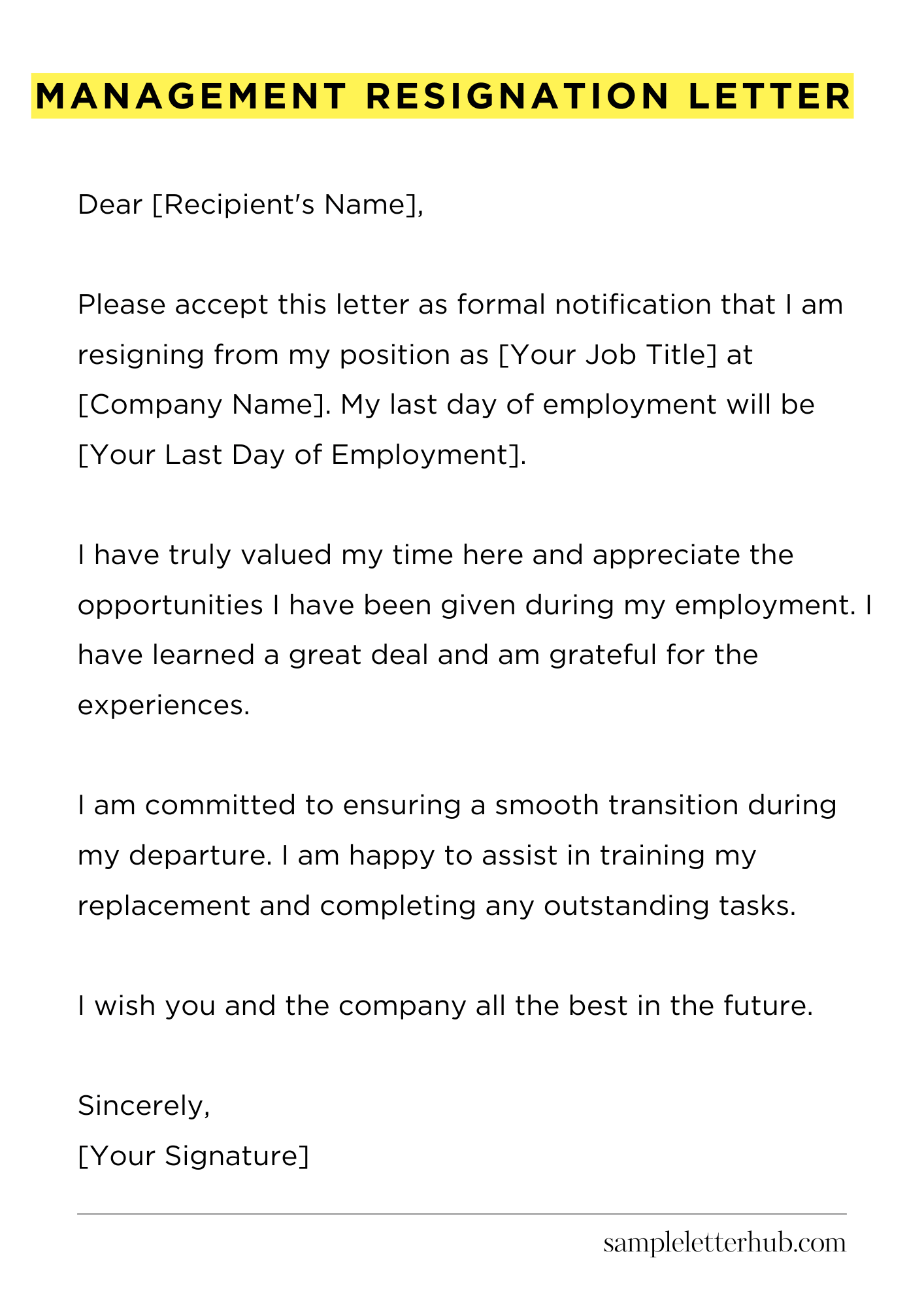
How to Write a Management Resignation Letter
1. Preparation is Key: Before You Put Pen to Paper (or Fingers to Keyboard)
So, you’re ready to move on. That’s a big step! But before you draft your resignation letter, take a moment. Ensure this is truly the right decision. Think through your reasons for leaving. What are your goals? Have you considered all the angles? Make sure you understand your company’s policy on resignations.
Do you need to give a specific amount of notice? Knowing this beforehand is crucial. This will influence the content of your letter and your overall approach.
2. Crafting the Core: The Essential Elements of Your Letter
Now, let’s get down to the writing. A management resignation letter should be professional and straightforward. First, state your intent clearly. Use direct language. Specify the date you are resigning.
This is non-negotiable! Next, briefly state your position and the company name. You don’t need a long, drawn-out introduction. Keep it concise. Then, provide a simple statement of resignation.
Include your effective date of resignation. This is the date you officially leave the company. Adhere to the notice period outlined in your employment agreement or company policy. Show gratitude. Thank your employer for the opportunities you’ve been given. Acknowledge the experience and skills you’ve gained. This adds a touch of professionalism and goodwill.
3. Detail and Delivery: What to Include (and What to Avoid)
While you should keep the letter brief, think about offering assistance during the transition. Offer to help train your replacement, complete any ongoing projects, or provide documentation.
This demonstrates your commitment to a smooth handover. But here’s an important tip: Avoid negativity. Refrain from criticizing your employer or colleagues. Steer clear of any lengthy explanations of your reasons for leaving. Remember, this is a professional communication. Keep it positive.
Once you have finished, proofread meticulously. Errors can undermine your professionalism. Check for grammar mistakes and typos. Have someone else review it as well.
Your letter will be read by your superiors; take the time to do it correctly. When you’re happy with it, choose the delivery method appropriate for your company. Typically, this is through email, or a physical letter delivered to your manager.
4. Keeping it Concise: Examples and Structure
Here’s a simplified structure you can adapt. Start with a formal salutation (e.g., “Dear [Manager’s Name],”). Then, state your intention to resign, your position, and the company. Include your effective date. Express your gratitude for the opportunity. Offer assistance with the transition. Finish with a professional closing (e.g., “Sincerely,” or “Regards,”). Sign your name. It’s that simple!
Here is an example structure:
- Salutation: Dear [Manager’s Name],
- Statement of Resignation: I am writing to inform you of my resignation from my position as [Your Position] at [Company Name].
- Effective Date: My last day of employment will be [Date].
- Gratitude: Thank you for the opportunities I have been given at [Company Name].
- Offer of Assistance: I am available to assist with the transition.
- Closing: Sincerely,
5. After the Letter: Wrapping Up and Moving Forward
Once you’ve submitted your letter, prepare for the next steps. Be prepared for a conversation with your manager. Be polite, professional, and ready to answer any questions. You might need to meet with HR to finalize paperwork, such as your exit interview. Remain professional throughout this process.
It’s also wise to organize your files and documentation. Make sure to back up any personal files if that is needed. Be sure that everything that belongs to the company is returned.
Remember, you’re leaving a role, not burning a bridge. Keeping a positive attitude will help you maintain a good relationship with your former employer. Focus on your future, but remember to leave on a positive note. Congratulations, and good luck with your next endeavor!
FAQs about Management Resignation Letter
What is the primary purpose of a management resignation letter?
The primary purpose of a management resignation letter is to formally notify an employer of an employee’s intent to leave their management position.
It serves as a written record, outlining the employee’s departure date and often provides a reason for leaving, although this isn’t always mandatory. It facilitates a smooth transition and ensures all parties are aware of the change in employment status.
What key elements should be included in a management resignation letter?
A well-crafted management resignation letter should include: a clear and concise statement of resignation, the effective date of departure, a formal acknowledgment of the position held, and a brief and professional expression of gratitude or a reason for leaving. It should also include contact information and a signature for formal confirmation.
How much notice should a management employee give when resigning?
The amount of notice required varies depending on the employment contract, company policy, and local laws. However, a general rule of thumb is to provide at least two weeks’ notice. For management positions, a longer notice period, such as a month or more, is often considered professional to allow ample time for transition and handover of responsibilities.
Can I include the reason for my resignation in the letter?
While not mandatory, including a reason for your resignation is often done. This can be as simple as stating “to pursue other opportunities,” or you can be more specific, depending on your comfort level.
If you are comfortable, you may list the reasons to better understand and manage your concerns. Keep it professional and concise. If the circumstances are more delicate, you can opt to state that you have personal reasons for leaving.
How should I handle the handover of my responsibilities as a manager?
As a manager, you have a responsibility to ensure a smooth transition. This involves clearly communicating your departure to your team, identifying and training a replacement if possible, compiling comprehensive documentation of your ongoing projects and duties, and assisting with the handover process. This demonstrates professionalism and ensures minimal disruption to the workplace.
Related:
Resignation letter due to rude boss
Resignation letter moving to another state
Resignation letter due to illness of family member
Resignation letter due to study