

A Management Associate resignation letter is a formal document. It informs your employer of your intention to leave your role. The purpose is to officially announce your departure. It should also state your last working day.
Writing this letter can seem daunting. It doesn’t have to be. We are here to help. We’ll provide you with various templates. Examples will also be available.
Our aim is to simplify the process. Use the provided samples. Adapt them to fit your specific needs. Say goodbye to guesswork. Say hello to a professional resignation.
Management Associate Resignation Letter
Below is a sample of a Management Associate Resignation Letter:
[Your Name]
[Your Address]
[Your Phone Number]
[Your Email Address]
[Date]
[Hiring Manager Name] (If known, otherwise use title)
[Hiring Manager Title]
[Company Name]
[Company Address]
Dear [Mr./Ms./Mx. Last Name or Hiring Manager],
Please accept this letter as formal notification that I am resigning from my position as Management Associate at [Company Name]. My last day of employment will be [Your Last Day of Employment].
I would like to thank you for the opportunity to work at [Company Name]. I have learned a great deal during my time here.
I am committed to ensuring a smooth transition during my departure. I am happy to assist in training my replacement and completing any outstanding tasks to the best of my ability.
I wish the company continued success in the future.
Sincerely,
[Your Signature]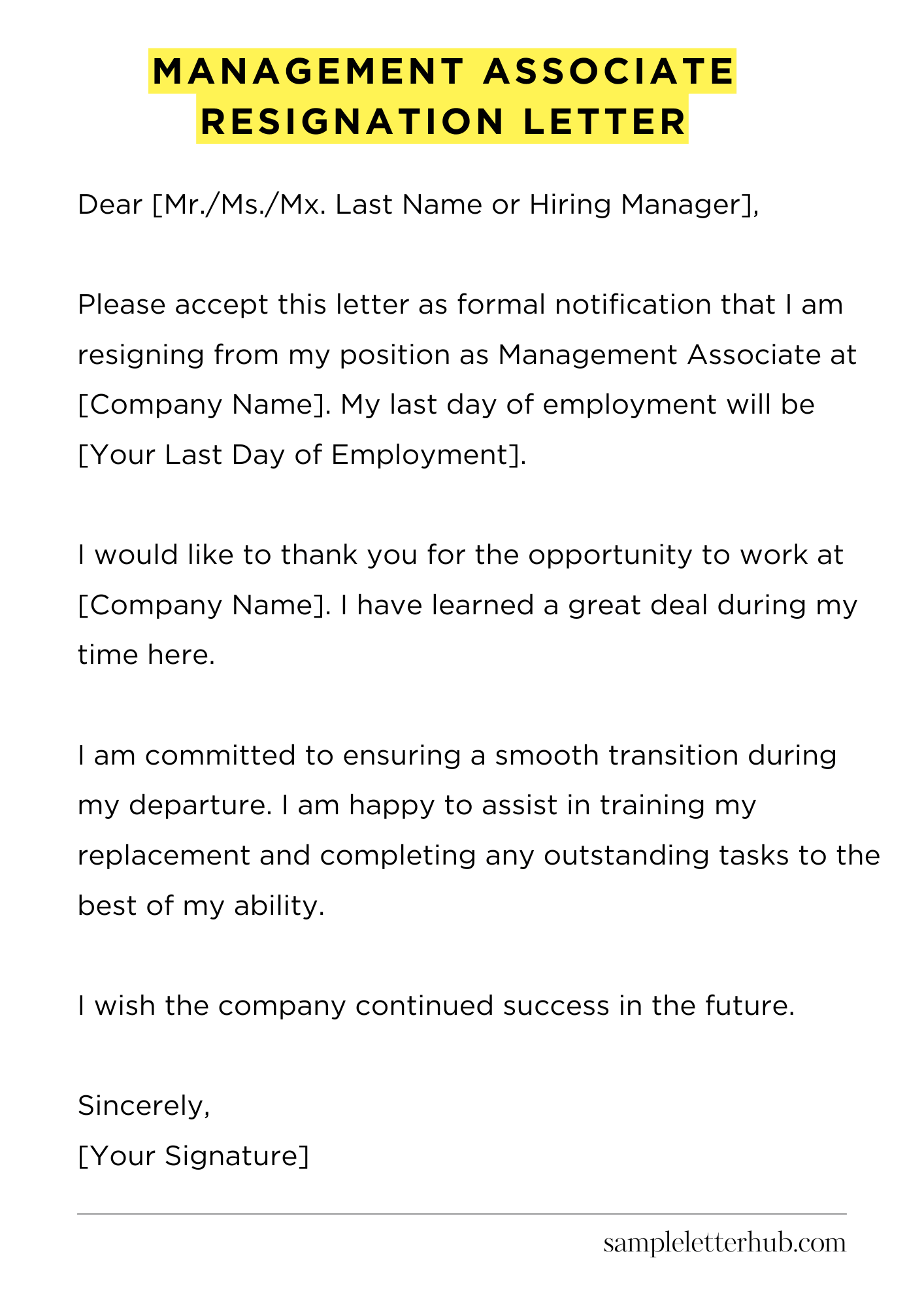
How to Write a Management Associate Resignation Letter
Leaving a job, especially as a Management Associate, requires a careful approach. You want to maintain a professional relationship with your employer. This is incredibly important. You may need them as a reference in the future.
Step 1: Planning and Preparation
Before you even begin typing, think things through. Consider your last day of employment. Make sure you know when your last working day will be. Review your employment contract or company handbook, if necessary. This will clarify any specific requirements for resignation.
Next, it’s about having a clear plan. Decide why you are leaving. Are you taking on another role? Maybe you have a personal reason? You don’t need to give extensive details, but it’s important to be clear.
Step 2: Crafting Your Letter: The Essentials
Your resignation letter should be concise. It needs to include essential information only. Start with your full name and current job title. State your clear intention to resign. The date of your last working day is very important too. Be very clear.
Keep your language professional. Avoid negative comments about your experience, or the employer. This is not the time or place to air grievances. Keep it simple.
Step 3: Expressing Gratitude and Providing Assistance
A touch of appreciation goes a long way. Thank your employer for the opportunity. Briefly mention any specific experiences or skills you gained during your time there. This shows professionalism. It also highlights the positives.
Offer assistance during the transition period. Are you willing to help train your replacement? Perhaps you can create a handover document. This shows you’re committed to ensuring a smooth departure.
Step 4: Structuring Your Letter
Begin with a formal salutation, like “Dear [Manager’s Name]”. Use a professional and easy-to-read font. The body of your letter should be 3-4 paragraphs. This allows you to include everything. Keep it easy to follow.
Close with a professional closing. “Sincerely,” or “Regards,” are good options. Add your typed name and then your signature.
Step 5: Review and Submission
Carefully proofread your letter. Check for grammar errors and typos. Read it aloud to ensure it flows smoothly. Make sure the tone is appropriate.
Print a hard copy for your records. If your company allows, you can submit the letter electronically. Hand the original to your manager. This is best practice. It shows respect and professionalism.
FAQs about Management Associate resignation letter
How do I start a Management Associate resignation letter?
Begin your letter with a formal salutation (e.g., “Dear [Manager’s Name]”), clearly state your intention to resign from your position as a Management Associate, and specify your last day of employment. Keep it concise and professional.
What key information should be included in a Management Associate resignation letter?
The letter should include your formal resignation, your last day of employment, a brief expression of gratitude for the opportunity to have worked in the company as a Management Associate, and a professional closing (e.g., “Sincerely”). Consider also including an offer to assist with the transition.
How should I phrase my reason for leaving in a Management Associate resignation letter?
While you are not obligated to provide detailed reasons, you can briefly and positively state your reason for leaving. Examples include “pursuing other opportunities,” “seeking a new challenge,” or “relocating.” Keep the tone neutral and professional. You can also simply state that it is for “personal reasons.”
Should I offer to help with the transition in my Management Associate resignation letter?
Offering to assist with the transition is generally a good practice. This demonstrates professionalism and a willingness to ensure a smooth handover of your responsibilities. You can state something along the lines of, “I am happy to assist in any way possible to ensure a seamless transition.”
What is the proper format and tone for a Management Associate resignation letter?
The format should be a formal business letter. Use a professional and respectful tone throughout the letter. Avoid negative comments or complaints. Proofread carefully for any errors in grammar and spelling before sending your letter to your manager. Ensure the tone is polite, appreciative, and forward-looking.
Related:
Resignation letter due to rude boss
Resignation letter moving to another state
Resignation letter due to illness of family member
Resignation letter due to study