

A Management Assistant resignation letter is a formal document. It informs your employer of your intention to leave your job. The letter officially marks the end of your employment. It is a crucial step in the resignation process.
Need to draft your own? We have you covered. This article offers several letter templates. These will help you compose your Management Assistant resignation letter. We provide different examples. These examples will assist in various situations.
We aim to make your letter writing easy. Choose the example that best suits you. Personalize it with your specific details. You’ll be ready to submit your resignation in no time.
Management Assistant Resignation Letter
Below is a sample of a Management Assistant Resignation Letter:
[Your Name]
[Your Address]
[Your Phone Number]
[Your Email Address]
[Date]
[Manager’s Name]
[Manager’s Title]
[Company Name]
[Company Address]
Dear [Manager’s Name],
Please accept this letter as formal notification that I am resigning from my position as Management Assistant at [Company Name]. My last day of employment will be [Your Last Day of Employment].
I would like to thank you for the opportunity to work here. I have learned a great deal and appreciate the experiences I have gained during my time in this role.
I am committed to ensuring a smooth transition during my departure. I am happy to assist in training my replacement and completing any outstanding tasks to the best of my ability.
I wish you and the company all the best in the future.
Sincerely,
[Your Signature]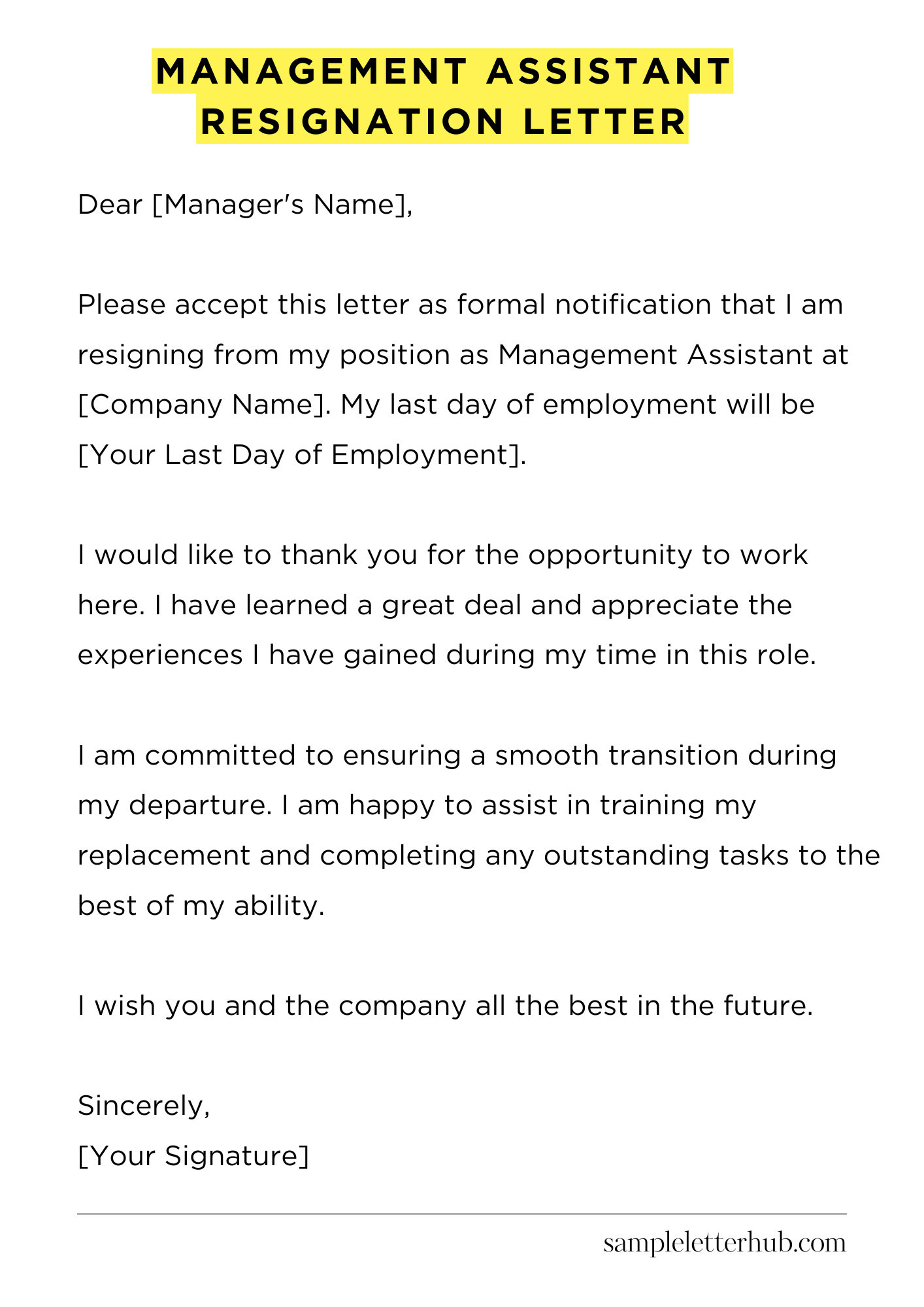
How to Write a Management Assistant Resignation Letter
Getting Started: Your Basics
Resigning from a job can be a big step. Especially when you’ve been working as a Management Assistant. You’ll want to make sure you do it right. This is especially true when it comes to the resignation letter.
This document is a formal declaration of your departure. First things first: be professional. Avoid any negativity or personal grievances. Keep the tone courteous, regardless of your reasons for leaving.
Start with a simple business letter format. Your contact information goes at the top. This includes your name, address, phone number, and email. Below that, on the left side, put the date.
Then, on the left side, add the recipient’s information. This includes your manager’s name, their title, and the company address. Always address the letter to the appropriate person, usually your direct supervisor.
Crafting the Core: The Body of Your Letter
The first paragraph is where you state your intention clearly. You want to immediately state that you are resigning from your position. Be direct and polite. Provide the effective date of your resignation. This is the last day you will be working. Make sure you align this date with your company’s policy on notice periods. This gives them time to plan for your departure.
In the following paragraphs, you can briefly express your gratitude. Acknowledge the opportunities the role has provided. Avoid going into too much detail about why you are leaving. If you feel comfortable, you *can* briefly mention the reason. This is not always necessary. If you decide to include it, keep it brief and professional.
You can also offer assistance with the transition. Offer to help train your replacement or complete ongoing projects before you leave. This demonstrates your professionalism and commitment. This creates a good impression.
Finishing Strong: The Closing and Beyond
The closing paragraph is just as important. Express your appreciation for the opportunity. Wish the company and your colleagues well in the future. Keep it simple. End with a formal closing, like “Sincerely” or “Best regards,” followed by your typed name.
Make sure you sign your name above your typed name. Then, proofread the entire letter carefully. Check for any grammatical errors or typos. Have someone else review it as well to catch anything you might have missed.
Key Elements to Include
Here’s a quick checklist to make sure your letter is complete. Include a clear statement of resignation, the date of your last day of employment, and an expression of gratitude.
Also include a mention of your availability to assist with the transition. Make sure your letter is in the correct business format, including the correct recipient information. Remember to close with a professional sign-off and your signature.
Finally, remember to keep it positive. Your letter represents you. It’s a key document. A well-written letter can leave a lasting positive impression. This can be very useful for future references.
What to Avoid
There are some things to avoid in a resignation letter. Don’t include excessive detail about your new job. Don’t engage in any negativity or criticism. This includes complaints about your manager, colleagues, or the company.
Also, avoid making demands. This isn’t the time to negotiate terms of your departure. Keep your letter brief and to the point. Most importantly, remain professional throughout. Think about what you want to achieve with the letter.
Remember that the purpose of the letter is to inform your employer of your departure. It is not an opportunity to air your grievances. Keeping these points in mind will help you write a successful resignation letter.
FAQs about Management Assistant Resignation Letter
What is the primary purpose of a Management Assistant resignation letter?
The primary purpose of a Management Assistant resignation letter is to formally notify your employer of your intention to leave your position. It serves as an official record of your departure, specifying your last day of employment and allowing for a smooth transition process. It also provides an opportunity to express gratitude and offer assistance during the handover.
What key elements should be included in a Management Assistant resignation letter?
A well-crafted Management Assistant resignation letter should include your formal announcement of resignation, the date of your last day of employment, a concise statement of your reason for leaving (optional but often included), an expression of gratitude for the opportunity to work there, any offers to assist with the transition process, and your contact information.
It should be professional, respectful, and clear.
How much notice should a Management Assistant give when resigning?
The standard notice period for a Management Assistant, similar to other professional roles, is typically two weeks. However, the specific notice period may be outlined in your employment contract or company policy. Always review your contract and company guidelines. Consider the complexity of your role and any ongoing projects.
Can a Management Assistant’s resignation letter be brief or does it need to be extensive?
A Management Assistant’s resignation letter should be concise and to the point. While brevity is valued, it’s essential to include all the necessary information, such as the effective date of resignation, and to maintain a professional tone. Extensive explanations are usually not required, unless you wish to provide additional context. Keep it professional, not overly emotional.
What are some common mistakes to avoid in a Management Assistant resignation letter?
Common mistakes to avoid include being overly negative or critical of the company or colleagues, not providing adequate notice, neglecting to proofread for errors, failing to express gratitude (if applicable), and including information that is irrelevant or overly personal. Ensure your letter remains professional and focuses on your departure and the handover process.
Related:
Resignation letter due to rude boss
Resignation letter moving to another state
Resignation letter due to illness of family member
Resignation letter due to study