

A “Management Analyst resignation letter” is a formal document. It informs your employer of your decision to leave your job. The letter officially states your last day of employment. It’s a crucial step in ending your employment professionally.
Preparing this letter can be daunting. You want to be clear and concise. You also want to maintain a positive tone. This article offers helpful resources. We’ll share several templates and examples.
These samples provide a solid foundation. You can customize them to fit your situation. This will help you craft your own effective resignation letter. Writing the letter will become easier.
Management Analyst Resignation Letter
Below is a sample of a Management Analyst Resignation Letter:
[Your Name]
[Your Address]
[Your Phone Number]
[Your Email Address]
[Date]
[Hiring Manager Name] (If known, otherwise use title)
[Hiring Manager Title]
[Company Name]
[Company Address]
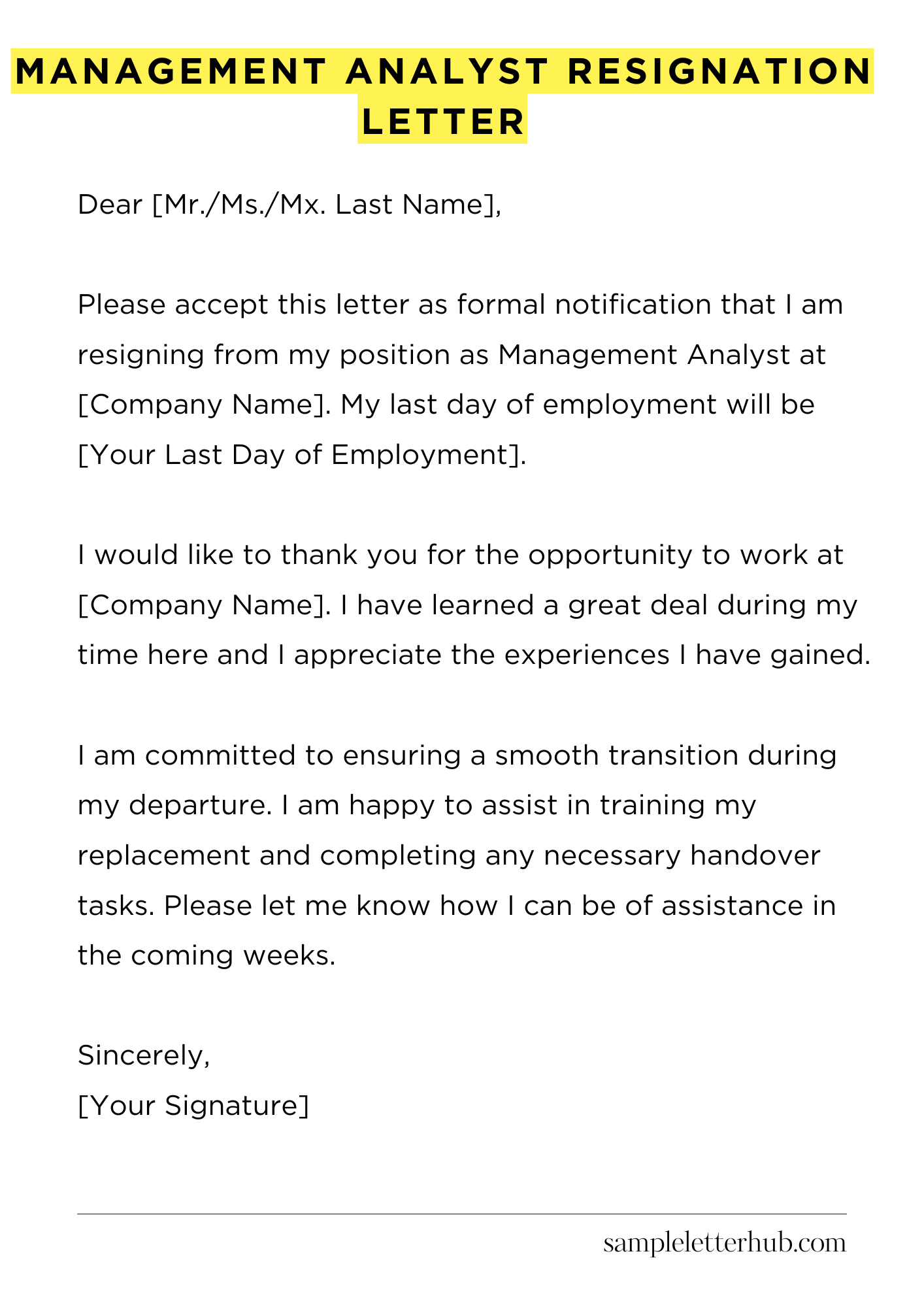
Dear [Mr./Ms./Mx. Last Name],
Please accept this letter as formal notification that I am resigning from my position as Management Analyst at [Company Name]. My last day of employment will be [Your Last Day of Employment].
I would like to thank you for the opportunity to work at [Company Name]. I have learned a great deal during my time here and I appreciate the experiences I have gained.
I am committed to ensuring a smooth transition during my departure. I am happy to assist in training my replacement and completing any necessary handover tasks. Please let me know how I can be of assistance in the coming weeks.
I wish you and [Company Name] all the best in the future.
Sincerely,
[Your Signature]
How to Write a Management Analyst Resignation Letter
1. Getting Started: The Basics You Can’t Miss
So, you’ve made the decision to move on. Congratulations! Now it’s time to put your intentions on paper – or rather, in a digital document. Writing a management analyst resignation letter might feel like a formality, but it’s a crucial step. This letter serves several important purposes.
Firstly, it formally informs your employer of your departure. Secondly, it helps to ensure a smooth transition. Lastly, it leaves a lasting impression, hopefully a positive one. Get this right, and you’re off to a great start. Make sure your tone is professional. Always be respectful, even if your experience hasn’t been perfect.
2. Structure is Key: Crafting the Perfect Framework
Let’s break down the essential components. A well-structured letter is much easier to read and understand. Start with the date and your contact information. Next, address the letter to your direct supervisor or the appropriate HR representative.
Then, clearly state your intention to resign and the effective date of your resignation. Be specific about your last day of employment. Use a concise and direct approach. Keep it short and sweet. Next, express your gratitude for the opportunity. This shows professionalism.
Then, you can briefly mention your willingness to assist with the transition. Include a sentence about handing over your responsibilities. Finally, close with a polite and professional sign-off, such as “Sincerely” or “Best Regards.”
3. Content Matters: What to Say and What to Avoid
Now, let’s look at the actual content of your letter. Begin by clearly stating your resignation, and provide the effective date. Don’t leave any room for ambiguity. Briefly express your gratitude for the opportunity to work there. Perhaps, you can mention some of the specific skills or experience you gained. Keep it brief.
Then, offer to help with the transition. Offer to train new team members and assist in any way you can to ensure a smooth handover of your duties. This is a very important part. Avoid negative comments or complaints about your job or employer.
This is not the time to air grievances. Stick to positive and neutral language. Keep your resignation letter professional.
4. The Tone of Voice: Professionalism is the Goal
The tone of your letter is critical. It sets the tone for your departure. Maintain a professional and respectful tone throughout the letter. Avoid any negative language. Stay away from gossip. Steer clear of any potentially offensive comments. Be polite and courteous.
Even if you haven’t always seen eye-to-eye with your employer or colleagues, keep your letter civil. Your goal is to leave on good terms.
A positive, professional letter can leave a better impression. This could be beneficial for future references. It helps to build your reputation. Proofread and edit it before you send it! Always double-check for grammar and spelling errors.
5. The Fine Print: Review, Revise, and Submit
Before you hit send or print, take a moment to review the entire letter. Proofread it carefully. Check for any errors in grammar or spelling. Ensure your contact information is correct. Does the letter reflect your intention? Make sure it’s clear and concise. Ask a friend or colleague to review it if possible.
Having a second pair of eyes can be very helpful. Once you’re confident that your letter is perfect, submit it according to your company’s policy. Generally, this means handing it in to your manager or HR department.
Following these steps will help you create a professional and effective resignation letter, setting you up for a smooth transition. Good luck in your next endeavor!
FAQs about Management Analyst Resignation Letter
What is the typical format for a Management Analyst resignation letter?
A typical resignation letter for a Management Analyst should include a formal business letter format. This generally consists of your contact information (name, address, phone number, and email) at the top, followed by the date, and then the recipient’s information (name, title, and company address).
The body of the letter should state your intention to resign, your last day of employment, and a brief expression of gratitude for the opportunity. It’s often followed by a closing such as “Sincerely” and your typed name.
What key information must be included in a Management Analyst resignation letter?
The core information that must be included is your unequivocal statement of resignation, the effective date of your resignation (your last day of employment), and your acknowledgment of the opportunity or experience.
While not required, expressing gratitude for your experience and offering assistance during the transition can be beneficial. It is important to remember to keep it professional.
Should I provide a reason for leaving in my Management Analyst resignation letter?
While not mandatory, it’s generally acceptable to briefly state your reason for leaving, especially if it’s for a positive opportunity like a new job or personal development. However, avoid going into excessive detail or negativity about your current employer or colleagues.
If you’re leaving for a sensitive reason, you can keep it brief or simply state that you are pursuing other opportunities. The primary purpose is to inform your employer of your departure, not to offer an explanation.
How much notice should I give in my Management Analyst resignation letter?
The standard notice period is typically two weeks. However, this may vary based on your employment contract, company policy, or industry practice. Always check your employment agreement or employee handbook to confirm the required notice period.
Providing more notice, if possible, can be viewed favorably, especially if you’re in a critical role and can assist with the transition. However, always abide by any written agreements.
What should I do after submitting my Management Analyst resignation letter?
After submitting your resignation letter, inform your colleagues. Follow up with your manager to discuss the handover process and your responsibilities during your remaining time. Cooperate with any requests for information, and ensure you complete any outstanding tasks.
Be proactive in helping with the transition, such as documenting your processes or training a replacement. Maintain a professional demeanor until your last day of employment, even if there are personal differences.
Related:
Resignation letter due to rude boss
Resignation letter moving to another state
Resignation letter due to illness of family member
Resignation letter due to study