

A “Management Accountant resignation letter” is a formal document. It informs your employer of your decision to leave your job. Its primary purpose is to officially end your employment. It also helps to maintain a professional relationship with your company.
Are you a Management Accountant planning your next move? Do you need to resign from your current role? We understand the process can be tricky. This article has you covered. We’ll share various templates and examples.
These examples are designed to make it easy. We provide different scenarios and formats. They will help you craft your perfect resignation letter. Choose the one that suits your needs.
Management Accountant Resignation Letter
Below is a sample of a Management Accountant Resignation Letter:
[Your Name]
[Your Address]
[Your Phone Number]
[Your Email Address]
[Date]
[Employer’s Name]
[Company Name]
[Company Address]
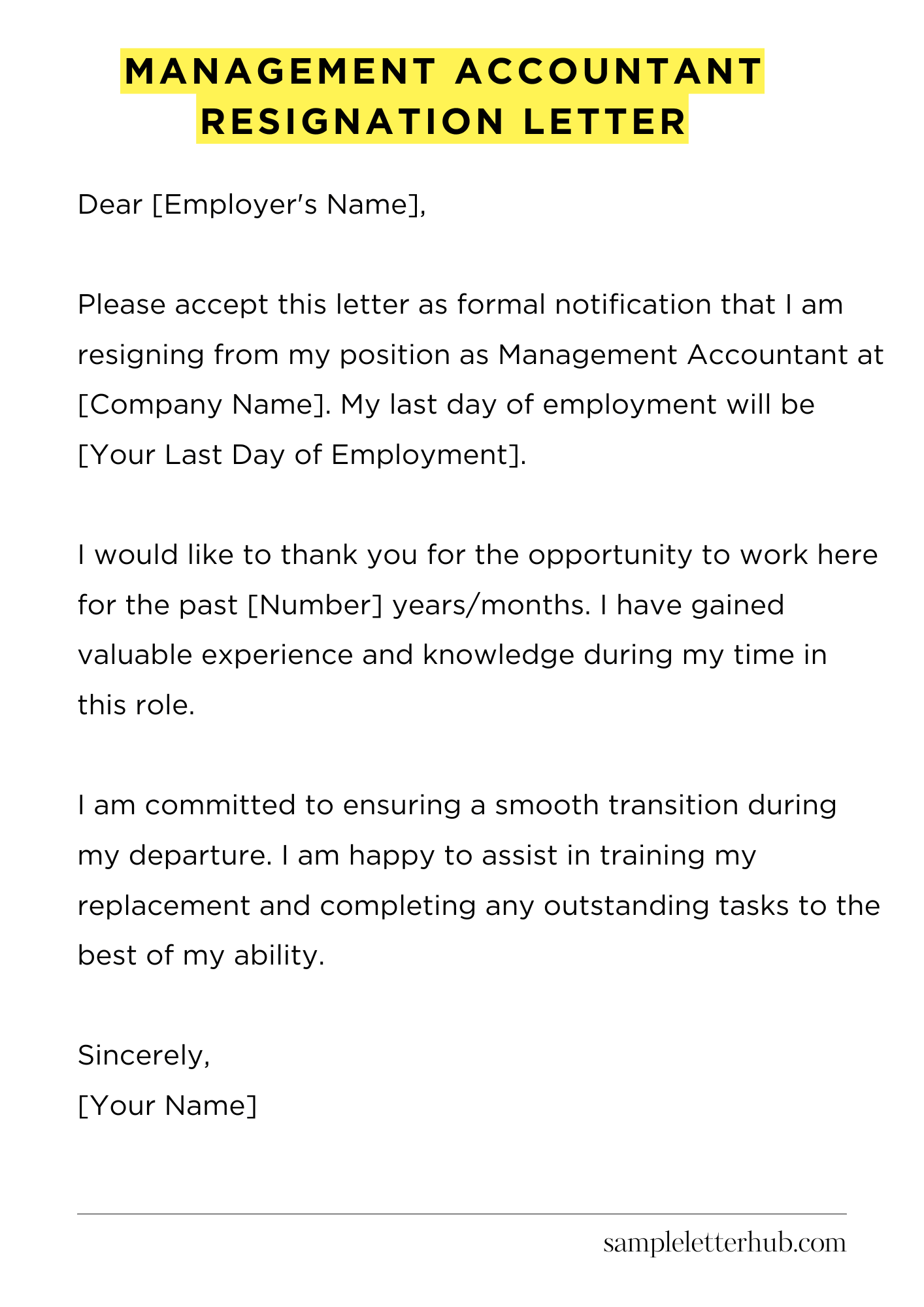
Dear [Employer’s Name],
Please accept this letter as formal notification that I am resigning from my position as Management Accountant at [Company Name]. My last day of employment will be [Your Last Day of Employment].
I would like to thank you for the opportunity to work here for the past [Number] years/months. I have gained valuable experience and knowledge during my time in this role.
I am committed to ensuring a smooth transition during my departure. I am happy to assist in training my replacement and completing any outstanding tasks to the best of my ability.
I wish you and [Company Name] all the best in the future.
Sincerely,
[Your Name]
How to Write a Management Accountant Resignation Letter
So, you’re moving on! Congratulations on the next chapter. If you are a Management Accountant and you’ve decided it’s time to leave your current role, a well-crafted resignation letter is a must.
This document is more than just a formality; it’s a professional courtesy and a crucial step in ensuring a smooth transition. It also protects your reputation. Let’s explore how to write a resignation letter that effectively communicates your intentions and leaves a positive lasting impression.
1. Get Started: The Essentials
Your letter should be concise and to the point. Start with the basics: your name, the date, and the recipient’s name and title. Clearly state your intention to resign from your position as Management Accountant.
Simple. Include the date your resignation will be effective. Ensure this aligns with your employment agreement, typically providing a notice period. Keep it professional and avoid any unnecessary jargon.
For example:
“Dear [Manager’s Name],
Please accept this letter as formal notification that I am resigning from my position as Management Accountant at [Company Name]. My last day of employment will be [Date]. ”
2. Show Gratitude (Yes, Really!)
Even if your reasons for leaving are less than ideal, expressing gratitude is always a good idea. Acknowledge the opportunities you’ve had during your time with the company. This shows class and professionalism. Reflect on any positive experiences or skills you’ve gained.
This creates a more positive tone and leaves a good impression. Mentioning a specific instance where you learned something can be powerful.
For example:
“I am grateful for the opportunities I’ve been given during my time here at [Company Name]. I have particularly valued my experience [mention a specific project or achievement].”
3. Be Brief, But Be Clear About the Handover
Resist the urge to over-explain your reasons for leaving. It’s often unnecessary and can complicate things. However, mentioning your willingness to assist with the handover process is vital. This demonstrates responsibility and a commitment to a smooth transition.
Offer to help train your replacement, complete outstanding tasks, or provide any necessary documentation. This proactive approach will be remembered.
For example:
“I am committed to ensuring a smooth transition during my departure. I am happy to assist in training my replacement and completing any outstanding tasks to the best of my ability.”
4. Keep it Positive (Even if You’re Not Feeling it)
Even if you’re leaving for a better opportunity, or perhaps because of issues within the company, keep the tone of your letter positive and professional.
Avoid negativity, complaints, or criticisms of your employer, colleagues, or the company itself. This can burn bridges and potentially impact future opportunities. Stick to neutral statements and maintain a professional demeanor throughout your letter.
Focus on your own growth and new opportunities. This reflects well on you. The goal is to leave on good terms, not to air grievances.
5. Final Touches: Proofread and Sign
Before submitting your resignation letter, meticulously proofread it for any spelling or grammatical errors. A polished, error-free letter reflects your attention to detail and professionalism. Ensure you include your full name and job title. Sign the letter, either physically or electronically, depending on your company’s policy. Make a copy for your records. This is just good practice.
By following these steps, you can craft a resignation letter that reflects well on you, protects your professional reputation, and sets the stage for a positive future. Good luck in your next endeavor!
FAQs about Management Accountant Resignation Letter
What essential information should a Management Accountant include in their resignation letter?
A Management Accountant’s resignation letter should contain the following essential information: a clear and concise statement of resignation, the effective date of resignation, a brief expression of gratitude for the opportunity, and any necessary information regarding the handover of responsibilities.
It’s also advisable to include contact information for future correspondence. The letter should be professional and polite, regardless of the reasons for leaving.
What is the recommended format and tone for a Management Accountant’s resignation letter?
The recommended format is a formal business letter. The tone should be professional, respectful, and positive, even if the departure is due to negative circumstances.
Avoid negativity or overly emotional language. Keep the letter concise and to the point. Consider using a standard business letter format with a salutation, body paragraphs, and a closing. Ensure proper grammar, spelling, and punctuation.
How much notice should a Management Accountant give when resigning?
The standard notice period for a Management Accountant typically aligns with their employment contract or local labor laws. Often, this is two to four weeks. Always review your employment contract for the specific requirements. If the contract doesn’t specify a notice period, it’s generally best to provide at least two weeks’ notice to allow for a smooth transition and handover of duties.
What should a Management Accountant include regarding the handover of responsibilities in their resignation letter?
In the resignation letter, a Management Accountant should express their willingness to assist with the transition process. They can offer to train a replacement or provide documentation to facilitate the handover.
They can briefly outline the major tasks they are responsible for and how they plan to ensure a smooth transition of duties. Detailing specific handover plans in the letter is less common; instead, focus on your commitment to assisting in the handover.
Should a Management Accountant explain the reason for their resignation in the letter?
It’s generally not necessary to provide an extensive explanation for the reason for resignation in the letter. A brief and professional statement, such as “pursuing other opportunities,” is usually sufficient. Avoid going into excessive detail about any dissatisfaction.
However, you might want to consider explaining the reasons to your manager directly, in a separate conversation, and providing more details if requested by your employer.
Related:
Resignation letter due to rude boss
Resignation letter moving to another state
Resignation letter due to illness of family member
Resignation letter due to study