

Losing something valuable is frustrating. A lost item insurance claim letter is your official way to get compensation. It tells your insurance company about the missing item. The purpose is to start the claims process. You are asking for reimbursement.
This article is your guide. We will share lost item insurance claim letter templates. We also provide examples and samples. Use these lost item claim letter samples to easily create your own. It makes the process much simpler. Writing these letters can be stressful, but no more!
Want to get started on your insurance claim? We’ve got you covered. This article will help you create a compelling and effective claim letter for lost item. Say goodbye to confusion. Our samples will assist in writing an impressive letter.
[Your Name]
[Your Address]
[Your Phone Number]
[Your Email Address]
[Date]
[Insurance Company Name]
[Insurance Company Address]
Subject: Insurance Claim for Lost Item – [Policy Number]
Dear Sir/Madam,
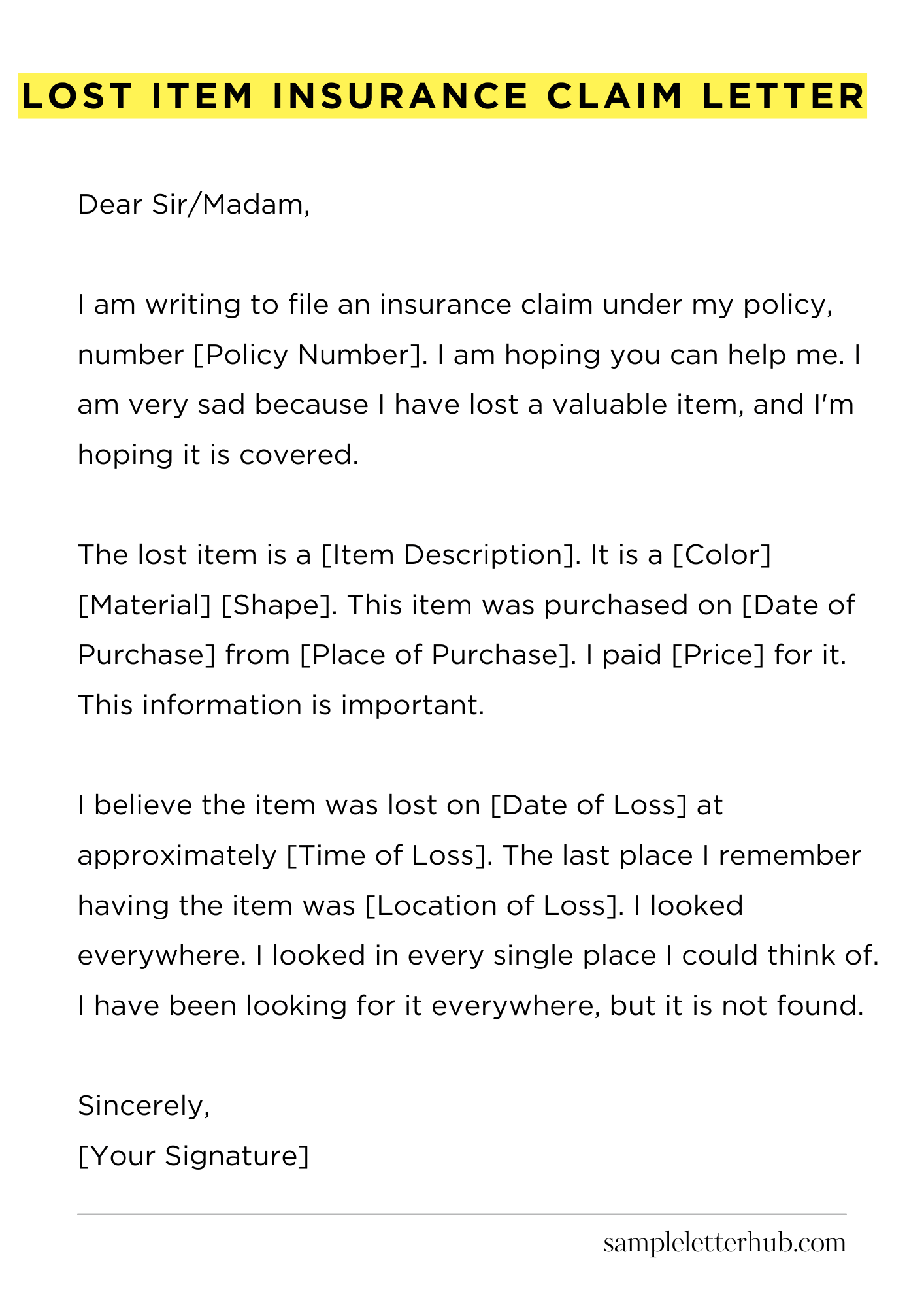
I am writing to file an insurance claim under my policy, number [Policy Number]. I am hoping you can help me. I am very sad because I have lost a valuable item, and I’m hoping it is covered.
The lost item is a [Item Description]. It is a [Color] [Material] [Shape]. This item was purchased on [Date of Purchase] from [Place of Purchase]. I paid [Price] for it. This information is important.
I believe the item was lost on [Date of Loss] at approximately [Time of Loss]. The last place I remember having the item was [Location of Loss]. I looked everywhere. I looked in every single place I could think of. I have been looking for it everywhere, but it is not found.
I have attached copies of the following documents to support my claim: [List of Documents Attached, e.g., Proof of Purchase, Photos, Police Report if applicable]. These documents will help clarify the claim.
The estimated value of the lost item is [Estimated Value]. I hope that you can help me recover this value. I would appreciate it if you would consider my claim promptly.
Please let me know what further information you require. I am available to discuss this matter further at your convenience. You can reach me by phone, or email.
Thank you for your time and consideration.
Sincerely,
[Your Signature]
How to Write Lost Item Insurance Claim Letter
Losing a valuable item is a distressing experience. Reclaiming its value through insurance requires a well-crafted lost item insurance claim letter. This guide will help you navigate the process. Follow these steps to maximize your chances of a successful claim.
1. Commence with a Cogent Header
Your letter’s commencement sets the tone. Use a formal, business-like salutation. Include your full name, address, phone number, and email address at the top. Underneath, provide the date, followed by the insurance company’s name and address. Clarity here is paramount; it averts any ambiguity about your identity and the recipient.
2. Subject Line: The Crucible of Clarity
The subject line is your letter’s hook. It should be concise, yet explicitly state the purpose. Something like “Insurance Claim – Lost [Item Name] – Policy Number [Your Policy Number]” works effectively. This allows the recipient to immediately understand the context of your correspondence without delving into the body of the letter.
3. The Introductory Statement: Laying the Groundwork
In the opening paragraph, introduce yourself and unequivocally state that you’re filing a claim for a lost item. Refer to your insurance policy number and the type of insurance you possess (e.g., homeowner’s, renter’s, personal articles). Briefly mention the item, setting the stage for more granular details.
4. Detail the Disappearance: Narrative Precision
The heart of your letter is the description of the item’s loss. Be as specific as possible. Describe the item in detail, including its brand, model, serial number, and any unique identifiers.
Chronicle the events leading to the loss, providing dates, times, and the location. If possible, elucidate the circumstances in which the item was last seen. The more detail you provide, the better. Substantiate all claims with evidence.
5. Present the Proof: Bolstering Your Case
This section is crucial for validating your claim. Include copies of any relevant documentation, such as purchase receipts, warranty information, appraisals, or photographs of the lost item.
If you have filed a police report, include a copy. If the item was recently purchased, a copy of the credit card statement can provide additional support. The more proof you supply, the more robust your assertion becomes.
6. The Claim’s Demands: Articulating Your Objectives
Clearly state what you are claiming. Specify the value of the lost item based on your supporting documentation (receipts, appraisals). Clearly state what you expect from the insurance company, such as reimbursement for the item’s replacement cost or its actual cash value, as dictated by your policy.
Explicitly reference your policy terms regarding claims settlement procedures.
7. The Concluding Adieu: Finalizing the Process
Conclude your letter with a polite but assertive closing. State that you look forward to a prompt resolution of your claim. Thank the recipient for their time and consideration. Include a concise closing phrase like “Sincerely” or “Respectfully” and sign your name above your printed name. Provide a method for them to contact you for any follow-up questions or needed clarifications.
Finally, make a copy of the entire letter and supporting documentation for your records.
FAQs about Lost Item Insurance Claim Letter
What information should I include in a lost item insurance claim letter?
Your letter should clearly state that you are filing a claim for a lost item. Provide your policy number, the date the item was lost, a detailed description of the lost item (including brand, model, serial number if available, and any distinguishing features), and the circumstances surrounding the loss.
You should also state the estimated value of the item, any relevant documentation supporting its value (like receipts or appraisals), and the date you discovered the item was missing. Finally, it’s beneficial to include contact information and your preferred method of communication.
What supporting documentation do I need to include with my claim letter?
The supporting documentation needed will vary based on the item and your insurance policy, but generally, you should include any proof of ownership, such as receipts, invoices, or warranty information.
If the item was recently purchased, include purchase details. If the item was a gift, you could provide any documentation that proves its existence or value, like a gift receipt or photographs. For valuable items like jewelry, appraisals are highly recommended. Photos of the item before it was lost can also be very helpful.
How do I determine the value of a lost item for my claim?
The value is typically determined based on the current market value or the replacement cost, depending on the terms of your policy. If your policy covers replacement cost, the insurer will pay the cost to replace the item with a new one of similar kind and quality. If it covers actual cash value, they’ll factor in depreciation.
Obtain quotes from retailers for similar items or, if possible, provide evidence of the original purchase price. For items that have depreciated significantly, you may need to research the item’s current value online or consult with a professional appraiser.
What is the typical timeframe for processing a lost item insurance claim?
The processing time varies depending on the insurance provider, the complexity of the claim, and the completeness of the documentation you provide.
It’s generally best to check your specific policy documents. The claim will be processed faster if there are no delays. However, claim processing times can range from a few weeks to several months. Ensure you follow up with your insurer if you don’t receive updates within the expected timeframe.
What should I do if my insurance claim for a lost item is denied?
If your claim is denied, carefully review the denial letter and understand the reasons for the denial. Contact your insurance company for clarification and gather any additional documentation that might support your claim.
You may have the option to appeal the decision by submitting a formal appeal letter, which should address the reasons for denial and include any new or supporting evidence.
If you’re dissatisfied with the outcome, you can often escalate the issue to the insurance company’s internal dispute resolution process or, in some cases, seek assistance from your state’s insurance regulatory agency.
Related:
Resignation letter due to rude boss
Resignation letter moving to another state
Resignation letter due to illness of family member
Resignation letter due to study