

Need to submit documents for your life insurance? You’ll likely need a “Life Insurance Required Documents Submission Letter.” This letter formally sends your crucial paperwork to the insurance company. Its main purpose is to clearly communicate what documents you’re providing. It also helps the insurer process your application or claim smoothly.
Writing this letter can seem daunting. We understand. That’s why we’re here to help. This article provides various Life Insurance Required Documents Submission Letter templates. You’ll find examples and samples. Use them as guides. Adapt them to fit your specific situation.
Our goal is simple. We aim to make your life easier. Writing a life insurance document submission letter should be stress-free. With our samples, you can craft a clear and effective letter. Save time and effort. Get your life insurance documents processed quickly.
[Your Name/Company Name]
[Your Address]
[Your Phone Number]
[Your Email Address]
[Date]
[Insurance Company Name]
[Insurance Company Address]
Subject: Submission of Required Documents for Life Insurance Policy
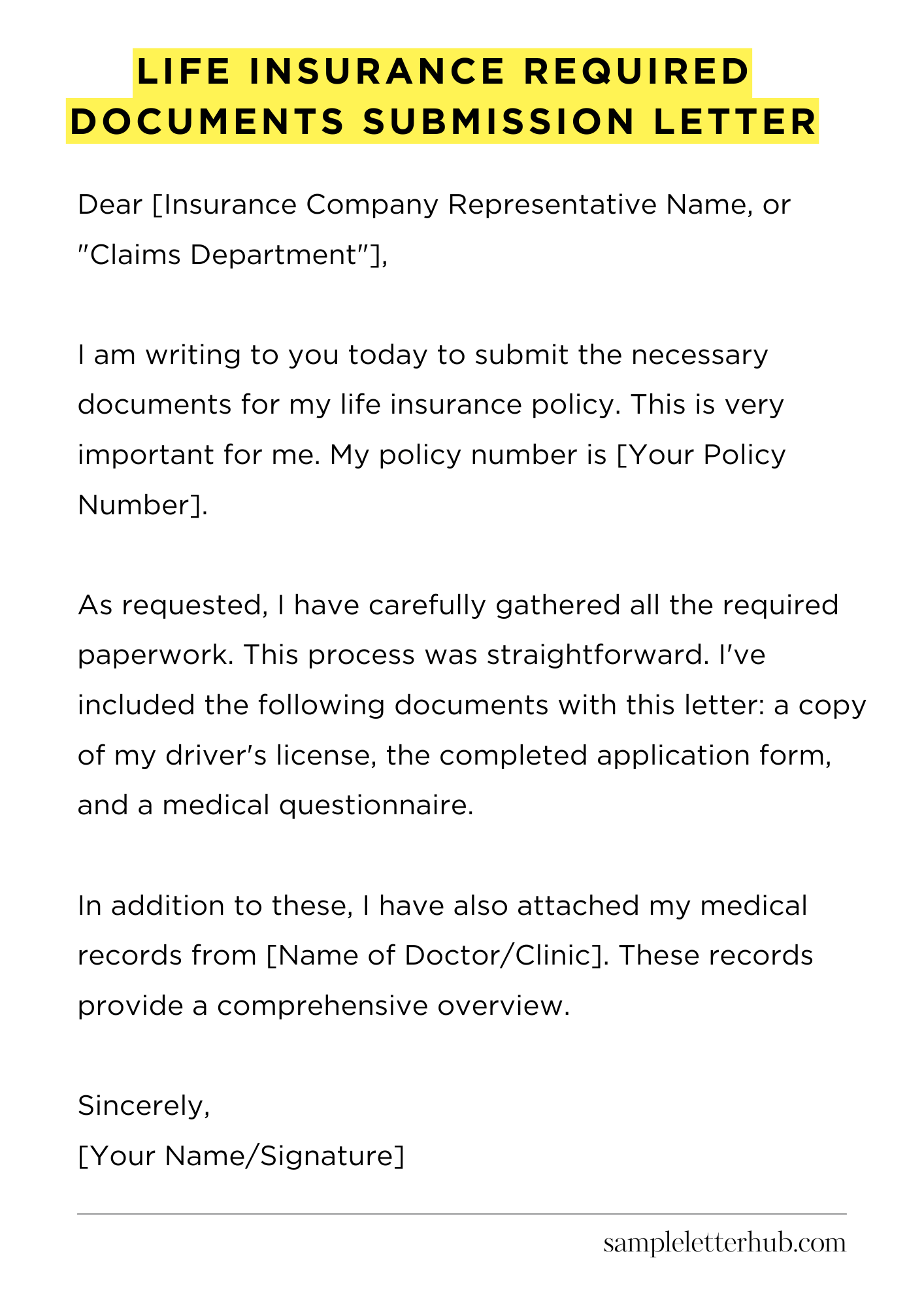
Dear [Insurance Company Representative Name, or “Claims Department”],
I am writing to you today to submit the necessary documents for my life insurance policy. This is very important for me. My policy number is [Your Policy Number].
As requested, I have carefully gathered all the required paperwork. This process was straightforward. I’ve included the following documents with this letter: a copy of my driver’s license, the completed application form, and a medical questionnaire.
In addition to these, I have also attached my medical records from [Name of Doctor/Clinic]. These records provide a comprehensive overview of my health history. Hopefully, everything is in order.
Please find enclosed the bank statement showing my recent premium payment. I hope this helps in keeping my policy current. I have made sure to provide all of the required information.
I understand that timely submission of these documents is crucial for processing my policy. I would appreciate it if you could confirm receipt of these documents. Please let me know if you require any further information.
Thank you for your time and attention to this matter. I am looking forward to hearing from you soon.
Sincerely,
[Your Name/Signature]
How to Write Life Insurance Required Documents Submission Letter
Submitting documents for life insurance can feel like navigating a bureaucratic labyrinth. However, a well-crafted submission letter can streamline the process and potentially expedite approval. This guide will walk you through composing a letter that is both informative and efficient.
1. Header: The Vanguard of Correspondence
Your letter’s header is the initial point of contact. Begin by positioning your full name, address, phone number, and email address in the upper-left corner.
Directly beneath this, on the right side, add the date of the letter. Following the date, insert the recipient’s information: the name of the insurance company’s representative or department, the insurance company’s name, and the company’s full address.
2. Salutation: Initiating the Dialogue
Commence your letter with a professional salutation. If you know the name of the recipient, use “Dear Mr./Ms./Mx. [Last Name]”. Otherwise, a more generic, yet acceptable, option is “To Whom It May Concern”. This sets a tone of respect and professionalism that is important for a document like this.
3. Subject Line: A Concise Abstraction
The subject line is your letter’s succinct summary. In a single line, clearly state the purpose of the communication. For example, “Submission of Life Insurance Documents – Policy Number [Your Policy Number]” is a precise and effective subject line. A strong subject line makes it easy for the recipient to grasp the nature of the correspondence without delay.
4. Body Paragraph 1: The Formal Introduction
The first paragraph should introduce yourself and the purpose of your letter. It should unambiguously state that you are submitting the required documentation for your life insurance policy. Specify the policy number and the type of policy.
Example: “I am writing to formally submit the requested documents for my life insurance policy, policy number [Your Policy Number], a [Type of Policy] policy.”
5. Body Paragraphs 2 & 3: Deciphering the Enclosures
The succeeding paragraphs should provide a detailed list of the enclosed documents. Be meticulous. Name each document, such as “Copy of Driver’s License,” “Medical Examination Report,” or “Application Form.”
If any of the documents require specific attention or have peculiar attributes, briefly allude to these aspects. For example, “The Medical Examination Report, conducted on [Date], is enclosed.” Ensure that you do not omit any document or its specifics. This is the crux of the communication.
6. The Closing: Polished Professionalism
Conclude your letter with a courteous closing statement. Express your gratitude for their time and assistance. Include a statement such as, “Thank you for your prompt attention to this matter.”
Consider including your contact information again for easy access. End with a professional closing, such as “Sincerely” or “Respectfully,” followed by your full name and signature (if sending a physical letter).
7. Proofreading and Mailing: The Penultimate & Ultimate Steps
Before dispatching your letter, meticulously proofread it for any grammatical errors or typos. Double-check all information, especially policy numbers and dates. Make a copy of the entire letter and all enclosures for your records.
If sending via mail, consider using certified mail with a return receipt requested to confirm delivery. This adds a layer of assurance. If sending electronically, consider saving the document as a PDF to maintain the formatting and ensure readability across different devices.
FAQs about Life Insurance Required Documents Submission Letter
What is a life insurance required documents submission letter?
A life insurance required documents submission letter is a formal communication sent by an insurance company to a policyholder or claimant.
This letter outlines the specific documents needed to process a life insurance application, policy update, or claim. It serves as an official request, detailing the requirements and providing instructions on how to submit the documents.
What documents are typically requested in a submission letter?
The specific documents requested vary depending on the situation. For a new application, this may include proof of identity (driver’s license, passport), proof of income (pay stubs, tax returns), and medical records.
For a claim, required documents often encompass the death certificate, the policy document, claim forms, and potentially proof of the beneficiary’s identity.
How should I submit the required documents?
The submission letter provides clear instructions on how to submit the required documents. This usually includes options like mailing physical copies, submitting digital scans via email or an online portal, or providing documents to a designated representative. It is important to follow the provided instructions to ensure timely and accurate processing.
What happens if I don’t submit all the required documents?
Failure to submit all required documents can significantly delay the processing of your life insurance application or claim. The insurance company may not be able to finalize the application, or the claim may not be paid until all documents are received. The letter usually specifies a deadline for submission, and missing this deadline could lead to further complications.
How long does it typically take to process after submitting all documents?
The processing time varies depending on the insurance company, the complexity of the case, and the completeness of the submitted documents. Generally, expect a processing time from a few weeks to a couple of months.
The submission letter may provide an estimated processing timeline, but it’s important to understand that this is only an estimate and factors can influence the actual time.
Related:
Resignation letter due to rude boss
Resignation letter moving to another state
Resignation letter due to illness of family member
Resignation letter due to study