

A Liaison Officer resignation letter is a formal document. It is written when a Liaison Officer decides to leave their position. The letter officially informs their employer of their departure. It also states their last working day.
Are you a Liaison Officer preparing to resign? Are you unsure how to write the letter? Don’t worry, we’ve got you covered. This article offers several letter samples. You can use these examples as a guide.
We provide a variety of templates. They fit different situations. Choose the one that suits your needs. Make your resignation process simple and smooth.
Liaison Officer Resignation Letter
Below is a sample of a Liaison Officer Resignation Letter:
[Your Name]
[Your Address]
[Your Phone Number]
[Your Email Address]
[Date]
[Hiring Manager Name] (If known, otherwise use title)
[Hiring Manager Title]
[Company Name]
[Company Address]
Dear [Mr./Ms./Mx. Last Name],
Please accept this letter as formal notification that I am resigning from my position as Liaison Officer at [Company Name]. My last day of employment will be [Your Last Day of Employment].
I would like to thank you for the opportunity to work at [Company Name]. I have enjoyed my time here and appreciate the experiences I have gained during my employment.
I am committed to ensuring a smooth transition during my departure. I am happy to assist in training my replacement and completing any outstanding tasks to the best of my ability. Please let me know how I can best support the transition process.
I wish you and the company all the best in the future.
Sincerely,
[Your Signature]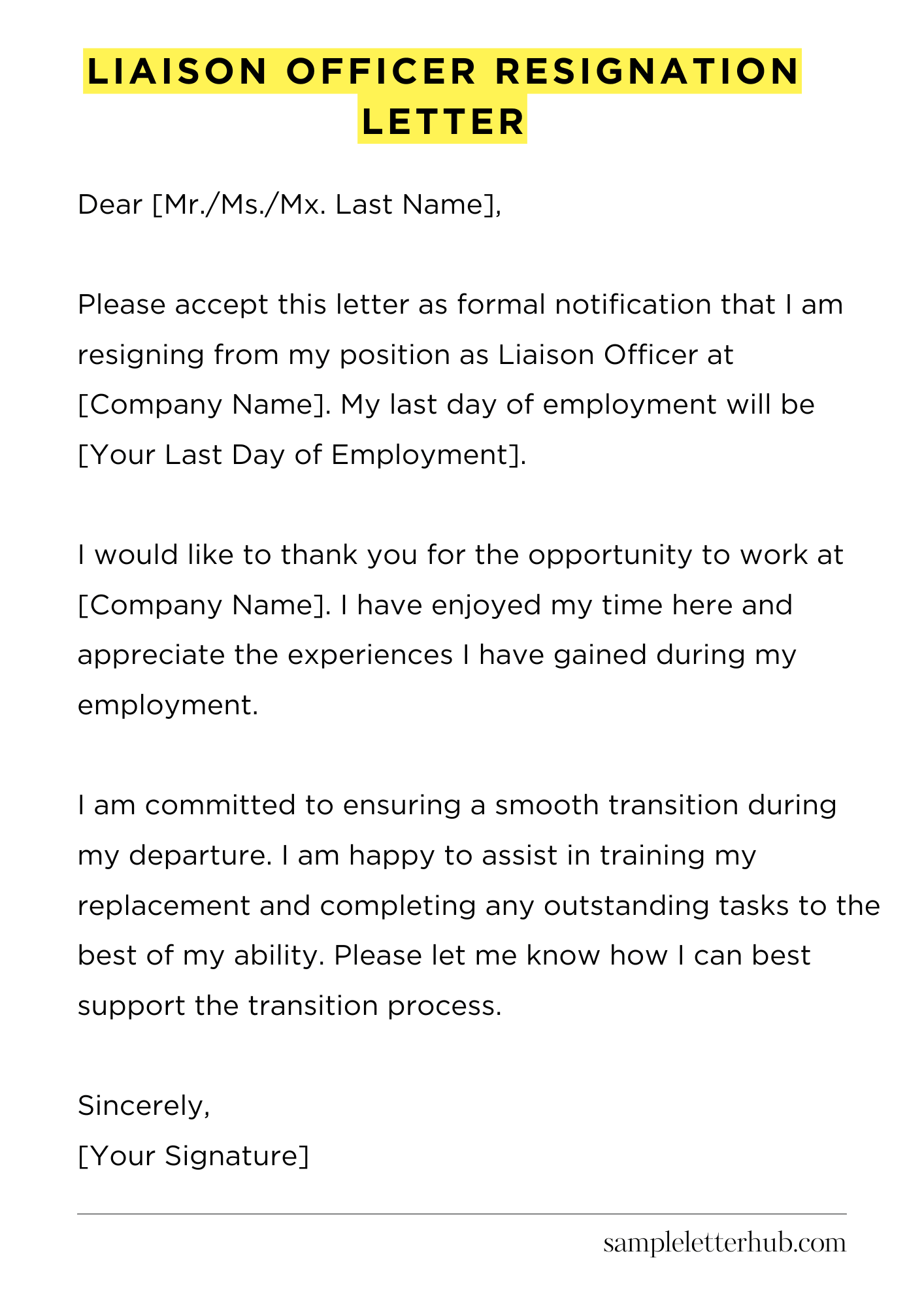
How to Write a Liaison Officer Resignation Letter
Resigning from a position, especially one as important as a Liaison Officer, requires careful consideration and a well-crafted letter. You want to leave a good impression, maintain professionalism, and ensure a smooth transition. This guide will walk you through the key elements needed to compose a successful resignation letter.
1. Start with the Basics: Formatting and Formalities
First things first: formatting. Your letter should be business-like. Use a standard business letter format. Your name and contact information go at the top, typically on the left side. Then, on the right side, include the date and the recipient’s name, title, and address. Keep it clean and easy to read.
Always address the letter to the appropriate person, usually your direct supervisor or the relevant department head. Be polite and professional in your salutation. Something like “Dear Mr./Ms. [Last Name]” is perfect. It demonstrates respect and sets the right tone.
2. The Core: Stating Your Intent and Effective Communication
The main purpose of the letter is to formally announce your resignation. Make this very clear in the first paragraph. State your intention to resign and the effective date of your last day of employment. Use straightforward language. Avoid ambiguity.
For example: “Please accept this letter as formal notification that I am resigning from my position as Liaison Officer, effective [Your Last Day].” Make sure the effective date is within the timeframe specified in your employment contract, if applicable.
Keep the letter concise. Remember, the letter’s primary function is to communicate your departure.
3. Expressing Gratitude and Providing Positive Context
After stating your resignation, express gratitude. This is a very important step. A simple “I would like to thank you for the opportunity to have worked as a Liaison Officer at [Company Name]” goes a long way. Briefly acknowledging the positive aspects of your employment shows professionalism.
You don’t need to write an essay, but a short expression of appreciation is always beneficial.
Mentioning any specific skills you’ve developed or experiences you’ve gained can subtly highlight your contributions. Be sincere.
4. Smooth Transitions: Offering Assistance and Keeping it Professional
Consider offering your assistance with the transition. This is a great way to leave a positive lasting impression. Include a phrase like, “I am committed to ensuring a smooth handover of my responsibilities and am happy to assist in training my replacement.” This demonstrates that you care about the organization’s success, even after you leave.
If you have any specific responsibilities that need to be covered, mention them. Outline any handover plans you have. Professionalism is paramount. Avoid any negativity or complaints about your job.
5. The Close: Sign-Off and Final Touches
Close your letter with a professional sign-off, such as “Sincerely,” or “Respectfully,” followed by your signature and your typed name. If you have any remaining unused vacation time or benefits to discuss, you can briefly mention them in the final paragraph or a separate communication.
Proofread your letter carefully before sending it. Check for any grammatical errors or typos. Having a second pair of eyes to review the letter is an excellent idea.
Remember, this letter is a reflection of your character. Following these steps will help you write a strong, professional resignation letter.
FAQs about Liaison Officer Resignation Letter
What information should I include in my Liaison Officer resignation letter?
Your resignation letter should clearly state your intention to resign from your position as Liaison Officer. Include your name, the date, and the effective date of your resignation.
Also, mention your supervisor’s name. You can briefly express your gratitude for the opportunity to work in the role or organization. A formal and professional tone is recommended. It’s often helpful to include a brief statement of your reason for leaving, although this isn’t mandatory. Ensure you provide your contact information for any follow-up.
How much notice should I give when resigning as a Liaison Officer?
The standard notice period for a Liaison Officer, like other positions, is usually two weeks, but it’s best to check your employment contract or company policy. Some organizations may require a longer notice period, particularly for senior roles or those with specific responsibilities.
Adhering to the required notice period ensures a smooth transition and demonstrates professionalism.
What if I want to resign immediately as a Liaison Officer?
Resigning immediately is possible, but it may have consequences. You should explain the urgency and the situation in your letter. Review your employment contract to understand any potential repercussions, such as loss of pay or legal action.
It’s advisable to speak with your manager or HR before submitting an immediate resignation, if possible, to discuss the situation and mitigate any negative effects.
Should I provide a reason for resigning in my Liaison Officer resignation letter?
While not mandatory, providing a brief reason for your resignation can be helpful. It allows your employer to understand your decision and potentially address any underlying issues. Keep the reason professional and concise. Common reasons include seeking a new opportunity, pursuing personal goals, or relocation. Avoid negative or overly critical statements.
How should I deliver my Liaison Officer resignation letter?
The preferred method is typically in writing, either as a printed letter or an email. Address the letter to your supervisor or the appropriate HR representative. If submitting an email, include a clear subject line such as “Resignation – [Your Name].”
Keep a copy of your letter for your records. If handing it in person, it’s also advisable to give a copy to your supervisor and HR so you both have a record of it.
Related:
Resignation letter due to rude boss
Resignation letter moving to another state
Resignation letter due to illness of family member
Resignation letter due to study