

Sometimes, you need to change how you use your vehicle. This means updating your vehicle usage type, either from commercial to personal or vice versa. A letter to update vehicle usage type is the official document. Its purpose is to inform relevant authorities. This ensures your vehicle registration and insurance are accurate.
Writing this letter might seem tricky. Don’t worry, we’re here to help. This article provides helpful templates, examples, and samples. You can use them to create your own letter to update vehicle usage type. We’ll make it easy for you.
We want to make this process simple. We have crafted different letter samples. They’re ready for you to adapt. Changing your vehicle’s usage type becomes easy. You will be able to write the perfect letter.
[Your Name/Company Name]
[Your Address]
[Your Phone Number]
[Your Email Address]
[Date]
[Insurance Company Name/Relevant Authority]
[Insurance Company Address/Relevant Authority Address]
Subject: Update of Vehicle Usage Type – Policy Number [Your Policy Number] – Vehicle Registration [Your Vehicle Registration Number]
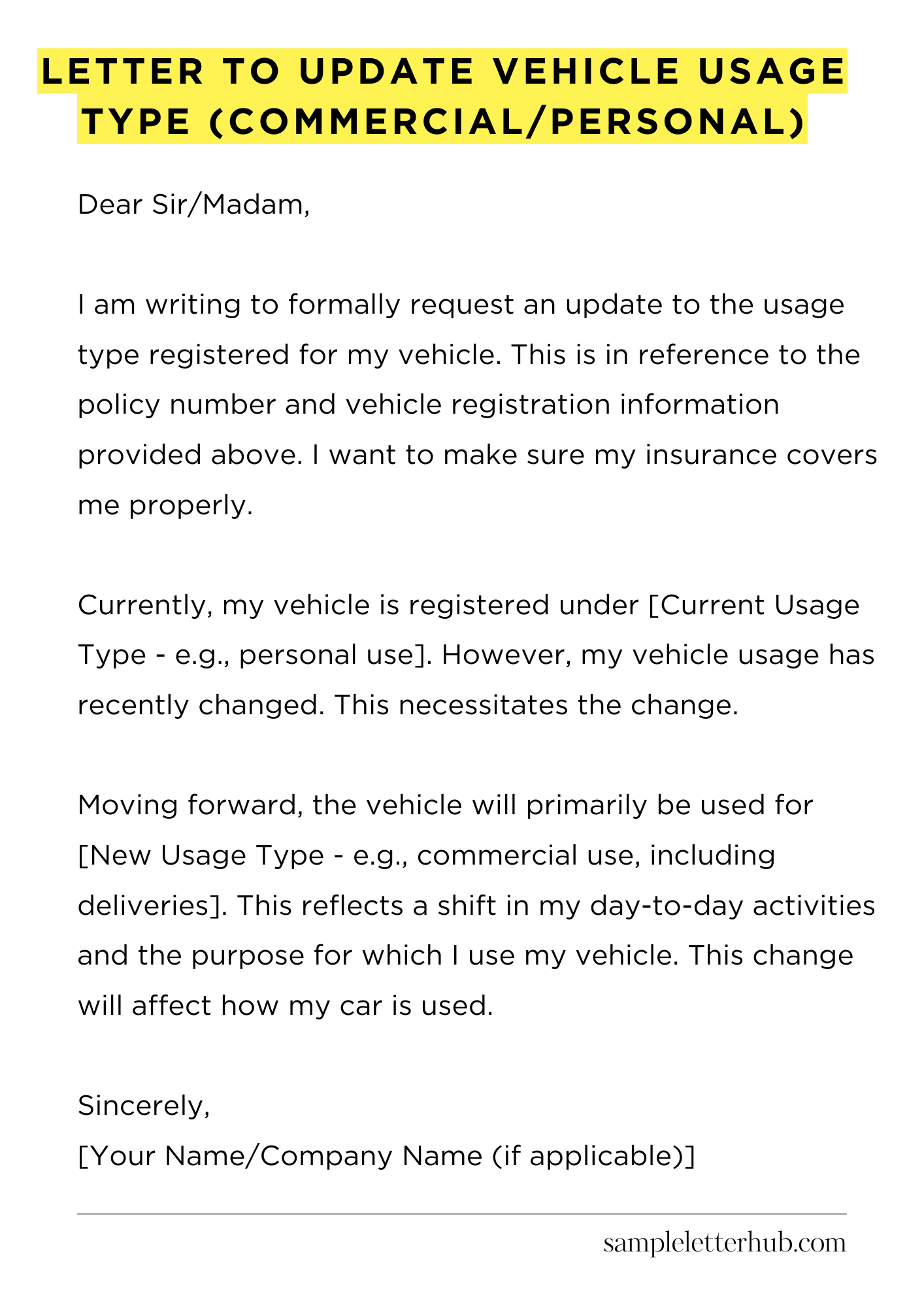
Dear Sir/Madam,
I am writing to formally request an update to the usage type registered for my vehicle. This is in reference to the policy number and vehicle registration information provided above. I want to make sure my insurance covers me properly.
Currently, my vehicle is registered under [Current Usage Type – e.g., personal use]. However, my vehicle usage has recently changed. This necessitates the change.
Moving forward, the vehicle will primarily be used for [New Usage Type – e.g., commercial use, including deliveries]. This reflects a shift in my day-to-day activities and the purpose for which I use my vehicle. This change will affect how my car is used.
I understand that this change may impact my insurance premium. Please let me know what steps are required to facilitate this update, and if any additional documentation or information is needed from my end. I am happy to comply with your requirements.
Please confirm the revised usage type and any associated changes in writing. I want to make sure everything is in order.
Thank you for your time and attention to this matter. I look forward to your prompt response and confirmation of the requested update.
Sincerely,
[Your Name/Company Name (if applicable)]
How to Write Letter to Update Vehicle Usage Type (commercial/personal)
Navigating the bureaucratic labyrinth of vehicle registration can often feel like a Herculean task. However, amending your vehicle’s usage type, whether transitioning from personal to commercial or vice versa, is a crucial step to ensure legal compliance and avoid potential penalties.
This guide provides a comprehensive roadmap for penning a persuasive and effective letter to facilitate this necessary adjustment.
1. Commence with the Essentials: Salutation and Sender Information
Your missive should begin with a formal salutation. Address the letter to the appropriate department within your local motor vehicle administration (MVA) or Department of Motor Vehicles (DMV).
Research the correct recipient; this demonstrates professionalism and expedites processing. Immediately following, meticulously include your full name, current address, phone number, and email address. This ensures the recipient can easily contact you if clarification is needed. Clarity in sender details prevents delays.
2. Subject Line: Concise and Categorical
Craft a subject line that is both succinct and unambiguously reflects the letter’s purpose. Something like “Request to Amend Vehicle Usage Type – [Vehicle Identification Number (VIN)]” will suffice. This immediately telegraphs the content, allowing the recipient to quickly categorize the correspondence.
3. The Introductory Paragraph: Articulating Intent
Begin with a clear and concise introductory paragraph. State your intention: you are writing to formally request a change in your vehicle’s usage type.
Specify the current and proposed usage types (e.g., “From personal to commercial”). Include the vehicle’s make, model, and year to establish unambiguous identification. This establishes the context for the subsequent details.
4. Vehicle Identification: The Cornerstone of Accuracy
Underscore the vehicle’s identification. In addition to the make, model, and year, emphatically state the VIN. This unique alphanumeric sequence is paramount for verifying the vehicle’s details within the DMV’s database.
Accompany the VIN with the vehicle’s license plate number; this offers a secondary layer of confirmation. This is critical in avoiding any misattribution.
5. Substantiating the Change: Providing Supporting Documentation
This is where you marshal your supporting evidence. Explicitly list all enclosed documents. This could include, but is not limited to, proof of commercial insurance if switching to commercial usage, a copy of a business registration certificate, or any other documentation the DMV requires. Be meticulously accurate in your document enumeration.
The more complete your submission, the swifter the processing. Providing all requested information upfront diminishes the chance of request rejection.
6. The Concluding Paragraph: Politeness and Professionalism
End the letter with a polite and professional closing. Thank the recipient for their time and consideration. Reiterate your contact information for easy access. Express your anticipation of a prompt response. This demonstrates courtesy and reinforces your commitment to resolving the matter efficiently.
7. Final Preparations: Proofreading and Delivery
Before dispatch, meticulously proofread the entire letter. Check for grammatical errors, spelling mistakes, and factual inaccuracies. Ensure all enclosed documents are legible and securely attached.
Consider sending the letter via certified mail with return receipt requested. This provides proof of delivery and acknowledgement, creating an audit trail. Preserve a copy of the letter and all supporting documentation for your records. This provides you with an irrefutable paper trail if further communications are required.
FAQs about Letter to Update Vehicle Usage Type (commercial/personal)
What is the purpose of a letter to update vehicle usage type?
The primary purpose of a letter to update vehicle usage type is to officially notify relevant parties, such as your insurance provider or a government agency (like the DMV), about a change in how you use your vehicle.
This is important because the usage type (commercial vs. personal) impacts insurance premiums, registration fees, and legal requirements. Updating this information ensures that you maintain appropriate coverage and comply with all applicable regulations.
Who needs to submit a letter to update vehicle usage type?
Generally, anyone who changes how they use their vehicle needs to submit this type of letter. This includes individuals who begin using a previously personal vehicle for commercial purposes (e.g., delivery, business travel) or individuals who cease using a vehicle for commercial purposes and revert to personal use.
It is critical to inform your insurance provider and relevant authorities to avoid potential issues with coverage or compliance.
What information should be included in a letter to update vehicle usage type?
A well-written letter typically includes your full name, address, vehicle identification number (VIN), vehicle make and model, the date of the change in usage, the current usage type, the new usage type (personal or commercial), the effective date of the change, and your signature.
You might also need to include your policy number if it relates to your insurance. It’s often advisable to check with your specific insurer or the relevant agency for their preferred format or any additional required details.
Where should I send the letter to update vehicle usage type?
The letter should be sent to the appropriate entities. This typically includes your insurance provider and, potentially, the Department of Motor Vehicles (DMV) or a similar government agency.
The specific address will be provided by your insurance company or available on the agency’s website. It’s recommended to send the letter via certified mail with a return receipt requested to confirm delivery and establish a record of the notification.
What are the consequences of not updating the vehicle usage type?
Failing to update your vehicle usage type can lead to significant consequences. For instance, if you use a vehicle commercially but only have personal insurance, your insurance company may deny a claim in the event of an accident.
You may also face penalties from government authorities, such as fines or even vehicle impoundment, depending on the jurisdiction. Ensuring that your vehicle usage type is accurate protects you legally and financially.
Related:
Resignation letter due to rude boss
Resignation letter moving to another state
Resignation letter due to illness of family member
Resignation letter due to study