

A “Letter to Submit Required Insurance Documents” is a simple request. It asks for specific documents. Insurance companies need these for claims or policies. The purpose is to ensure all necessary paperwork is in place. This makes the insurance process smooth.
Need to draft this letter? Don’t worry, we’ve got you covered. We’re sharing templates today. You’ll find examples and samples here. These will help you write your own insurance document submission letter. Tailor these to fit your needs.
Writing this kind of letter can feel daunting. But our letter templates will simplify things. Whether it’s a letter for insurance claim documents or a policy document submission, we have examples. Get ready to easily create your own letter to submit documents!
[Your Name/Company Name]
[Your Address]
[Your City, Postal Code]
[Your Email]
[Your Phone Number]
[Date]
[Insurance Company Name]
[Insurance Company Address]
[Insurance Company City, Postal Code]
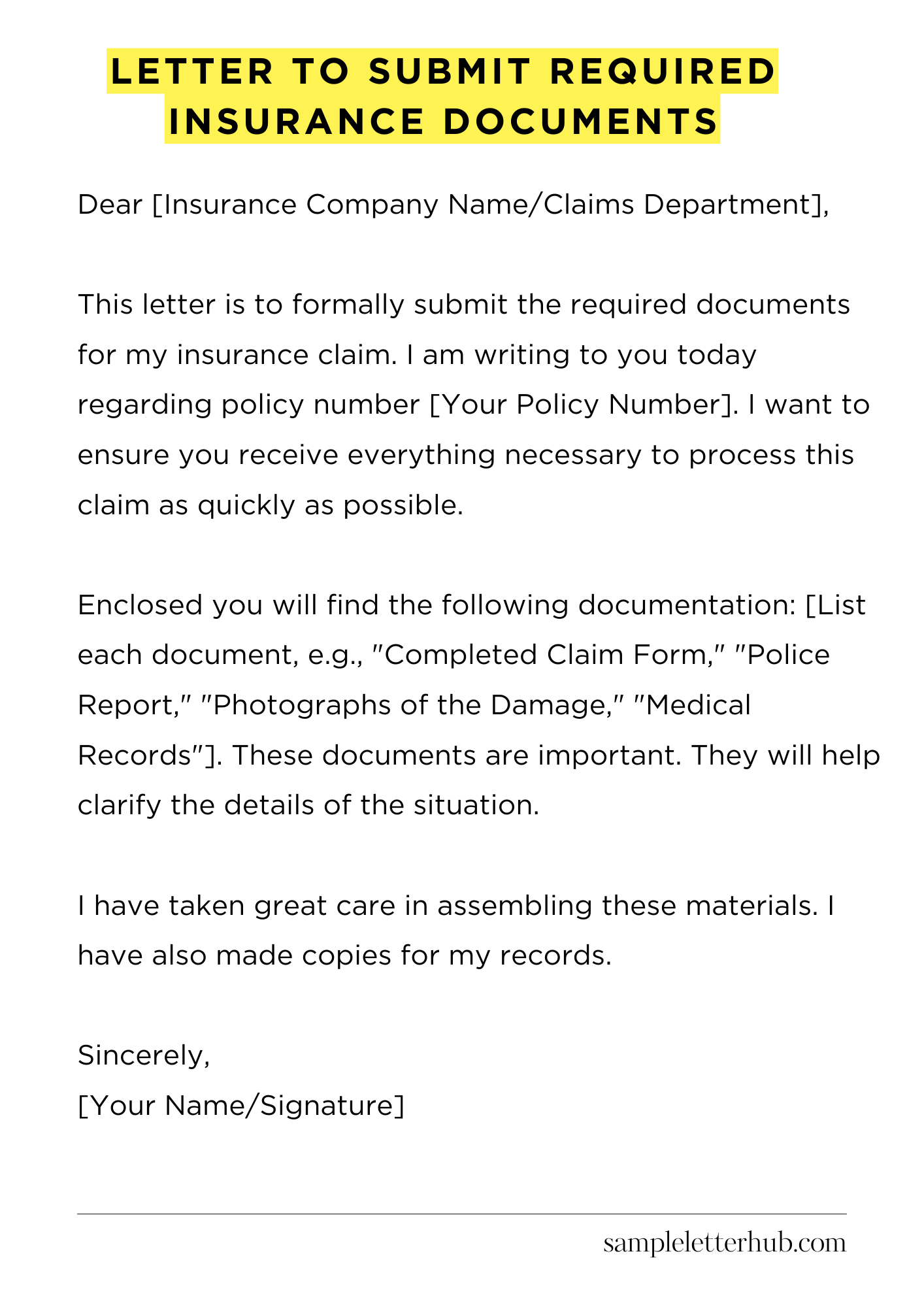
Dear [Insurance Company Name/Claims Department],
This letter is to formally submit the required documents for my insurance claim. I am writing to you today regarding policy number [Your Policy Number]. I want to ensure you receive everything necessary to process this claim as quickly as possible.
Enclosed you will find the following documentation: [List each document, e.g., “Completed Claim Form,” “Police Report,” “Photographs of the Damage,” “Medical Records”]. These documents are important. They will help clarify the details of the situation.
I have taken great care in assembling these materials. I have also made copies for my records.
Please let me know if you require any further information or documentation from my end. If you have any questions, feel free to contact me using the information provided above.
I would appreciate an update on the status of my claim within [Number] business days. Thank you very much for your time and assistance.
Sincerely,
[Your Name/Signature]
How to Write Letter to Submit Required Insurance Documents
Submitting insurance documents can feel like navigating a bureaucratic labyrinth. But, a well-crafted letter can illuminate the path and ensure a smooth process. Here’s a concise guide to help you orchestrate a compelling submission.
1. Commence with Clarity: The Salutation and Subject Line
Begin your epistle with a formal salutation. “Dear [Insurance Company Name] Claims Department” is a safe and professional choice. Follow with a clear and concise subject line.
Think of it as the headline of your document. “Submission of Required Documentation for Policy Number: [Your Policy Number]” immediately orients the recipient, streamlining their workflow. This is crucial for rapid triage.
2. The Art of Precise Identification
Immediately state your purpose. Mention you are providing the documents requested by the insurance company. Provide your full name, address, phone number, email address, and, most critically, your insurance policy number. Accuracy here is paramount. Errors can lead to delays or misfiling; an absolute epistolary faux pas.
3. Enumerating the Enclosures: The Document Inventory
Create a succinct list of all enclosed documents. Use numbered bullet points for ease of reference. For example:
- Copy of Driver’s License
- Medical Records
- Police Report (Case Number: XXXXXXX)
This clear cataloging prevents ambiguity and assures that all required items are accounted for. This is good for record-keeping and a display of your seriousness.
4. The Narrative: Briefly Explaining the Circumstances
Provide a brief, factual narrative of the situation, if relevant. For example, if the documents relate to a claim, briefly explain the incident. Keep it concise and stick to the verifiable facts. Avoid emotive language; objectivity is key. You need to clearly lay out the context.
5. The Concluding Couplet: Gratitude and Anticipation
Express your gratitude for their time and attention. Something like, “Thank you for your prompt attention to this matter,” or “I appreciate your assistance in processing this claim.”
Then, state your expectation regarding the next steps. For instance, “I look forward to hearing from you regarding the status of my claim.” This provides closure and sets the stage for a reply.
6. The Formal Finale: Closing and Signature
Conclude with a formal closing. “Sincerely,” “Respectfully,” or “Yours faithfully” (if you began with “Dear Sir/Madam”) are appropriate choices. Sign your name clearly, and if sending a hard copy, print your name below the signature. This is to ensure you do not commit any blunders.
7. Polishing and Perfection: Proofreading and Delivery
Before dispatching your letter, meticulously proofread it for any grammatical errors, typographical errors, or inconsistencies. Ensure all information is accurate and that the document is well-organized.
Deliver the letter via the preferred method specified by the insurance company (e.g., mail, email, or their online portal). Maintaining these standards helps secure a speedy and effective response.
FAQs about Letter to Submit Required Insurance Documents
What information should be included in a letter requesting insurance documents?
A letter requesting insurance documents should include the policyholder’s full name, policy number, and the specific documents required (e.g., proof of insurance, medical records, claim forms).
The letter should clearly state the reason for the request, the timeframe for submission, and contact information for inquiries. It’s also crucial to specify the preferred method of document submission, such as email, mail, or online portal if available.
What is the purpose of a letter to submit insurance documents?
The primary purpose of a letter requesting insurance documents is to formally communicate to the policyholder what specific documents are needed.
This is crucial for various reasons, including claim processing, policy updates, underwriting reviews, and ensuring compliance with policy terms. The letter serves as a written record of the request, providing clarity and establishing a timeline for the policyholder’s response.
What happens if I don’t submit the requested insurance documents?
Failure to submit the requested insurance documents can lead to several negative outcomes. This might include delays in claim processing, denial of claims, suspension or cancellation of the insurance policy, and potential legal ramifications. It’s imperative to respond promptly to such requests to avoid these adverse consequences and maintain active insurance coverage.
How should I submit the insurance documents after receiving the request letter?
The method of submission often depends on the insurance provider’s instructions in the letter. Documents can be submitted via email, regular mail, or through the insurer’s online portal or app.
Some providers may also accept documents in person. Ensure you follow the specific guidelines provided by the insurer to ensure timely receipt and processing of your documents.
What if I don’t understand the request for insurance documents?
If you’re unclear about any aspect of the document request, it’s essential to contact your insurance provider immediately. The letter should include contact details, such as a phone number or email address, for clarification.
Don’t hesitate to ask for assistance or further explanation to avoid any misunderstandings and ensure the accurate fulfillment of the request.
Related:
Resignation letter due to rude boss
Resignation letter moving to another state
Resignation letter due to illness of family member
Resignation letter due to study