


Dealing with an insurance claim can be stressful. Sometimes, you need to prove your income. This is where a “Letter to Submit Income Proof for Insurance Claim” comes in. The purpose? To provide the insurance company with evidence of your earnings. This helps them assess your claim fairly. It’s a key step in getting the process moving.
Feeling overwhelmed by writing this letter? You’re not alone! Drafting the perfect letter can feel tricky. We have you covered. We’re sharing templates, examples, and samples. These will help you craft a professional letter. Need to prove income for your insurance claim? Look no further! This article simplifies the process.
We know it can be hard to write something like this. Our goal? To make it simple. We offer different versions. Find the one that fits your situation. Use these letter examples as your guide. Quickly create your own letter to submit income proof. Make things easy with our help.
[Your Name]
[Your Address]
[Your Phone Number]
[Your Email Address]
[Date]
[Insurance Company Name]
[Insurance Company Address]
Dear [Insurance Adjuster Name or “Claims Department”],
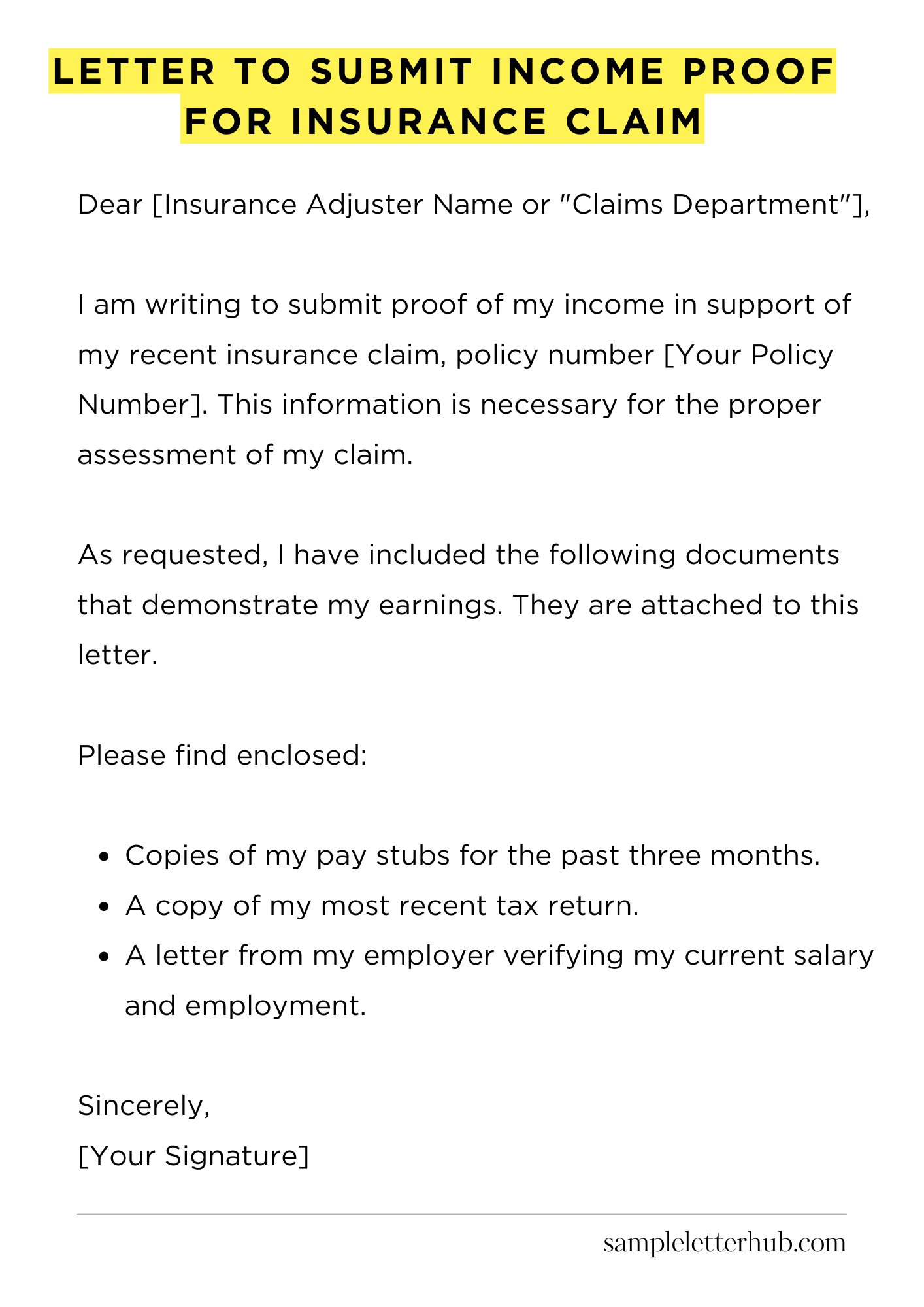
I am writing to submit proof of my income in support of my recent insurance claim, policy number [Your Policy Number]. This information is necessary for the proper assessment of my claim. I had a recent incident, and I hope to receive a fair claim settlement.
As requested, I have included the following documents that demonstrate my earnings. They are attached to this letter. These documents should provide a clear picture of my financial standing. I want to make the process as easy as possible for you.
Please find enclosed:
- Copies of my pay stubs for the past three months.
- A copy of my most recent tax return.
- A letter from my employer verifying my current salary and employment.
I trust that these documents will be sufficient to support my claim. I have tried my best to keep everything organized. I understand that processing this information may take some time.
If you require any further documentation or clarification, please do not hesitate to contact me. You can reach me by phone or email. I am readily available to assist in any way I can.
Thank you for your prompt attention to this matter. I appreciate your assistance. I am looking forward to a favorable outcome.
Sincerely,
[Your Signature]
How to Write Letter to Submit Income Proof for Insurance Claim
Submitting an income proof letter for an insurance claim can feel daunting. However, armed with the right knowledge, the process becomes manageable. This guide will navigate you through composing a potent letter that bolsters your claim and accelerates its processing.
1. Begin with a Decisive Salutation
Your missive should commence with a formal salutation. Address the recipient, usually the insurance adjuster or claims department, directly. The standard “Dear Mr./Ms./Mx. [Last Name]” is prudent.
If the specific name is unavailable, use “Dear Claims Adjuster” or “To Whom It May Concern.” Make certain the tone is courteous but resolute, laying the groundwork for a professional exchange.
2. State Your Identity and the Purpose Unequivocally
Clarity is crucial. In the first paragraph, unequivocally declare your identity and the purpose of your letter. Include your full name, policy number, and the incident date for which you’re filing the claim.
Explicitly state that you’re submitting income verification in support of your claim. This immediate exposition prevents any ambiguity.
3. Detail the Pertinent Events, Briefly
Provide a concise summary of the event that necessitates the claim. A few sentences are sufficient. Focus on the facts relevant to your income loss.
For example, if you were unable to work due to an accident, mention the nature of the accident and the period of absence from your occupation. Keep the narrative succinct and avoid embellishment; objectivity is your ally here.
4. Include the Proofs and Documents
This section constitutes the core of your income verification. Precisely list the documents you are enclosing. Common examples include pay stubs, W-2 forms, tax returns, and employment verification letters from your employer.
Specify the period covered by each document (e.g., “Pay stubs from January 1, 2023, to December 31, 2023”). If applicable, provide copies of your contract. This meticulous approach ensures the assessor can easily verify your income.
5. Estimate Your Income Loss Precisely
Calculate your income loss as accurately as possible. The computation may incorporate lost wages, missed opportunities, and any other relevant financial setbacks directly attributable to the insured event.
State the total amount in both numbers and words. Include a breakdown of how you arrived at this figure, showing how your calculations are made, such as a summary of the days you missed at work multiplied by your daily rate of pay. Ensure to back up your claims with supporting documentation.
6. End with a Cordial yet Assertive Closing
Conclude your letter with a professional closing. Use phrases such as “Sincerely,” “Respectfully,” or “Yours faithfully.” Reiterate your policy number and any contact information, including phone numbers and email addresses, to facilitate easy communication. Express your gratitude for their time and consideration while subtly underlining your expectations for a prompt resolution.
7. Proofread Meticulously Before Submission
Before dispatching your letter, proofread it assiduously. Check for grammatical errors, spelling mistakes, and factual inaccuracies. A well-written, error-free letter projects credibility and demonstrates diligence.
Consider having a second set of eyes review it to catch any oversights you might have missed. Ensure that all the documents are in order and readily accessible. Finally, retain a copy of both the letter and all supporting documentation for your records; it’s a critical component of risk management.
FAQs about Letter to Submit Income Proof for Insurance Claim
What information should I include in a letter to submit income proof for an insurance claim?
A comprehensive letter should include your full name, address, policy number, and the date. You must clearly state the reason for the claim and that you are providing income documentation as requested.
Specify the type of income proof enclosed (e.g., pay stubs, tax returns, employment verification letters). It is also important to mention the period the income proof covers and provide a brief description of the claim event. Sign and date the letter.
What types of documents are typically accepted as income proof for an insurance claim?
Acceptable income proof varies depending on your income source and the insurer’s requirements, but commonly include pay stubs covering the period relevant to the claim, W-2 forms or 1099 forms (for self-employed individuals).
How do I format a letter to submit income proof for an insurance claim?
The letter should be professionally formatted, preferably typed, on standard-sized paper. Use a clear and concise style. Include your contact information at the top. Use a formal salutation (e.g., “Dear Claims Department”).
The body of the letter should briefly describe the reason for the letter and list the attached documentation. End with a closing (e.g., “Sincerely”) and your signature above your printed name.
Where should I send the letter and income proof for an insurance claim?
The letter and supporting documentation should be sent to the address specified by your insurance company or the claims adjuster handling your case.
This information is typically found in your policy documents, claim forms, or correspondence from the insurer. Send the documentation via a tracked method (certified mail with return receipt requested, or electronic methods) to ensure you have proof of submission.
What happens if I cannot provide all the income proof requested by the insurance company?
If you are unable to provide all the documentation, contact your insurance company immediately. Explain the situation and provide any documentation you can provide.
Discuss alternate forms of proof that you could provide. The insurer may request additional documentation, such as a statement from your employer, or they may make a determination based on the available information. Failure to provide sufficient proof could delay or impact the outcome of your claim.
Related:
Resignation letter due to rude boss
Resignation letter moving to another state
Resignation letter due to illness of family member
Resignation letter due to study