

Need to provide your insurance company with ID proof? You might need a letter to submit ID proof to the insurance company. This document officially informs them you’re sending your identification. The purpose? To verify your identity and finalize your insurance application or claim.
Writing this letter can seem tricky. Don’t worry. We’ve got you covered. This article offers helpful Letter to Submit ID Proof to Insurance Company samples. Find a template that fits your specific situation.
We’ll share several easy-to-use examples. These letter formats will make the process simple. Just personalize them with your details. Get your ID proof submitted quickly and efficiently.
[Your Name]
[Your Address]
[Your Phone Number]
[Your Email Address]
[Date]
[Insurance Company Name]
[Insurance Company Address]
Subject: Submission of ID Proof for Insurance Policy [Policy Number]
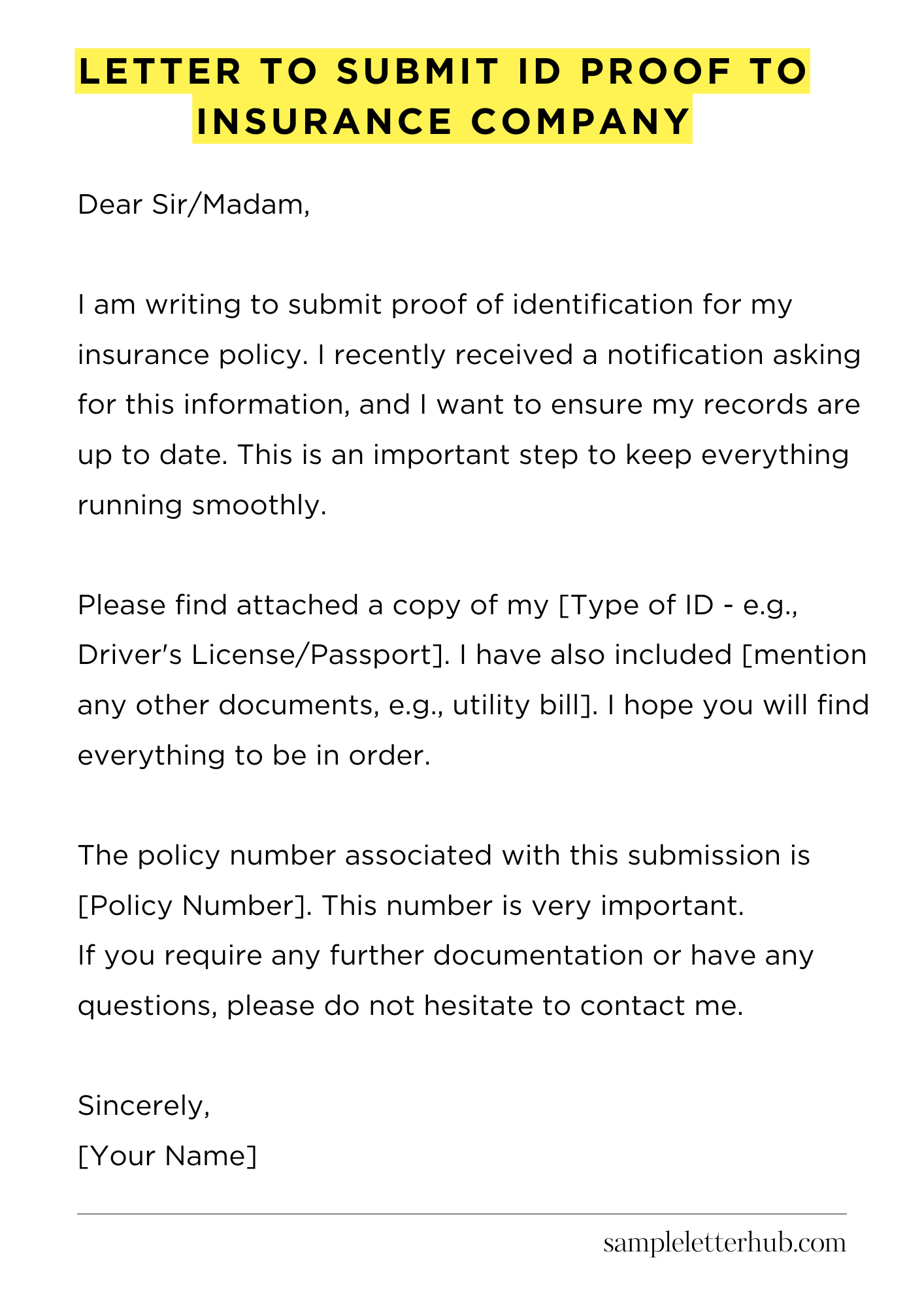
Dear Sir/Madam,
I am writing to submit proof of identification for my insurance policy. I recently received a notification asking for this information, and I want to ensure my records are up to date. This is an important step to keep everything running smoothly.
Please find attached a copy of my [Type of ID – e.g., Driver’s License/Passport]. I have also included [mention any other documents, e.g., utility bill]. I hope you will find everything to be in order.
The policy number associated with this submission is [Policy Number]. This number is very important.
If you require any further documentation or have any questions, please do not hesitate to contact me. You can reach me at the phone number or email address listed above. I want to assist you with anything you need.
Thank you for your time and attention to this matter. I appreciate your prompt processing of this request. I look forward to your confirmation of receipt.
Sincerely,
[Your Name]
How to Write Letter to Submit ID Proof to Insurance Company
1. Commence with a Formal Salutation
Begin your letter with a formal salutation. Employ the appropriate salutation, such as “Dear Sir/Madam,” or if you know the recipient’s name, “Dear Mr./Ms. [Surname]”.
This establishes the tenor of the communication from the get-go. Maintain this level of professionalism throughout the missive. Ensure you are addressing the correct department or individual for a swift response.
2. Clearly State the Letter’s Purpose
Immediately articulate the precise objective of your missive. This is where your clarity of thought comes into play. State succinctly that you are submitting ID proof to comply with an insurance policy requirement.
Specify the policy number, if applicable, to aid in the expeditious processing of your request. Avoid verbose language here; conciseness is key.
3. Enumerate the Enclosed Identification Documentation
Precisely list the documents you are providing as identification. This is a critical step. For instance, you might state: “I am enclosing a copy of my driver’s license, passport, and a utility bill as proof of address.”
Accuracy is paramount here to avert any processing delays or, worse, rejection of your submission. Be meticulous in your documentation listing.
4. Ensure Absolute Clarity and Legibility
Guarantee that your documents are crystal clear and easily readable. If submitting copies, ensure they are sharp, well-lit, and devoid of any obstructions. If possible, consider scanning the documents to create digital copies. Digital copies frequently offer superior clarity compared to photocopies. Poor legibility can trigger complications.
5. Integrate Concise Explanatory Commentary
Though the primary aim is to present documentation, include brief explanatory remarks. For example, explain why you’re submitting these particular forms of identification. This adds context and shows proactive communication. Explain in brief, but do not overwrite.
6. Conclude with a Cordial Closing and Call to Action
Close the letter with a professional valediction, such as “Sincerely,” or “Respectfully,” followed by your full name. Include your contact information—phone number and email address—in case they have follow-up queries.
Adding a brief call to action, such as “Please acknowledge receipt of these documents,” can help ensure prompt action on their part. This step solidifies a closed loop of communication.
7. Proofread Meticulously Before Dispatch
Before submitting your letter, dedicate time to thorough proofreading. Scan for grammatical errors, spelling inaccuracies, and any inconsistencies in your language. A polished, error-free letter conveys professionalism and attention to detail.
Double-check all details, especially policy numbers and contact information, to safeguard accuracy. After proofreading, review again and then dispatch.
FAQs about Letter to Submit ID Proof to Insurance Company
What is the purpose of writing a letter to an insurance company to submit ID proof?
The primary reason for writing a letter to an insurance company to submit ID proof is to provide verification of your identity. This is usually required for a variety of reasons, including but not limited to, claim processing, policy updates, fraud prevention, and compliance with regulatory requirements.
The insurance company needs to confirm that the individual making a claim or interacting with the policy is who they claim to be, safeguarding both the insurer and the policyholder.
What type of identification is typically requested in a letter requesting ID proof?
The types of identification typically requested can vary depending on the insurance company and the specific situation. Common examples include a government-issued photo ID (driver’s license, passport, or national ID card), a utility bill.
What information should be included in the letter submitting ID proof to the insurance company?
When submitting ID proof, the letter should include your full name, policy number, and the date. You should also clearly state that you are enclosing the requested.
How should the letter and ID proof be submitted to the insurance company?
The method of submission often depends on the insurance company’s guidelines. Options typically include mail, email (as a scanned attachment), or through a secure online portal provided by the insurance company.
Always follow the instructions provided by the insurance company. If mailing, it’s advisable to send the documents via certified mail with return receipt requested to provide proof of delivery. Confirm the receipt with the company if possible.
What are the potential consequences of not submitting ID proof when requested by the insurance company?
Failure to submit the requested ID proof can lead to several consequences. These may include delays in claim processing, inability to update or change policy details, or in extreme cases, the potential suspension or cancellation of your insurance policy.
The insurance company needs to verify your identity to fulfil their responsibilities, and without verification, they may not be able to provide the services and benefits outlined in your policy.
Related:
Resignation letter due to rude boss
Resignation letter moving to another state
Resignation letter due to illness of family member
Resignation letter due to study