

A letter to review rejected warranty claim is your chance. You can fight a denial. It’s a formal way to appeal. Its main purpose is to convince the company. You want them to reconsider their decision.
We get it. Writing these letters can be tricky. Don’t worry, though. We have you covered. This article offers samples and templates. You can easily write your own letter. We have various letter to review rejected warranty claim examples.
These examples are adaptable. Use them as a starting point. Tailor them to your situation. This guide helps you craft a strong warranty claim appeal letter. Good luck!
[Your Name/Company Name (if applicable)]
[Your Address]
[Your Phone Number]
[Your Email Address]
[Date]
[Warranty Company Name]
[Warranty Company Address]
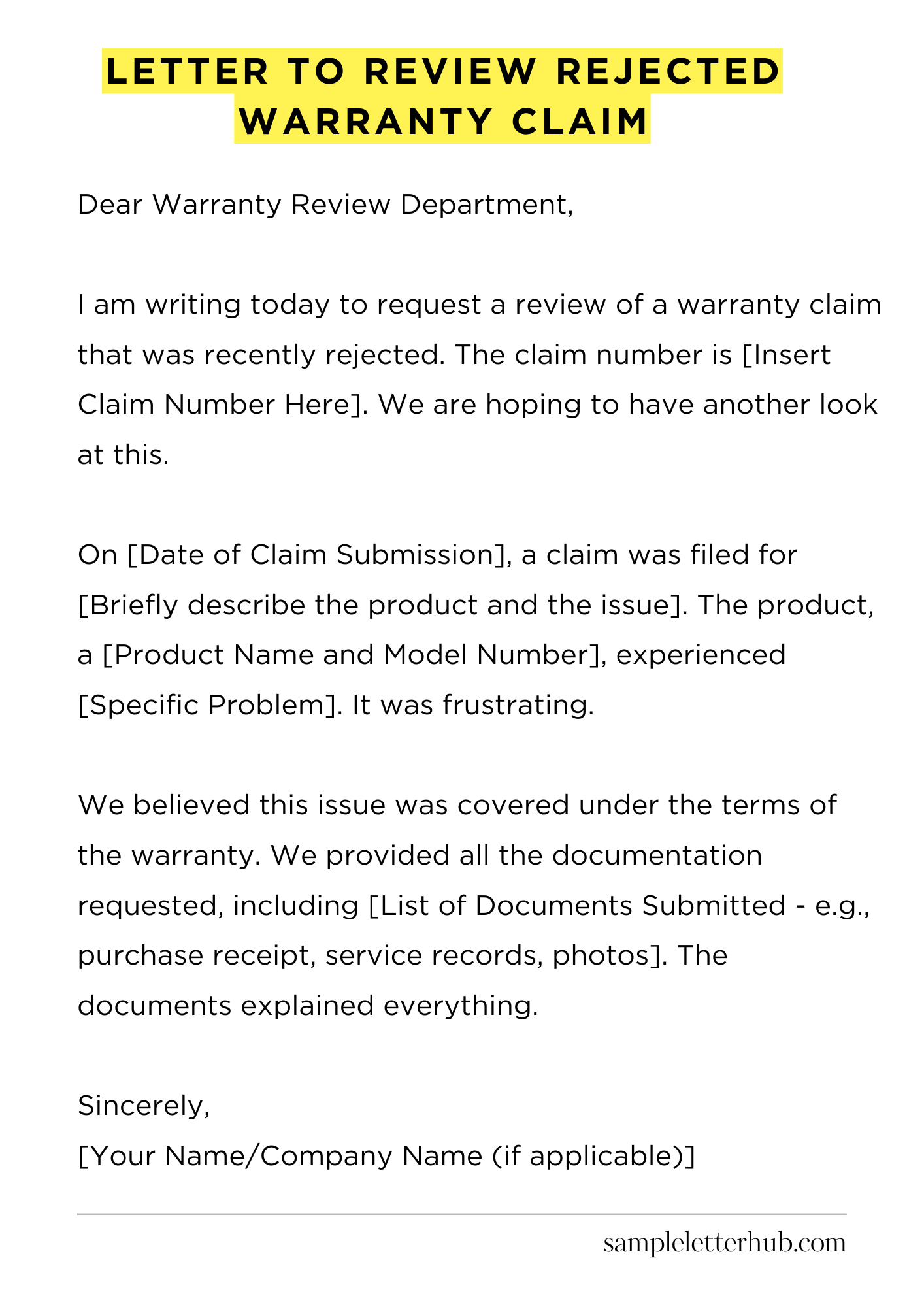
Dear Warranty Review Department,
I am writing today to request a review of a warranty claim that was recently rejected. The claim number is [Insert Claim Number Here]. We are hoping to have another look at this.
On [Date of Claim Submission], a claim was filed for [Briefly describe the product and the issue]. The product, a [Product Name and Model Number], experienced [Specific Problem]. It was frustrating.
We believed this issue was covered under the terms of the warranty. We provided all the documentation requested, including [List of Documents Submitted – e.g., purchase receipt, service records, photos]. The documents explained everything.
However, the claim was denied on [Date of Denial] for the reason of [State the Reason Given for Denial]. This reason was not as we understood it. We respectfully disagree with this decision for the following reasons: [Clearly and concisely explain why you disagree with the denial – 1-3 short bullet points are helpful here]. Explain clearly.
- [Reason 1, e.g., The damage occurred during normal use.]
- [Reason 2, e.g., The terms of the warranty do not exclude this type of issue.]
- [Reason 3, e.g., The provided repair estimates indicate that the issue is within the warranty guidelines.]
We have also attached [Mention any additional supporting documents you’re including, e.g., further evidence, updated repair estimates]. We want the best solution. We truly believe the [Product] still has value.
We kindly request that you reconsider the denial based on the information provided above and the attached documents. We would appreciate it if you would give this claim another careful review. We are available to answer any questions you may have. You can reach me by phone or email.
Thank you for your time and consideration. We await your response.
Sincerely,
[Your Name/Company Name (if applicable)]
How to Write Letter to Review Rejected Warranty Claim
A warranty claim denial can be frustrating. You’ve likely experienced a setback and are now grappling with the practicalities of rectifying the issue. Don’t despair. A well-crafted letter of appeal can sometimes reverse the decision. Follow these steps to maximize your chances of success. It’s time to draft a cogent argument.
1. Scrutinize the Denial Notice
The first step is to carefully analyze the rejection notice. The crux of your strategy lies in understanding the reasons for denial. Look for explicit justifications. Is the denial based on pre-existing damage? Improper usage?
Perhaps the claim falls outside the stipulated warranty period? Identify the precise grounds cited for refusal. Pinpoint the specific clauses in the warranty document the insurer is referencing. This meticulous examination forms the bedrock of your rebuttal.
2. Gather Pertinent Documentation
Amass all supporting documentation. This is where you buttress your claim. Collect any and all evidence. This might include the original purchase receipt, warranty card, service records, and photographs or videos demonstrating the issue.
Any correspondence with the manufacturer or retailer before the claim’s rejection should be included. If you’ve obtained expert opinions, such as a technician’s assessment, include those too. This information strengthens your case, serving as the ammunition for your argumentation.
3. Frame Your Opening Statement
Begin your letter with a polite, yet assertive, opening statement. State the purpose of the letter clearly and succinctly. Specify the product, the date of purchase, and the original claim reference number.
You may also include your contact information. Express your disappointment with the rejection and then declare your intent to appeal the decision. Be direct. Don’t be verbose. This sets the tone for your appeal and informs the reader what to expect.
4. Address the Denial Rationale
Here’s where you mount your counter-offensive. Systematically address each reason for denial, itemized by the insurer. If they allege pre-existing damage, provide evidence to the contrary.
If they claim improper use, explain how you used the product. Refute each point raised with facts and supporting documentation. Be precise in your language. For instance, if the denial pivots on “failure to adhere to routine maintenance,” counter with proof of regular servicing, and include relevant dates of inspection and services.
5. Present Your Case with Clarity
Your argument must be logically structured and easy to follow. Organize your points in a clear, concise manner. Use concise paragraphs, each tackling a specific point of contention.
Avoid jargon. Refrain from hyperbole. Maintain a professional tone throughout. This helps your argument resonate with greater impact. Use bullet points or numbered lists to highlight key pieces of evidence or points. Clarity is the most important facet for ensuring comprehension.
6. Request a Review and Desired Outcome
Politely request a reevaluation of your claim. Clearly state what resolution you seek. This might involve repair, replacement, or a refund, depending on the warranty terms.
Reiterate the supporting documentation attached to the letter, emphasizing the veracity of your claim. Specify a reasonable timeframe for the review. Finish the letter by thanking the claims adjuster for their time and consideration. Be hopeful but realistic.
7. Finalize and Submit
Before sending, proofread the letter meticulously. Check for grammar, spelling, and punctuation errors. Ensure all supporting documentation is properly attached or referenced.
Make a copy of the entire package for your records. Send the letter via certified mail with return receipt requested, to get tangible proof of delivery. This is a crucial final step. This establishes a firm record of the submission.
FAQs about Letter to Review Rejected Warranty Claim
What is the primary purpose of a letter to review a rejected warranty claim?
The primary purpose of a letter to review a rejected warranty claim is to formally contest the denial of warranty coverage. It aims to persuade the manufacturer or service provider to reconsider their decision by presenting additional information, evidence, or arguments supporting the claim that the warranty should apply.
What key information should be included in a letter to review a rejected warranty claim?
A well-crafted letter should include: the date of the original claim, the claim number, a clear statement of disagreement with the rejection, a detailed description of the product or service, the specific reasons why the warranty should apply (citing warranty terms), supporting evidence (photos, repair records, etc.), and a requested action (e.g., reevaluation, repair, refund).
What is the importance of providing supporting evidence in a review letter?
Supporting evidence is crucial as it strengthens the argument for warranty coverage. It can include documentation like purchase receipts, maintenance records, photos or videos of the defect or damage, and expert opinions. The more compelling and relevant the evidence, the higher the chances of a favorable review.
What are the possible outcomes after sending a letter to review a rejected warranty claim?
The outcomes can vary. The manufacturer or service provider may uphold their initial decision, reverse their decision and approve the claim, request further information, offer a partial solution (e.g., discounted repair), or initiate negotiations. The response time also varies, so patience is advised.
What steps should be taken if the review letter is unsuccessful?
If the review letter is unsuccessful, the consumer has several options. They could explore options like mediation, arbitration, or litigation. They could also contact consumer protection agencies for assistance or review the company’s internal dispute resolution process. The best course of action depends on the specifics of the warranty and local laws.
Related:
Resignation letter due to rude boss
Resignation letter moving to another state
Resignation letter due to illness of family member
Resignation letter due to study