

Ever paid for an insurance policy but didn’t use it? You might be entitled to a refund for unused insurance coverage. This happens when your policy term ends before you’ve filed a claim. The letter to request refund for unused insurance coverage is your formal way of asking the insurer for money back. The goal is to get back premiums you paid for coverage you didn’t need.
Feeling overwhelmed? Don’t worry. Crafting the perfect refund request letter can be easier than you think. We’ve got you covered. We’re providing letter templates, examples, and samples of a letter to request a refund for unused insurance!
Our easy-to-use letter samples will help you. They will guide you through writing your own refund letter. Whether it’s car insurance, home insurance, or another type, we have different formats. Get ready to write your letter to request a refund.
[Your Name]
[Your Address]
[Your Phone Number]
[Your Email Address]
[Date]
[Insurance Company Name]
[Insurance Company Address]
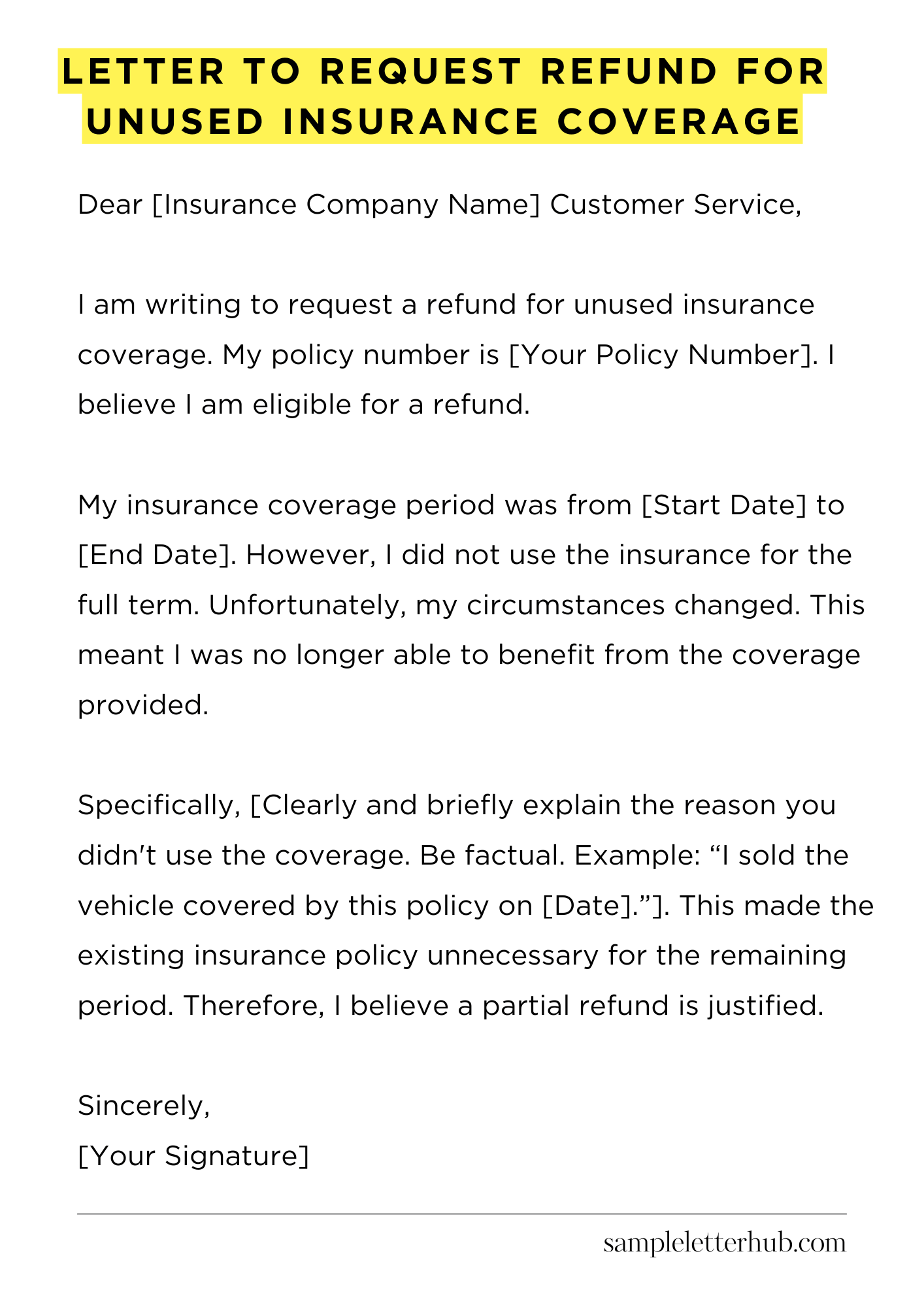
Dear [Insurance Company Name] Customer Service,
I am writing to request a refund for unused insurance coverage. My policy number is [Your Policy Number]. I believe I am eligible for a refund.
My insurance coverage period was from [Start Date] to [End Date]. However, I did not use the insurance for the full term. Unfortunately, my circumstances changed. This meant I was no longer able to benefit from the coverage provided.
Specifically, [Clearly and briefly explain the reason you didn’t use the coverage. Be factual. Example: “I sold the vehicle covered by this policy on [Date].”]. This made the existing insurance policy unnecessary for the remaining period. Therefore, I believe a partial refund is justified.
I have attached copies of [List any supporting documents you are including, e.g., “the bill of sale”, “proof of cancellation”]. I trust these documents will support my request. The attached documents are important for verification.
Could you please review my policy and process my refund request? I would appreciate it if you could inform me about the procedure involved and the expected amount of the refund. I am keen to understand all the steps.
Please send the refund to [Your preferred method of refund: “the original payment method”, “the address above”, etc.]. I look forward to hearing from you soon. I will be very happy with a quick response.
Thank you for your time and attention to this matter.
Sincerely,
[Your Signature]
How to Write Letter to Request Refund for Unused Insurance Coverage
Requesting a refund for unused insurance coverage might seem daunting, but armed with the right knowledge, it’s a straightforward process.
This guide will navigate you through crafting a compelling letter that maximizes your chances of a favorable outcome. Follow these steps meticulously, and you’ll be well on your way to reclaiming your unearned premium.
1. Commence with Cogent Correspondence: Your Salutation
Begin your missive with a formal and respectful salutation. Address the letter to the appropriate department or individual at your insurance provider.
You can typically find this information on your policy documentation or by contacting their customer service line. “Dear Claims Department” or “Dear Mr./Ms. [Last Name]” are acceptable options. Avoid informal greetings; professionalism is key.
2. Declare Your Intent: The Subject Line and Introductory Paragraph
The subject line is your first opportunity to capture the reader’s attention. Make it clear and concise: “Request for Refund – Policy Number [Your Policy Number]”.
In the introductory paragraph, explicitly state your request for a refund. Provide a brief overview of the situation, mentioning the policy’s start and end dates or the specific dates of coverage you wish to have adjusted. Be transparent from the outset.
3. Delineate the Circumstances: The Body of Your Plea
This is where you elucidate the reasons for your refund request. Clearly explain why the coverage wasn’t utilized. Did you sell the insured asset? Were you double-covered?
Did the policy period commence prematurely? Be precise. Provide all relevant details, dates, and any supporting evidence. The more specific you are, the stronger your case will be. Remember to maintain a tone of polite assertiveness.
4. Furnish Supporting Documentation: Bolster Your Argument
Include copies of any documents that substantiate your claim. This might encompass proof of sale (for instance, a bill of sale), documentation demonstrating duplicate coverage, or a cancellation notice. Ensure all copies are legible.
Reference these documents within the body of your letter: “Attached is a copy of the bill of sale for [Item]”. This lends credibility to your request.
5. Specify Your Expectations: Clearly State the Desired Outcome
Clearly state the amount of the refund you are requesting. If you’re uncertain, you can state, “I request a refund for the unused portion of my premium, calculated from [Start Date] to [End Date].”
Indicate your preferred method of refund (e.g., check, direct deposit). Provide the necessary information for the refund, such as your mailing address or banking details. This will facilitate the refund process.
6. Conclude with a Cordial Closing: Express Gratitude and Anticipation
Conclude your letter with a polite and professional closing. “Sincerely,” or “Respectfully,” are both appropriate choices. Express your gratitude for their time and consideration.
Include a concise statement of expectation regarding a response: “I look forward to receiving confirmation of my refund within [Number] business days.” Include your full name, contact number, and email address for easy communication.
7. Polishing Your Prose: Proofreading and Delivery
Before sending your letter, proofread it meticulously. Check for grammatical errors, spelling mistakes, and clarity. Ensure the letter is free from ambiguity. Make a copy of the letter and all supporting documents for your records.
Send the letter via certified mail with return receipt requested to provide proof of delivery. This is a critical step in case you need to escalate the matter.
FAQs about Letter to Request Refund for Unused Insurance Coverage
What information should I include in the letter?
Your letter should clearly state your policy number, the specific coverage period you’re requesting a refund for, and the reason for the refund (e.g., policy cancellation, change in circumstances).
Include your full name, address, contact information, and the date. You should also state the desired amount to be refunded and how you prefer to receive the refund (e.g., check, bank transfer). Finally, it’s wise to include any supporting documents like proof of cancellation.
What is the typical timeframe for receiving a refund?
The timeframe for receiving a refund varies depending on the insurance provider and the complexity of your request. Generally, it can take anywhere from a few weeks to a couple of months.
Some companies may process refunds quicker than others. It’s helpful to inquire about the estimated processing time when you submit your letter or check your policy terms and conditions.
What if the insurance company denies my refund request?
If your refund request is denied, carefully review the denial letter to understand the reason for the decision. You may have the option to appeal the decision by providing additional documentation or clarifying information. If you still disagree, you can contact your state’s insurance regulatory agency to file a formal complaint. In some cases, legal action might be a final resort.
What documents do I need to include with my letter?
The specific documents required will vary depending on the reason for your refund request and your insurance policy. However, common documents to include are a copy of your insurance policy, proof of payment (e.g., receipts, bank statements), and any documentation related to the event that resulted.
How should I send the letter to ensure it’s received?
It’s generally recommended to send your refund request letter via certified mail with return receipt requested. This provides proof that the insurance company received your letter and allows you to track its delivery. You should also keep a copy of the letter and all supporting documents for your records.
If possible, consider sending a digital copy via email, but always follow up with a physical copy sent via certified mail.
Related:
Resignation letter due to rude boss
Resignation letter moving to another state
Resignation letter due to illness of family member
Resignation letter due to study
Resignation letter due to long commute