


Need a letter to request payment or claim history? You’re in the right place. This letter is a formal way to ask for financial records. It helps you get important information quickly. Its primary purpose is to get detailed payment or claim history information.
Writing these letters can be tricky. We want to make it easy for you. That is why we are sharing letter to request payment templates. We also have claim history letter examples. These sample letters cover various situations.
Our payment request letter examples are ready to use. Need a specific type of claim history letter? You’ll find it here. Use these to draft your own letters today. Good luck!
[Your Name/Company Name]
[Your Address]
[Your Phone Number]
[Your Email Address]
[Date]
[Recipient Name/Company Name]
[Recipient Address]
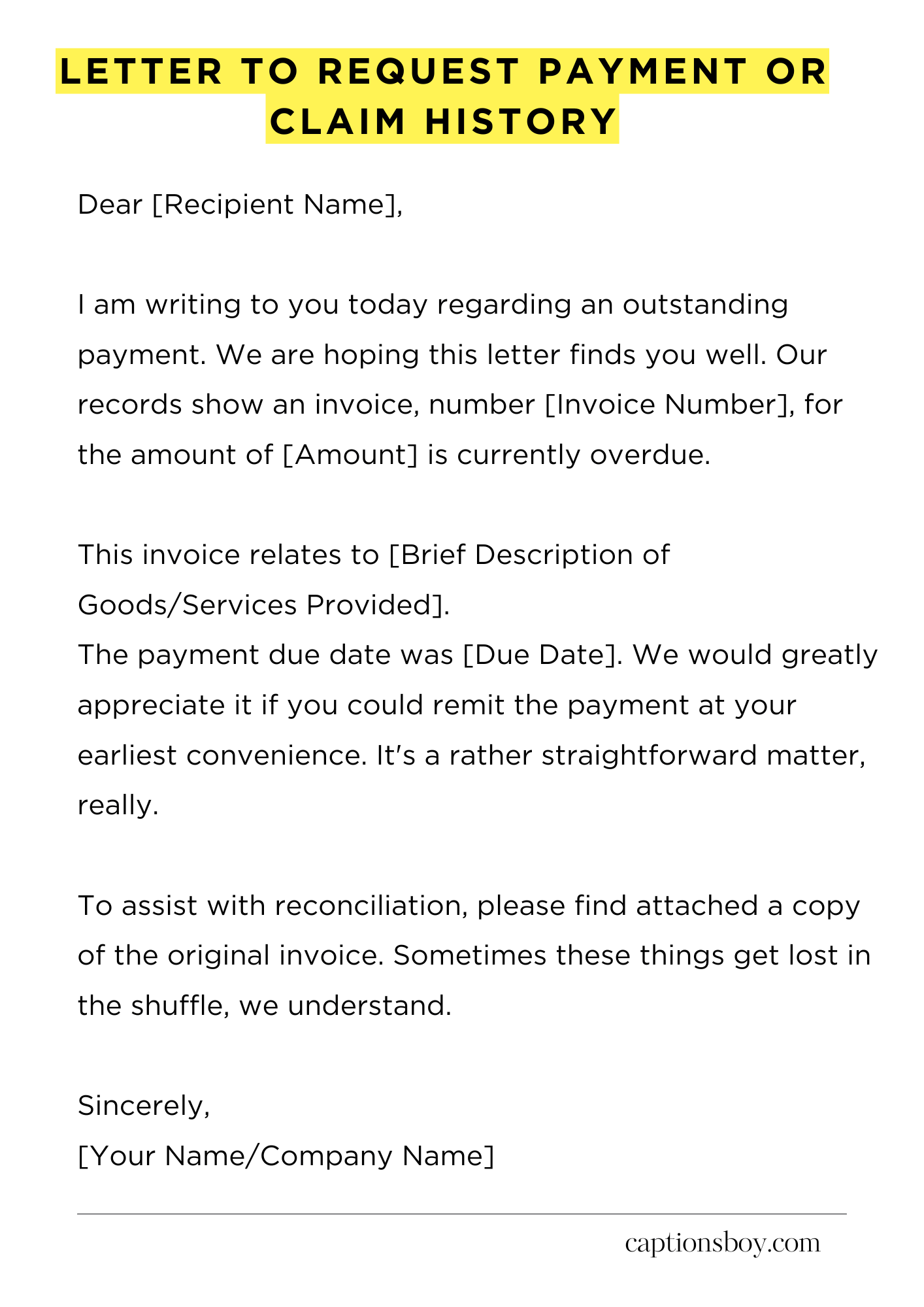
Dear [Recipient Name],
I am writing to you today regarding an outstanding payment. We are hoping this letter finds you well. Our records show an invoice, number [Invoice Number], for the amount of [Amount] is currently overdue. This invoice relates to [Brief Description of Goods/Services Provided].
The payment due date was [Due Date]. We would greatly appreciate it if you could remit the payment at your earliest convenience. It’s a rather straightforward matter, really.
To assist with reconciliation, please find attached a copy of the original invoice. Sometimes these things get lost in the shuffle, we understand.
Alternatively, if you have already submitted the payment, please disregard this letter. However, kindly forward the payment confirmation or reference number for our records. This would be a great help to us.
Also, we would like to request a complete claims history for [Policy Number/Account Number]. We need this information to [State the reason – e.g., reconcile our records, assess coverage, etc.]. This history should include all claims filed under this account, including dates, descriptions, and payment amounts. This is also very helpful.
We would be grateful if you could provide this claims history within [Number] days.
Thank you for your prompt attention to these matters. We value your business and appreciate your cooperation. We always aim to keep things moving smoothly.
Sincerely,
[Your Name/Company Name]
How to Write Letter to Request Payment or Claim History
1. Precursory Planning: Defining Your Objective
Before you even touch your keyboard or pen, it’s vital to crystallize your purpose. What precisely do you need? A payment for a completed service? A detailed account of your claim history? This initial phase dictates the tenor and content of your missive. This careful assessment provides the framework for the entire letter. Consider it the cornerstone of your persuasive argument.
2. The Art of the Salutation: Addressing the Recipient Correctly
Your opening gambit sets the tone. Use a formal salutation like “Dear Mr./Ms./Mx. [Surname]” for business communications. If you have a specific contact person, address them directly. This demonstrates respect and attention to detail. Avoid casual greetings; it’s always best to err on the side of formality. Remember, precision is paramount.
3. Illuminating the Core: The Body of Your Request
The body of the letter is where you unfurl your narrative. Explicitly state what you are requesting. Be succinct and crystal clear. Provide essential information: the invoice number, the claim reference, the dates involved, and the specific amount.
Back up your request with relevant documentation, such as copies of invoices or claim forms. Ensure that you have a clearly articulated case.
4. The Tangible Argument: Presenting Your Case Persuasively
Here’s where you articulate your rationale. Why should the recipient fulfill your request? Briefly, but powerfully, explain the context. If it’s a payment request, specify the work done. If it’s a claim history request, mention any pertinent events.
Keep it concise, avoiding unnecessary embellishments. Support your arguments with verifiable facts. This is the crux of your persuasion.
5. The Cogent Conclusion: Summarizing and Seeking Action
Conclude your letter by reiterating your request. State the desired action in no uncertain terms: “I request payment of [amount] by [date].” Or, “Please provide the requested claim history within [timeframe].” Express your gratitude for their consideration. Offer your contact information for any follow-up inquiries. This reinforces the core message and prompts a response.
6. The Grand Finale: Employing Proper Form and Style
Proofread your letter meticulously for grammatical errors, typos, and inconsistencies. Utilize a professional font like Times New Roman or Arial. Keep the tone formal, courteous, and businesslike. Maintain a consistent style throughout. The precision and polish of your letter are reflections of your professionalism.
7. Delivery and Follow-Up: Ensuring Receipt and Acknowledgment
Choose the appropriate method of delivery. For important requests, consider sending it via certified mail with a return receipt requested. This provides proof of delivery. Following up is crucial. If you don’t receive a response within a reasonable timeframe (typically 1-2 weeks), send a polite follow-up reminder. Persistence, when executed professionally, can yield results.
FAQs about Letter to Request Payment or Claim History
What information should I include in a letter requesting payment or claim history?
When drafting a letter requesting payment or claim history, it’s crucial to include your full name, address, contact information (phone number and email address), and account number or policy number, depending on the context. Clearly state the specific period for which you’re requesting the information.
Be explicit about what you’re seeking—whether it’s payment records, a detailed claim history, or both. Include any relevant dates, policy numbers, or claim numbers to facilitate accurate retrieval of the requested documents.
Finally, specify the preferred method for receiving the information (e.g., mail, email) and provide the relevant address or email.
Who should I send a letter requesting payment or claim history to?
The recipient of your letter depends on the nature of your request. If you’re seeking payment records, direct your letter to the billing department or customer service of the company you made the payment to (e.g., a credit card company, utility provider, or healthcare provider).
For claim history requests, send the letter to the claims department of your insurance provider or the relevant agency managing your insurance policy.
If unsure, consult your policy documents or company website for contact information. Ensure you send the letter to the correct department and address or email to avoid delays.
How long does it typically take to receive a response to a request for payment or claim history?
The response time varies depending on the organization and the complexity of your request. It’s generally advisable to allow at least 15 to 30 business days for a response.
Some companies may process requests faster, especially if submitted electronically, while others, particularly those with a backlog or needing to manually search for information, may take longer.
If you haven’t received a response within the estimated timeframe, consider following up with a phone call or a second written request.
What are the legal implications of requesting payment or claim history?
Requesting payment or claim history is generally a straightforward process with few direct legal implications for the requester. However, the information you receive may have legal significance, especially if you’re involved in a dispute or legal proceeding.
If the information reveals errors or discrepancies, it may serve as evidence in your favor. Conversely, if the history contradicts your claims, it could negatively impact your case.
Always retain copies of your requests and any responses for your records. Be aware of any privacy laws that may affect how your information is handled.
What if I disagree with the payment or claim history provided?
If you find discrepancies or disagree with the information provided, it’s crucial to take the following steps: review the documentation thoroughly, gather any supporting evidence (e.g., receipts, policy documents), and then contact the company or provider immediately. Communicate your concerns clearly and concisely, referencing specific details and providing your evidence. You can file a formal complaint or start an appeal process, depending on the situation. Maintain detailed records of all communications, and if necessary, consider seeking legal counsel or assistance from a consumer protection agency.
Related:
Resignation letter due to rude boss
Resignation letter moving to another state
Resignation letter due to illness of family member
Resignation letter due to study
Resignation letter due to long commute