

Dealing with insurance billing errors can be a headache. A letter to request correction of insurance billing error is your tool. Its purpose is simple: to inform your insurance company of a mistake. You provide supporting documentation. You request a correction to your insurance claim. This can save you money and frustration.
Writing this type of letter doesn’t have to be complicated. We are here to help. We’ll provide you with several letter to request correction of insurance billing error samples. These are letter templates. They cover common scenarios. We will make it easy to draft your own letter today.
Our goal is to give you a head start. Use these examples. Modify them to fit your situation. Navigate the world of insurance billing with confidence. Let’s get started on your letter to insurance company.
[Your Name]
[Your Address]
[Your Phone Number]
[Your Email Address]
[Date]
[Insurance Company Name]
[Insurance Company Address]
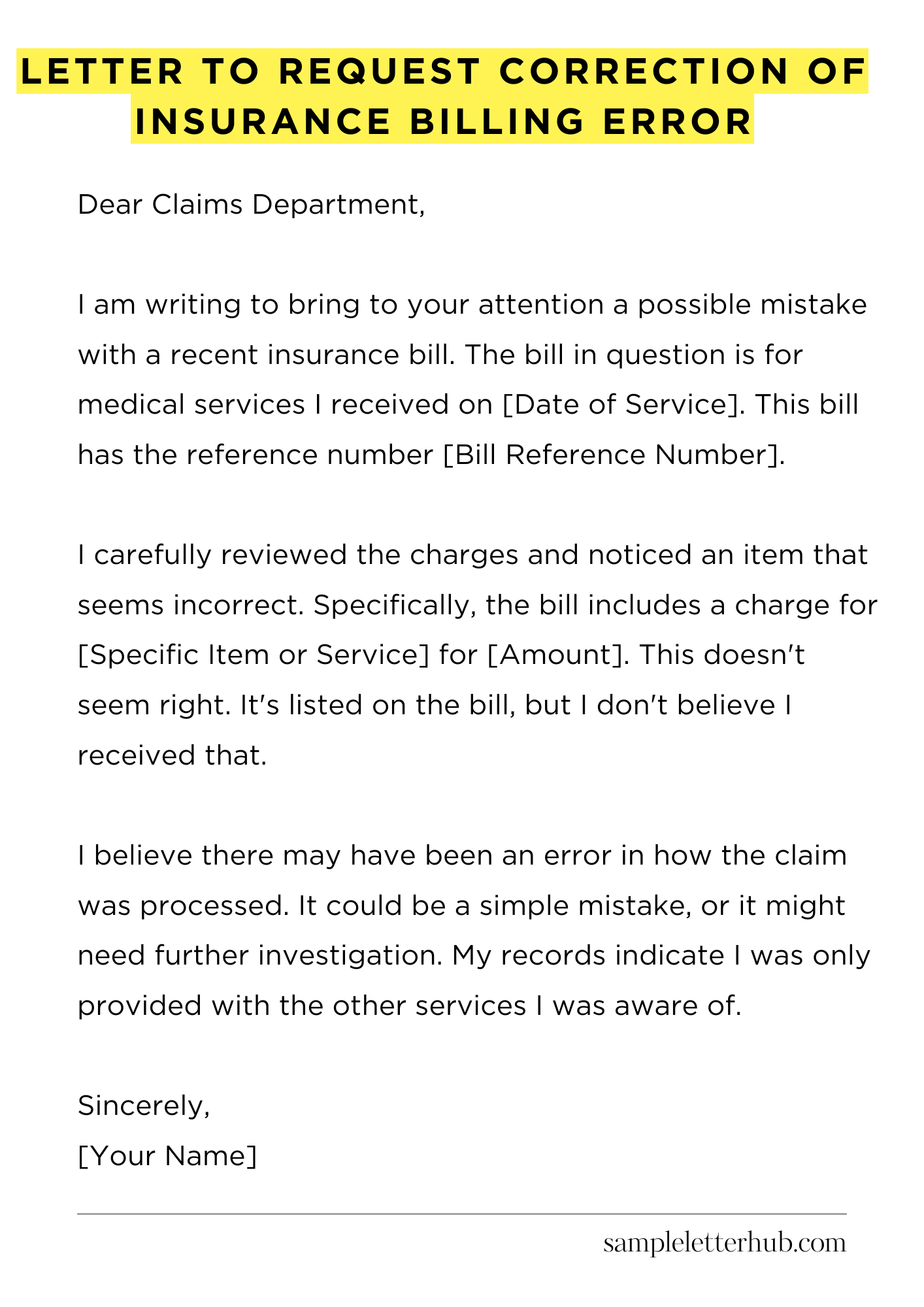
Dear Claims Department,
I am writing to bring to your attention a possible mistake with a recent insurance bill. The bill in question is for medical services I received on [Date of Service]. This bill has the reference number [Bill Reference Number].
I carefully reviewed the charges and noticed an item that seems incorrect. Specifically, the bill includes a charge for [Specific Item or Service] for [Amount]. This doesn’t seem right. It’s listed on the bill, but I don’t believe I received that.
I believe there may have been an error in how the claim was processed. It could be a simple mistake, or it might need further investigation. My records indicate I was only provided with the other services I was aware of.
To help you with this, I am including a copy of my [Relevant Document – e.g., Explanation of Benefits, Appointment Summary] and [Another Relevant Document – e.g., Receipt]. These documents should provide additional information. They should help you to clear things up quickly.
Could you please review the bill and make the necessary corrections? I would greatly appreciate it. I would like to make sure that everything is correct.
I would be grateful if you could notify me of the outcome of your review and any adjustments made. You can reach me at the phone number or email address listed above. I look forward to hearing from you soon. I am expecting your reply.
Thank you for your time and attention to this matter. I appreciate your assistance.
Sincerely,
[Your Name]
How to Write Letter to Request Correction of Insurance Billing Error
Encountering an erroneous insurance bill can be a frustrating experience. It is important to remember that proactive communication is key to rectifying these situations. This guide provides a detailed roadmap to crafting a compelling letter, ensuring your concerns are heard and resolved efficiently.
1. Initiate: Gathering Your Arsenal of Information
Before you even begin to draft a single sentence, you need to collect all relevant documentation. This is your initial strategic imperative. Assemble the following, creating an effective dossier:
- Your insurance policy number.
- The specific bill(s) in question.
- Any Explanation of Benefits (EOBs) you’ve received related to the erroneous billing.
- Statements from your healthcare provider.
- Any other paperwork that can substantiate your claim, for instance, records of payments.
Having a thorough compendium of evidence strengthens your position and expedites the resolution process.
2. Format: Crafting a Professional Missive
Your letter’s appearance is as important as its content; it signals respect and professionalism. Begin with your full name, address, and contact information at the top left. Then, on the right, include the date. Directly beneath this, provide the insurance company’s name and address. Maintain a formal tone throughout the letter.
3. Salutation: Choosing the Right Greeting
Start your letter with a formal salutation. “Dear [Insurance Company Representative/Customer Service Department],” is a safe and polite choice. If you have a specific contact person, address the letter to them. Avoid overly casual greetings; keep it concise and dignified.
4. Enunciation: Articulating the Issue with Precision
This is where you clearly state the purpose of your letter. Start by explicitly stating you are writing to dispute an erroneous billing error. Provide the specifics: the bill date, the bill amount, and the service(s) listed. State what you believe the error to be, with a high degree of clarity.
Be unequivocal. Substantiate your claims. Include concrete examples.
5. Substantiation: Presenting Your Corroborating Evidence
This section is the heart of your argument. Detail the specific evidence supporting your claim. “Please refer to the attached copy of my EOB, which indicates…” or “As evidenced by the invoice from my provider, which demonstrates…”.
Attach copies of all supporting documentation—do not send originals—and explicitly reference each attachment within your text. Ensure all attachments are clearly labeled and referenced in your letter to help the reviewer go through them quickly and comprehensively.
6. Request: Defining the Desired Outcome
Clearly state what action you want the insurance company to take. This is critical. Do you want them to correct the bill? Issue a refund? Provide a revised EOB? Be specific.
For instance, “I request that you revise the bill to reflect the correct charges and reimburse me for any overpayment.” The clearer your request, the higher the probability of your desired outcome.
7. Conclusion & Closing: Finalizing the Correspondance
Conclude your letter politely but firmly. State your expectation for a timely response. Include a closing statement, like “Sincerely,” or “Respectfully,” followed by your typed name.
Under your typed name, leave space for your signature and sign the letter. It is useful to include “Enclosures:” followed by a list of all attached documents. Keep a copy of the entire letter, including all attachments, for your records. Consider sending your letter via certified mail with a return receipt requested. This provides proof that the insurance company received your correspondence.
FAQs about Letter to Request Correction of Insurance Billing Error
What information should I include in my letter to request a correction of an insurance billing error?
Your letter should clearly state the error, providing specific details such as the date of service, the claim number, the policyholder’s name, the patient’s name (if different), and the specific service in question. Include any relevant documentation like an Explanation of Benefits (EOB) or receipts.
Be sure to explain the nature of the error, indicating why you believe the bill is incorrect, and specify the correct amount you believe is owed. Finally, provide your contact information, including your name, address, phone number, and email address, for easy communication.
Who should I address my letter to when requesting a correction of an insurance billing error?
The addressee of your letter will depend on the insurance provider’s specific instructions. Generally, you should address the letter to the “Appeals Department,” “Claims Department,” or a similar department responsible for handling billing disputes.
You can usually find the correct department and mailing address on your Explanation of Benefits (EOB) form, the insurance company’s website, or by contacting their customer service department. If the error originates with a medical provider, you might first address your request to their billing department before involving the insurance company directly.
What supporting documentation should I include with my letter?
The supporting documentation you include is crucial for substantiating your claim. This typically includes a copy of the Explanation of Benefits (EOB) that shows the billing error, any receipts or invoices related to the service in question, and any other relevant documentation, such as medical records or statements from the healthcare provider.
Gathering all necessary documents upfront helps expedite the correction process and provides clear evidence to support your claim.
What is the typical timeframe for an insurance company to respond to a request for correction?
The timeframe for an insurance company to respond to a request for correction varies. It’s often dictated by state regulations or the terms of your insurance policy.
However, most insurance companies aim to respond within 30 to 60 days of receiving your request. Be sure to check your insurance policy for their specific guidelines. If you haven’t received a response within the stated timeframe, follow up with the insurance company by phone or mail, referencing your original request and the date it was sent.
What steps should I take if the insurance company denies my request for correction?
If the insurance company denies your request for correction, you should first carefully review the denial to understand the reasoning behind it.
The denial should provide information on the appeals process, including any deadlines for filing an appeal. You should gather any additional evidence to support your claim. Initiate the appeals process by writing a formal appeal letter, providing a detailed explanation of why you disagree with the denial, and including all supporting documentation.
If the appeal is also denied, and the amount in dispute is significant, you may consider contacting your state’s insurance regulatory agency or seeking legal advice.
Related:
Resignation letter due to rude boss
Resignation letter moving to another state
Resignation letter due to illness of family member
Resignation letter due to study