


Changing your insurance policy is sometimes necessary. A letter to remove beneficiary from insurance policy is a formal document. It informs the insurance company of your intent. The purpose is to legally remove a person or entity from receiving benefits. This ensures your assets go where you intend.
We know it can be a tricky process. That is why we are here to help. This article provides helpful resources for you. We will share letter to remove beneficiary from insurance policy templates. You’ll find different examples and samples. Our goal is to make it easy to write your own letter.
Need to disinherit someone? Or simply update your policy? These beneficiary removal letter samples cover various situations. You can adapt them to your specific needs. Using these templates can save you time and hassle. You can easily craft your own letter to remove beneficiary quickly.
[Your Name]
[Your Address]
[Your Phone Number]
[Your Email Address]
[Date]
[Insurance Company Name]
[Insurance Company Address]
Subject: Request to Remove Beneficiary from Insurance Policy – Policy Number [Your Policy Number]
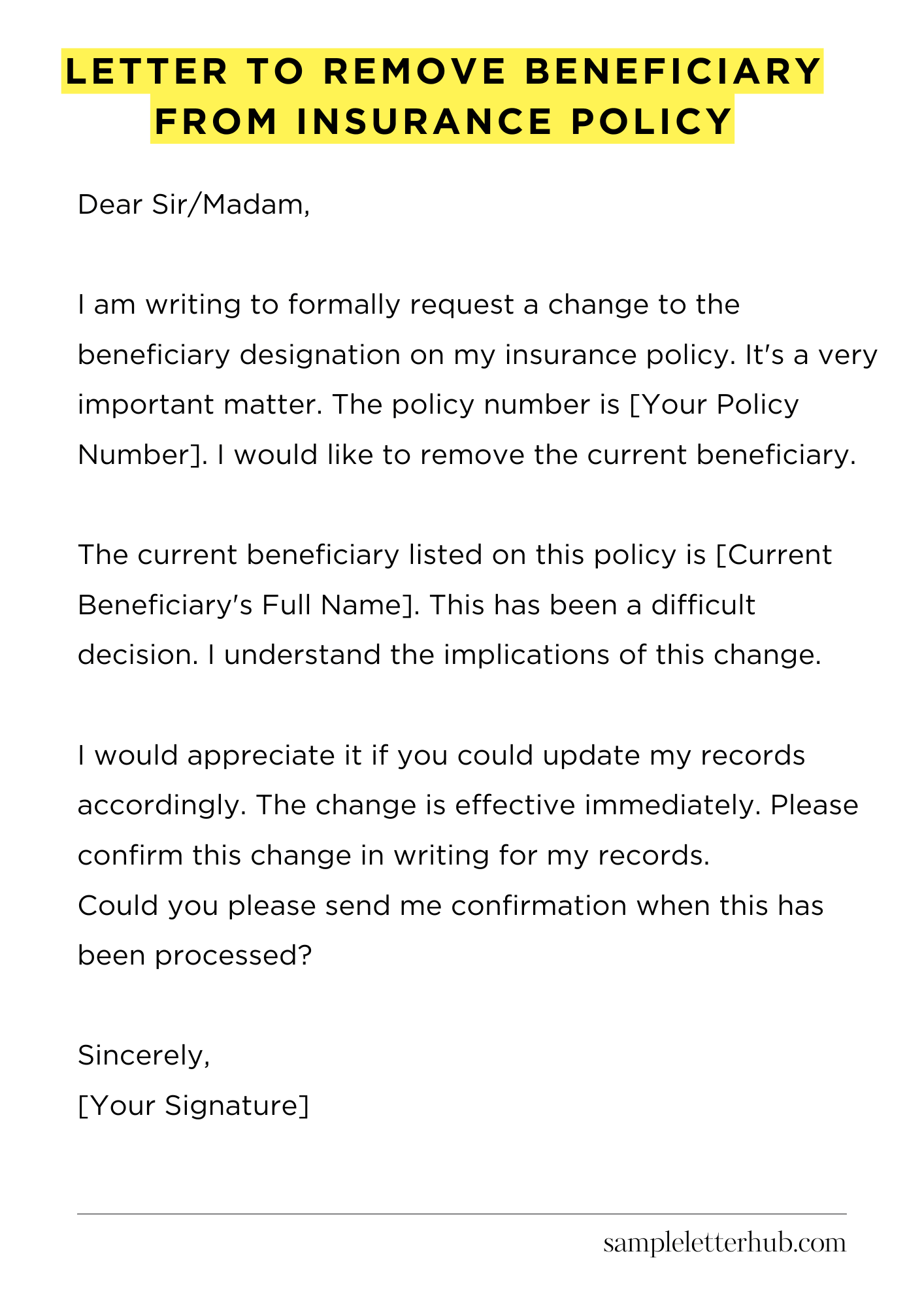
Dear Sir/Madam,
I am writing to formally request a change to the beneficiary designation on my insurance policy. It’s a very important matter. The policy number is [Your Policy Number]. I would like to remove the current beneficiary.
The current beneficiary listed on this policy is [Current Beneficiary’s Full Name]. This has been a difficult decision. I understand the implications of this change.
I would appreciate it if you could update my records accordingly. The change is effective immediately. Please confirm this change in writing for my records.
Could you please send me confirmation when this has been processed? It’s essential to ensure everything is correct. I would like to receive this confirmation at the address listed above.
Thank you very much for your time and assistance in this matter. I appreciate your prompt attention to my request.
Sincerely,
[Your Signature]
How to Write Letter to Remove Beneficiary from Insurance Policy
Life changes, and sometimes those changes necessitate alterations to your insurance policies. One of the most common adjustments is removing a beneficiary.
This process, while straightforward, demands a meticulously crafted letter. Proper execution ensures your wishes are legally binding and unequivocally understood by your insurance provider. Let’s unravel the intricacies of composing such a letter.
1. Identifying the Policy and the Players
Before you even begin to formulate a single sentence, you need foundational information. Start by meticulously gathering all the relevant policy documentation. Locate the policy number – this is paramount and serves as the bedrock of your request. Pinpoint the name of the insured (that’s you!) and the current beneficiary or beneficiaries you intend to excise.
Double-check all spellings. Accuracy is not merely a virtue here; it’s a prerequisite for a legally sound document. Finally, ascertain the full name and address of your insurance provider; you’ll need it for delivery. Don’t commence writing until you have these details at your fingertips.
2. Crafting the Salutation and the Introduction
Your letter must commence with a professional salutation. Use “Dear [Insurance Company Name] Customer Service” or “To Whom It May Concern,” depending on your familiarity with the company’s internal structure. In the introductory paragraph, succinctly state the purpose of your communication.
Clearly declare your intent: to remove a specified beneficiary from the designated insurance policy. Include the policy number immediately, again, reinforcing its importance. Briefly mention the insured’s name as well. This establishes your position and the subject matter from the get-go. Clarity and directness are your allies here.
3. Specifying the Beneficiary Removal
This is the core of your communication. Clearly and unequivocally state the name of the beneficiary you wish to remove. Include their full legal name and any other identifying information, such as their date of birth or last known address if the policy documents contain them.
Explicitly state that you are removing this individual as a beneficiary. Use declarative sentences: “I am requesting that [Beneficiary’s Full Name] be removed as a beneficiary from Policy Number [Policy Number].” Employ precise language; ambiguity could be detrimental. You must meticulously convey your intent.
4. Designating New Beneficiaries (Optional but Recommended)
If you intend to add or replace beneficiaries, now is the time to articulate those wishes. For each new beneficiary, provide their full legal name, date of birth (highly recommended), relationship to you, and current address.
Indicate the percentage or proportion of the death benefit each beneficiary should receive. Be incredibly clear about this apportionment; otherwise, it will be subject to state law.
5. Your Signature and Notarization
Your signature transforms the letter from a mere document into a legally binding directive. Sign your full legal name, exactly as it appears on your policy. Below your signature, type your printed name and the date. In some cases, depending on the insurance company’s specific requirements or your state’s laws, notarization of your signature may be necessary.
This requires you to sign the letter in the presence of a notary public, who will then affix their seal and signature to verify your identity. Check your policy’s conditions for additional details.
6. Delivery and Retention
Once your letter is complete, make a copy for your records. This is vital. Consider sending the original letter via certified mail with a return receipt requested.
This ensures proof of delivery and confirmation that the insurance company received your request. Retain the copy of the letter, the return receipt, and any acknowledgment from the insurance company in a secure location. This documentation will be invaluable for future reference.
7. Follow-Up and Confirmation
After sending the letter, proactively follow up with your insurance provider. Allow a reasonable timeframe (usually a few weeks) for processing. Then, contact them to confirm receipt of your request and verify that the beneficiary change has been implemented.
Request a confirmation letter or a revised policy document that reflects the changes. This offers definitive proof and provides you with the peace of mind of knowing that your wishes are duly recorded.
FAQs about Letter to Remove Beneficiary from Insurance Policy
What is a letter to remove a beneficiary from an insurance policy?
A letter to remove a beneficiary from an insurance policy is a formal written document sent to the insurance company by the policyholder. This letter officially instructs the insurance provider to remove a previously designated individual or entity from receiving the death benefit upon the policyholder’s passing.
This ensures that the proceeds are distributed according to the policyholder’s current wishes, reflecting changes in personal circumstances or relationships.
How do I write a letter to remove a beneficiary?
A typical letter to remove a beneficiary should include the policyholder’s full name, policy number, and contact information. It should clearly state the intention to remove the beneficiary’s name, along with the beneficiary’s full name and relationship to the policyholder.
The letter should be dated and signed by the policyholder, and some insurance companies may require the signature to be notarized. It is important to also specify if a new beneficiary is to be named or if the policy should default to contingent beneficiaries or the estate.
What information do I need to include in the letter?
The essential information to include is the policyholder’s full legal name, the policy number, and the specific beneficiary to be removed, including their full legal name and current contact details if known.
The letter must explicitly state the intention to remove the beneficiary. Include the date and the policyholder’s signature. Consider mentioning any new beneficiaries if you want to replace them immediately, or you may be able to file a separate form for this.
Do I need to inform the beneficiary I am removing them?
No, you are generally not legally obligated to inform the beneficiary that you are removing them from your insurance policy. The decision to remove a beneficiary is private and solely at the discretion of the policyholder.
However, depending on personal relationships, you might consider informing the individual to avoid any potential misunderstandings or distress after your death. The letter is solely between the policyholder and the insurance company.
What happens after I send the letter to the insurance company?
After you submit the letter, the insurance company will process the request. They will typically send a written confirmation to the policyholder acknowledging the change. It is crucial to keep this confirmation for your records.
This confirmation serves as proof that the beneficiary change has been officially recorded. It is advisable to review the policy details periodically, especially after making changes, to ensure everything aligns with your current wishes.
Related:
Resignation letter due to rude boss
Resignation letter moving to another state
Resignation letter due to illness of family member
Resignation letter due to study
Resignation letter due to long commute