

Dealing with an insurance claim? You’ll likely need to send a letter to provide supporting documents for insurance claim. This letter is crucial. Its purpose is to officially share the documents needed to support your insurance claim. It helps the insurer assess your claim accurately.
Writing this letter can seem daunting. Don’t worry, we’re here to help! We’ll provide you with various templates, examples, and samples of a letter to provide supporting documents for insurance claim. This will make the process simple.
Our aim is to empower you. These sample letters will make it easy to craft your own. Whether it’s a car accident claim or a medical bill, you’ll find guidance. Get ready to simplify your insurance claim process today!
[Your Name/Insurance Company Representative Name]
[Your Address]
[Your Phone Number]
[Your Email Address]
[Date]
[Insurance Company Name]
[Insurance Company Address]
Dear [Recipient Name/Claims Department],
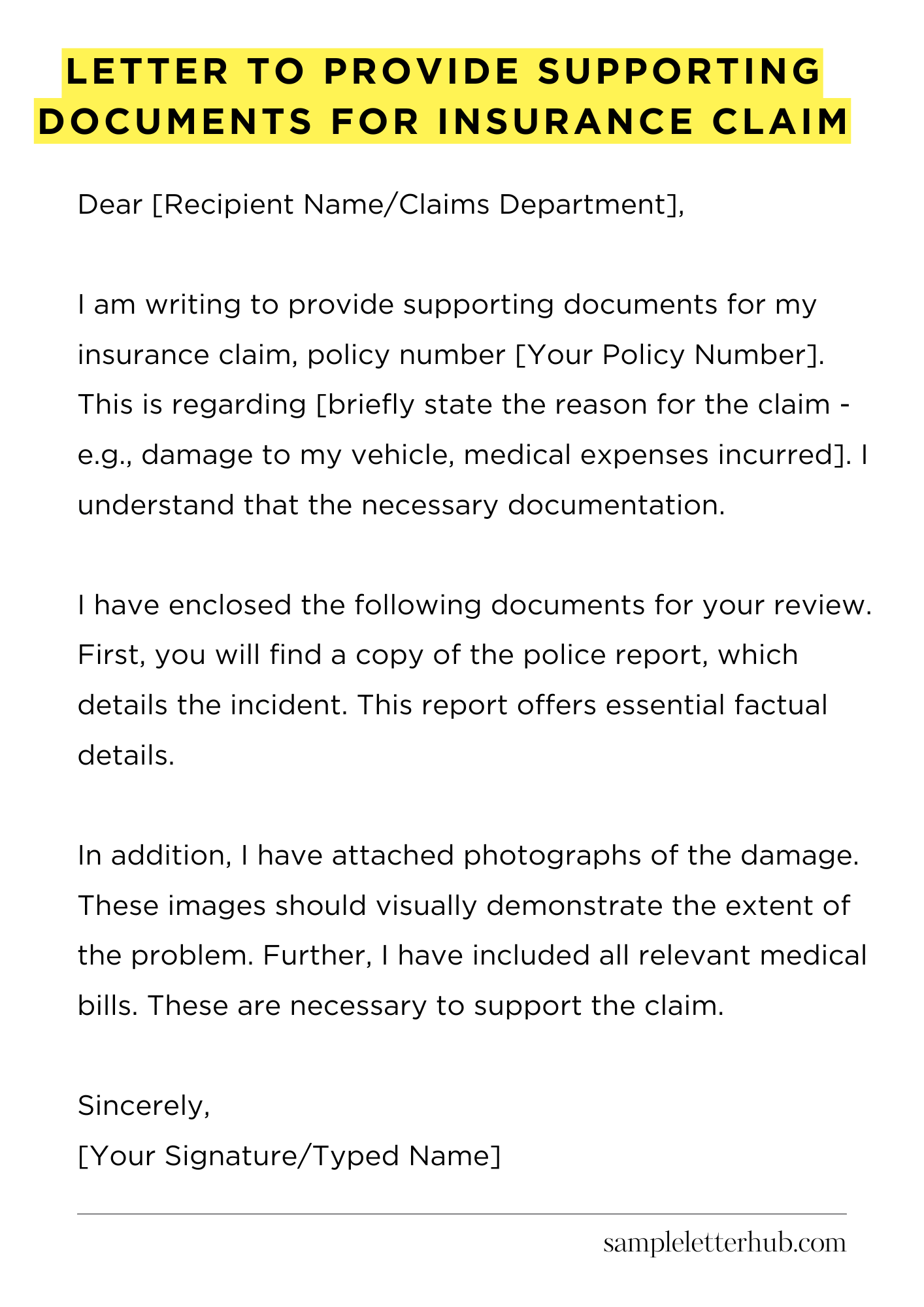
I am writing to provide supporting documents for my insurance claim, policy number [Your Policy Number]. This is regarding [briefly state the reason for the claim – e.g., damage to my vehicle, medical expenses incurred]. I understand that the necessary documentation is crucial for the efficient processing of my claim.
I have enclosed the following documents for your review. First, you will find a copy of the police report, which details the incident. This report offers essential factual details. Also included is a detailed estimate from a certified mechanic for the repair of the vehicle. This clearly outlines the estimated costs involved.
In addition, I have attached photographs of the damage.
These images should visually demonstrate the extent of the problem. Further, I have included all relevant medical bills. These are necessary to support the claim.
I have also provided a statement from a witness who saw the incident occur. This supporting documentation may help you assess the claim. I believe that all the necessary information for a swift claim resolution has been provided.
Please let me know if you require any further information or documentation. I am available to answer any questions you may have. I look forward to hearing from you soon regarding the status of my claim. Thank you for your time and attention to this matter.
Sincerely,
[Your Signature/Typed Name]
How to Write Letter to Provide Supporting Documents for Insurance Claim
Submitting an insurance claim can be a labyrinthine process. It is a necessary evil that almost everyone has to face at some point. Ensuring your claim’s expeditious processing often hinges on the meticulous provision of supporting documentation. This is where a well-crafted letter comes into play.
1. Commence with Precise Identification
Your letter’s commencement must be impeccably clear. Begin by including your full name, address, and contact information. These are essential for identification and communication.
Immediately following this, append the insurance policy number, claim number, and the date the claim was filed. This information swiftly allows the claims adjuster to contextualize your communication.
2. Articulate the Core Objective
In the opening paragraph, unequivocally state the purpose of your letter. This is the crux. Indicate that you are submitting supporting documentation for your insurance claim.
Specify the nature of the claim (e.g., property damage, medical expenses, etc.). Directness here is paramount. Your goal is swift and unambiguous comprehension.
3. Detail the Included Documentation
Carefully itemize each document you are providing. Include a brief description of each, such as “copy of the invoice,” “medical report from Dr. Smith,” or “police report number.”
Be exhaustive to mitigate any potential confusion. This meticulous approach aids the adjuster in verifying that they have received all the necessary paperwork.
4. Elucidate the Pertinent Circumstances
While the initial claim may have provided preliminary details, briefly reiterate the salient facts of the incident. This is an opportunity to reinforce the context. Keep this section succinct, focusing on the key events that precipitated the claim. Avoid superfluous details that might obscure the core narrative.
5. Maintain an Impeccable Tone
The tone of your letter should be professional and courteous. Refrain from accusatory language or emotional outbursts. Focus on providing the facts in a calm and collected manner.
Remember, this is a formal communication, so stick to a professional demeanor throughout. This will contribute to a smoother claims process.
6. The Concluding Salutation and Signature
Conclude your letter with a formal closing, such as “Sincerely” or “Respectfully.” Sign the letter legibly, ideally using the same signature that appears on your insurance policy.
Below your signature, type your full name. This final step formalizes the communication and provides an unambiguous confirmation of authorship.
7. Delivery and Archival
Send your letter and all supporting documentation via a traceable method, such as certified mail with return receipt requested. This provides proof of delivery.
Additionally, retain a copy of the letter and all enclosed documents for your records. This is critical for future reference. This practice is essential for maintaining a comprehensive record of your claim.
FAQs about Letter to Provide Supporting Documents for Insurance Claim
What is the purpose of a letter providing supporting documents for an insurance claim?
The primary purpose of a letter accompanying supporting documents for an insurance claim is to formally submit evidence substantiating the claim.
This evidence helps the insurance provider assess the validity and scope of the claim, leading to a decision on coverage and the amount of compensation, if any, to be paid. The letter serves as an official record of the submission and helps ensure all necessary documentation is received and reviewed.
What types of documents should I include with my letter?
The specific documents needed vary depending on the nature of the insurance claim. Generally, you should include documents that prove the event occurred, demonstrate the extent of the loss or damage, and support the associated costs.
Examples include police reports, medical records, repair estimates, photographs, invoices, receipts, and any other documentation specifically requested by the insurance company.
How should I format and write the letter?
The letter should be professional and clear, providing essential details about the claim. Begin with your contact information, the date, and the insurance company’s address.
Clearly state your policy number and a brief description of the incident. List the included documents and their relevance. Keep the language concise, factual, and avoid emotional language. Proofread carefully before sending.
Where should I send the letter and supporting documents?
The letter and supporting documents should be sent to the insurance company’s claims department or the address specifically designated for claims submissions.
This information can typically be found within your insurance policy documents or on the insurance company’s website. It is advisable to send the documents via a method that provides proof of delivery, such as certified mail or a courier service, or through the insurance company’s online portal if available.
What happens after I submit the letter and supporting documents?
After submission, the insurance company will review the documents and investigate the claim. They may contact you for further information or clarification.
Once their investigation is complete, they will make a decision on your claim – either accepting it and detailing the coverage amount, denying it with an explanation, or requesting additional information. You should receive a written notification of their decision.
Related:
Resignation letter due to rude boss
Resignation letter moving to another state
Resignation letter due to illness of family member
Resignation letter due to study