


Facing a rejected insurance claim? Need to appeal it? A letter to explain prior rejected claim is your tool. Its purpose is simple. You explain why the initial denial was incorrect. You provide new information. This letter helps insurance companies reconsider their decision.
We’re here to help you navigate this process. This article contains letter to explain prior rejected claim templates. We also have examples and samples. Using these, you can easily craft your own insurance claim appeal letter. They make the process simple.
Our goal is to assist you. Our provided examples cover various situations. From denied medical claims to property damage denials, we got you covered. Get ready to write a compelling appeal letter without any stress!
[Your Name/Company Name (If Applicable)]
[Your Address]
[Your City, State, ZIP Code]
[Your Email]
[Your Phone Number]
[Date]
[Recipient Name/Company Name]
[Recipient Address]
[Recipient City, State, ZIP Code]
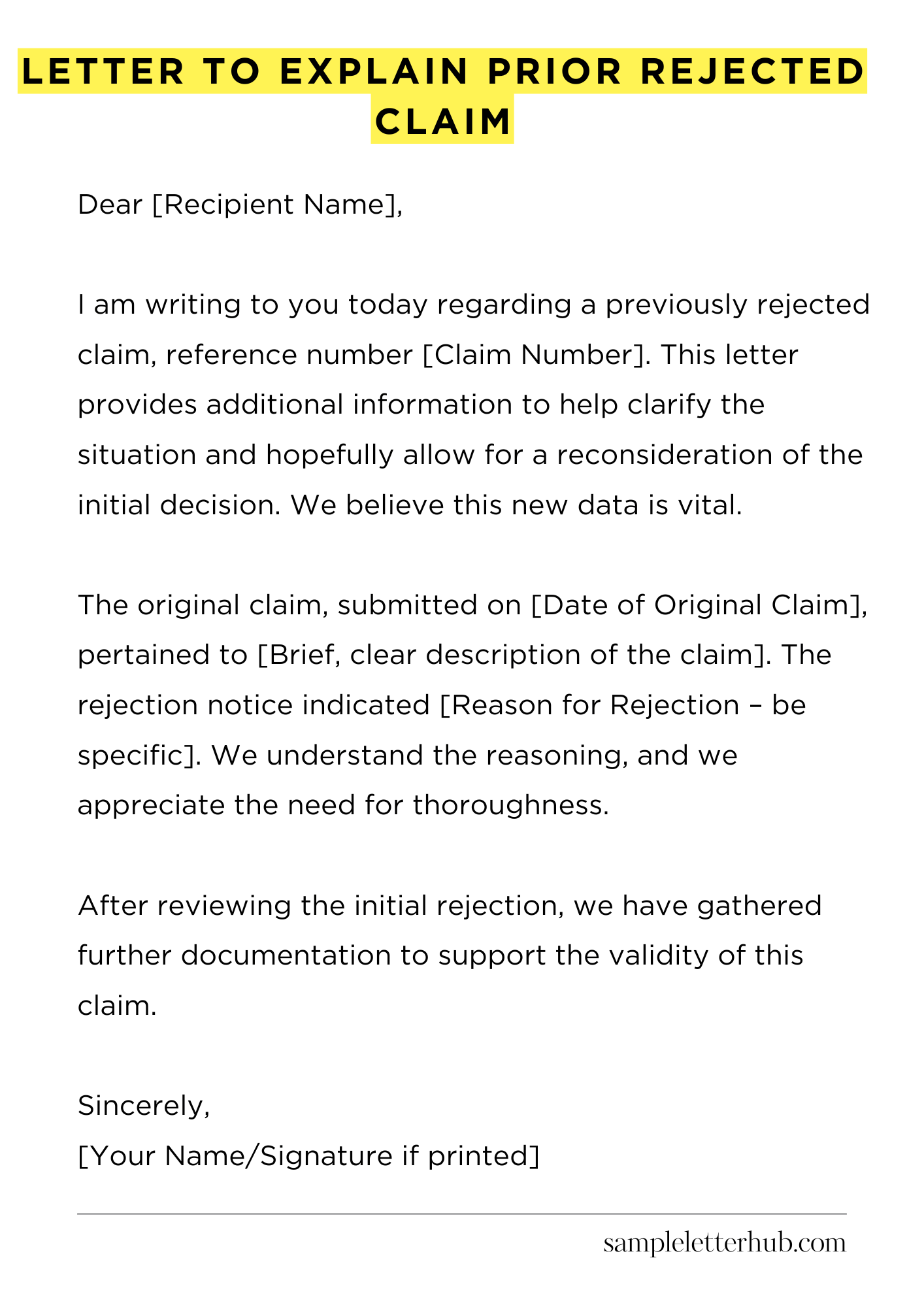
Dear [Recipient Name],
I am writing to you today regarding a previously rejected claim, reference number [Claim Number]. This letter provides additional information to help clarify the situation and hopefully allow for a reconsideration of the initial decision. We believe this new data is vital.
The original claim, submitted on [Date of Original Claim], pertained to [Brief, clear description of the claim]. The rejection notice indicated [Reason for Rejection – be specific]. We understand the reasoning, and we appreciate the need for thoroughness.
After reviewing the initial rejection, we have gathered further documentation to support the validity of this claim. These documents include [List the documents – e.g., updated medical records, additional invoices, supplementary reports].
These are now attached to this letter for your review. The new data more clearly demonstrates the necessity of [Service/Item] for [Patient/Client]. This is critical to the issue.
Specifically, the attached [Document Name] provides [Explain what the document shows and why it’s important]. Furthermore, we would like to highlight [Specific detail from the new information that supports the claim]. The overall condition of [Patient/Client] will certainly improve.
We believe that the additional information provided clearly addresses the concerns outlined in the original rejection notice. We hope that this new documentation will allow you to re-evaluate the claim favorably. We are prepared to answer any further questions.
Thank you for your time and consideration in this matter. We look forward to your response and a positive outcome.
Sincerely,
[Your Name/Signature if printed]
How to Write a Letter to Explain a Prior Rejected Claim
A rejected claim can be a disheartening experience. However, a well-crafted letter can often provide the necessary ammunition to overturn that decision. Persuading the initial decision-maker to reconsider requires precision and strategic communication. Here’s a comprehensive guide to help you navigate this process effectively:
1. Commence with a Cogent Opening
The commencement sets the tone. Begin by explicitly stating the purpose of your communication. Concisely reference the original claim, including the claim number, date of rejection, and the specific subject matter.
Clearly articulate that the letter’s objective is to provide additional information or clarify points which may have led to the initial disapproval. Maintain a professional and respectful tone throughout the opening statement. This initial impression is crucial.
2. The Art of Accurate Fact-Stating
Accuracy is paramount when writing to contest a rejected claim. Furnish an unvarnished and comprehensive account of the situation. Be scrupulous in presenting dates, times, names, and any other relevant contextual data.
Cross-reference the information with any supporting documentation. Ensure the facts presented are incontrovertible. Leave no room for ambiguity or misinterpretation.
3. Deciphering the Rejection’s Rationale
A thorough understanding of the grounds for rejection is crucial. Scrutinize the rejection notice meticulously. Analyze the reasons cited for the denial. Identify the specific points that need to be addressed or contested.
Your subsequent arguments must directly counteract the stated reasons. Failing to do so is a strategic misstep, and the attempt will likely fail.
4. Providing Substantive Corroborating Evidence
The strength of your refutation lies in the quality of the supporting evidence. Assemble any documentation that bolsters your claim. This may include receipts, invoices, medical records, photographs, witness statements, or any other pertinent exhibits.
Organize the evidence logically and refer to each piece within your text. Ensure all supporting documentation is legible and easily accessible. Avoid submitting irrelevant material; it will only dilute your argument.
5. Structuring Your Rebuttal with Precision
A logically structured rebuttal is essential for clarity. Address each reason for rejection sequentially. For each point, present your counter-argument, supported by the evidence you have provided. Employ clear and concise language.
Avoid convoluted sentences or jargon that might obscure your message. Keep the tone courteous yet assertive. The letter should follow a clear and easily followed trajectory to convey your message.
6. The Summation and a Call to Action
The concluding paragraph is your final opportunity to reiterate your key points. Summarize the information you’ve presented and re-emphasize why the initial decision should be overturned.
Clearly state what action you are seeking (e.g., reconsideration of the claim, payment of the claim). Express your willingness to provide further clarification or documentation if needed. Finish with a polite and professional closing, such as “Sincerely” or “Respectfully.”
7. Polishing Your Prose and Proofreading with Rigor
Before dispatching your letter, subject it to a final, comprehensive review. Check for any grammatical errors, spelling mistakes, or stylistic inconsistencies. Ensure that the tone is professional, the language is clear, and the arguments are well-supported.
Verify that all attachments are included and properly labeled. A well-presented letter demonstrates diligence and increases the likelihood of a favorable outcome. This final step is often the difference between success and failure.
FAQs about Letter to Explain Prior Rejected Claim
What is the primary purpose of a “Letter to Explain Prior Rejected Claim”?
The primary purpose is to provide additional information or clarification to an insurance company or other entity that previously denied a claim. This letter aims to address the reasons for the initial denial, offer supporting evidence, and potentially overturn the decision.
What key information should be included in a Letter to Explain Prior Rejected Claim?
Essential components include a clear reference to the original claim, the specific reason(s) for the rejection as stated by the insurer, a detailed explanation addressing each reason, any new or supporting documentation (medical records, photos, witness statements, etc.), and a polite request for reconsideration of the claim. It should be concise and well-organized.
What types of supporting documentation are typically included with such a letter?
The types of supporting documentation will vary depending on the nature of the claim. Common examples include medical records and bills for medical claims, photos and repair estimates for property damage claims, invoices and contracts for business disputes, and witness statements.
Essentially, any evidence that substantiates the validity of the claim and counters the reasons for denial should be provided.
How should one address the reasons for the initial claim denial in the letter?
Each reason for the denial must be addressed individually and specifically. The letter should clearly and factually explain why the denial was incorrect or based on incomplete information.
It is crucial to be respectful in tone but to strongly and logically rebut the insurer’s arguments, using the supporting documentation to back up claims.
What are some strategies for improving the likelihood of a successful reconsideration of a rejected claim?
Several strategies can increase the chances of success. Ensure the letter is well-organized, easy to read, and free of errors. Focus on providing clear and concise answers to the insurer’s objections.
Include all relevant documentation. Consider consulting with a legal professional or claims adjuster if the claim is complex or the amount in dispute is significant. Finally, maintain a professional and persistent demeanor throughout the process.
Related:
Resignation letter due to rude boss
Resignation letter moving to another state
Resignation letter due to illness of family member
Resignation letter due to study