

Dealing with insurance companies can be a headache. Sometimes, they need more information about your prescription history. This is when a letter to explain prescription history to the insurance company comes in handy. The letter helps them understand your medical needs. It clarifies your past and present medication usage.
We understand writing this letter can be tricky. That’s why we’re here to help. This article offers helpful letter to explain prescription history samples. You’ll find templates, and examples of letters to insurance companies. Use them to easily craft your own letter.
Need a letter template? You got it! Our goal is to make your life easier. We have provided diverse letter to explain prescription history formats and tips. We hope these examples help you to write an insurance appeal letter quickly.
[Your Name]
[Your Address]
[Your Phone Number]
[Your Email Address]
[Date]
[Insurance Company Name]
[Insurance Company Address]
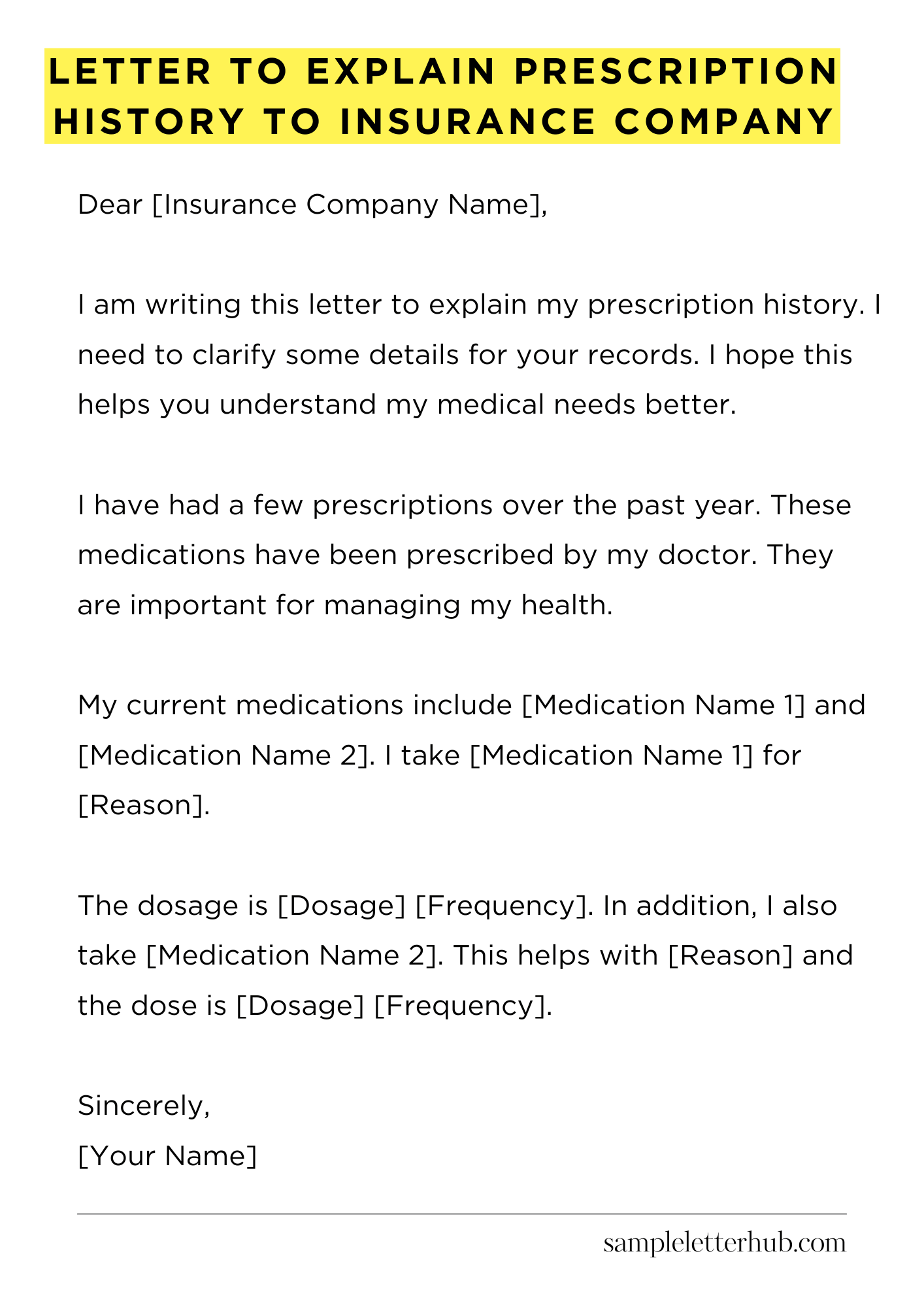
Dear [Insurance Company Name],
I am writing this letter to explain my prescription history. I need to clarify some details for your records. I hope this helps you understand my medical needs better.
I have had a few prescriptions over the past year. These medications have been prescribed by my doctor. They are important for managing my health. The purpose is to address specific health concerns I have.
My current medications include [Medication Name 1] and [Medication Name 2]. I take [Medication Name 1] for [Reason]. The dosage is [Dosage] [Frequency]. In addition, I also take [Medication Name 2]. This helps with [Reason] and the dose is [Dosage] [Frequency].
I have also taken other medications in the past. These include [Previous Medication Name 1] and [Previous Medication Name 2]. My doctor prescribed these to help me feel better. I stopped using [Previous Medication Name 1] on [Date] and [Previous Medication Name 2] on [Date].
Please find attached copies of my prescription records. These documents should provide additional information. They include the dates, dosages, and prescribing doctors. Providing this information should allow for a more comprehensive review of my prescriptions.
I am available if you need any more details. Please contact me if you have any questions. You can reach me by phone or email.
Thank you for your time and attention to this matter. I appreciate your assistance in processing my information. I look forward to your prompt response.
Sincerely,
[Your Name]
How to Write Letter to Explain Prescription History to Insurance Company
1. Commence with Precise Identification
First things first, you’ll want to clearly identify yourself. This is the cornerstone of your entire communication. Begin by furnishing your complete legal name, address, and contact information.
Ensure the accuracy of every detail; even a minor discrepancy can lead to bureaucratic logjams. Include your policy number – this is akin to your personal key to the insurance company’s files. This expedites the process and allows the adjuster to immediately link your letter to your records.
2. The Salutation: A Formal Overture
The salutation sets the tone for your letter. Start by addressing the letter to the appropriate department or, if possible, a specific claims adjuster. A generic “To Whom It May Concern” is acceptable, but a name elevates the sense of personal attention.
Use a formal greeting such as “Dear Mr./Ms./Mx. [Last Name]” or “Dear Claims Department.” This seemingly minor detail fosters a professional rapport from the outset.
3. Declare Your Intentions: State the Predicament
The opening paragraph is your opportunity to clearly state your intentions. Explicitly articulate the purpose of your letter: to explain your prescription history and provide supporting documentation. Briefly summarize the issue at hand.
Were there discrepancies in your records? Is your medication coverage in question? Succinctness is key here. State the issue concisely and avoid verbose circumlocution.
4. Enumerate Your Prescription History: Meticulous Detailing
This is the core of your explanatory letter. Provide a comprehensive listing of your prescription history. Include the name of each medication, dosage, frequency of use, and the date the prescription was filled. If you have medical conditions linked to medications, also mention this. Don’t omit anything – thoroughness is essential for successful claims settlement.
This is your chance to showcase your commitment to providing complete and accurate information. If necessary, use bullet points or a numbered list for clarity.
5. Furnish Supporting Documentation: The Evidentiary Arsenal
No persuasive correspondence is complete without compelling evidence. Append copies of all relevant documents. This includes prescription receipts, doctor’s notes, and any other evidence that bolsters your claim.
Avoid sending original documents; always retain copies for your records. Organize these attachments logically, referencing them within your letter (“as documented in Attachment A”). This methodical approach enhances the persuasiveness of your communication.
6. Compose a Concluding Paragraph: A call to action
Summarize your request in the concluding paragraph. Reiterate the information you have provided and the action you expect the insurance company to take.
Express your gratitude for their time and consideration, and specify a timeframe within which you expect a response. End with a professional closing, such as “Sincerely” or “Respectfully,” followed by your full name. This reiterates the important points made in the body of the letter.
7. Polishing and Dispatching Your Letter
Before dispatching your missive, proofread the entire document meticulously. Check for grammar and spelling errors. Ensure your contact information is correct. Make a copy for your records, keeping a log of the date you mailed it and the method used (e.g., certified mail, email).
Certified mail with a return receipt requested ensures confirmation of delivery. Sending an email allows you to track open rates. This diligent approach validates the significance of your communication and helps ensure that all key aspects of the letter are accurately recorded and delivered.
FAQs about Letter to Explain Prescription History to Insurance Company
Why do insurance companies need a letter explaining my prescription history?
Insurance companies often require a letter explaining your prescription history for several reasons. It helps them understand the medical necessity of medications, verify claims accuracy, assess eligibility for coverage, manage formularies, and detect potential fraud or abuse. The letter provides a clear record of your prescriptions and the rationale behind them.
What information should I include in the letter?
A comprehensive letter should include your full name, date of birth, policy number, and the dates of the prescriptions in question. You should list each medication, dosage, and the condition it treats.
It’s crucial to also include the prescribing physician’s name, contact information, and a clear explanation of why the medication was prescribed, its effectiveness, and any other relevant medical history. Be sure to address any specific questions the insurance company raised in their request.
How do I obtain the necessary information to write the letter?
Gathering the necessary information involves several steps. You can obtain prescription records from your pharmacy. You’ll also need to contact your doctor’s office to request a summary of your medical history and a letter of medical necessity if the insurance requires it. Make sure you keep copies of all documents.
What if I disagree with the insurance company’s decision after submitting the letter?
If you disagree with the insurance company’s decision after submitting the letter, you have options. Review the denial letter to understand the reasons for the denial.
Contact your insurance company to clarify the decision and provide any missing information. You may also file an appeal, which may require additional documentation from your physician. Be sure to follow the specific appeals process outlined by your insurance provider and to meet any deadlines.
What is a “letter of medical necessity” and how is it used?
A “letter of medical necessity” is a document written by your prescribing physician that details why a particular medication is medically necessary for your condition.
This letter justifies the need for the medication and is often used when prior authorization or appeals are required by your insurance company. The letter provides specific information about the condition being treated, the medication’s effectiveness, and the impact it has on your health.
Related:
Resignation letter due to rude boss
Resignation letter moving to another state
Resignation letter due to illness of family member
Resignation letter due to study
Resignation letter due to long commute