

Ever needed a letter to explain medical treatment before policy start? It’s a formal document. Its purpose is to inform your insurance provider about pre-existing medical conditions. This is done before your new health insurance coverage begins. This is key to ensuring proper insurance claims down the line.
We understand navigating this can be tricky. That’s why we’re here to help. We’ll provide a variety of letter to explain medical treatment before policy start templates. These are designed to be easy to use. Use them to create your own letter without stress.
You can customize these letter samples. We offer letter examples for various situations. Consider them your starting point. Make writing this vital letter a breeze with our resources. Get ready to write!
[Your Name/Company Name]
[Your Address]
[Your Phone Number]
[Your Email Address]
[Date]
[Insurance Company Name]
[Insurance Company Address]
Subject: Information Regarding Medical Treatment Prior to Policy Commencement
Dear [Insurance Company Representative Name or “To Whom It May Concern”],
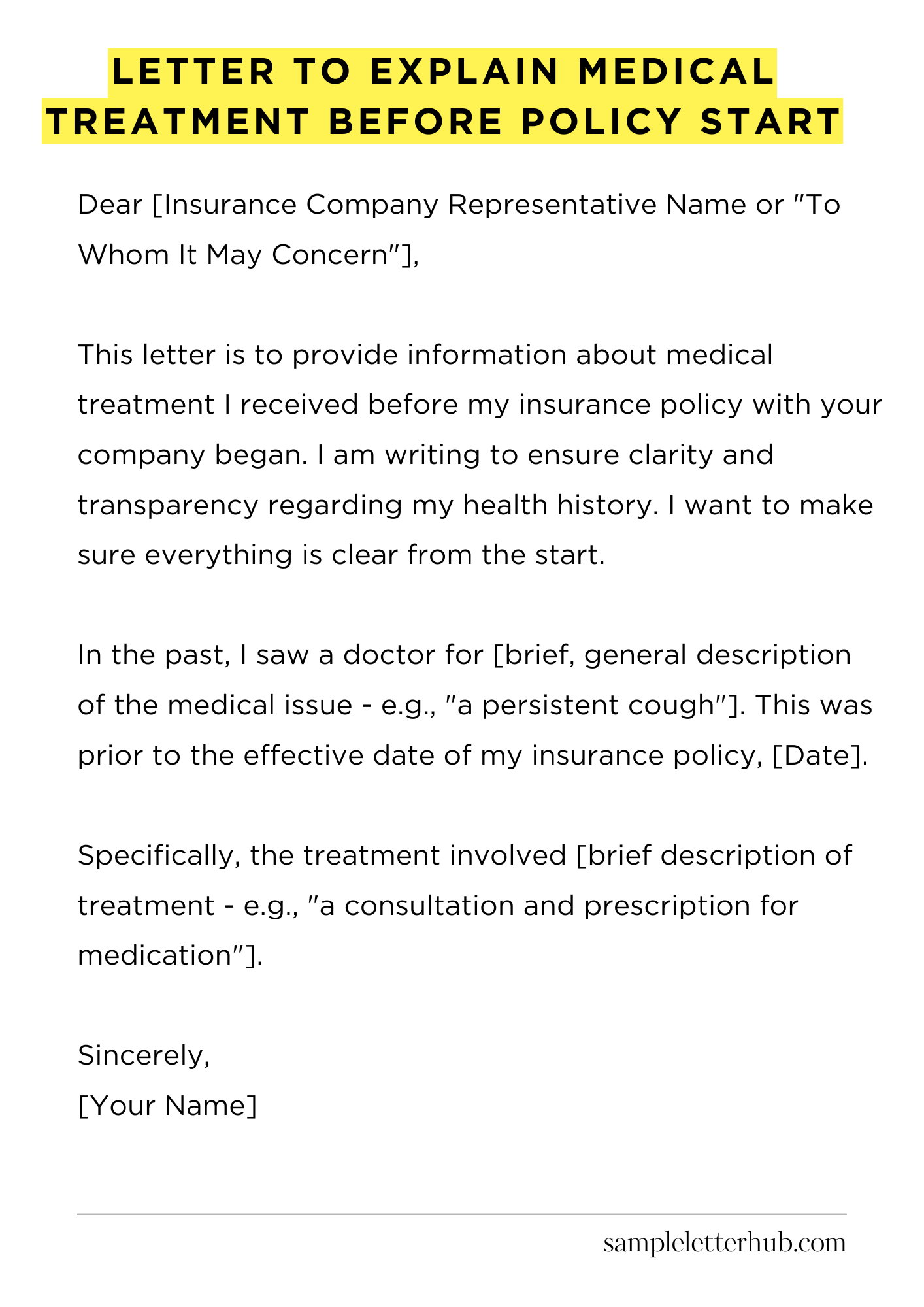
This letter is to provide information about medical treatment I received before my insurance policy with your company began. I am writing to ensure clarity and transparency regarding my health history. I want to make sure everything is clear from the start.
In the past, I saw a doctor for [brief, general description of the medical issue – e.g., “a persistent cough”]. This was prior to the effective date of my insurance policy, [Date].
Specifically, the treatment involved [brief description of treatment – e.g., “a consultation and prescription for medication”]. The doctor’s name was [Doctor’s Name] from [Clinic Name or Practice]. I received this treatment on or about [Date(s) of treatment].
I have attached copies of any relevant documentation, such as medical records or receipts, for your review. Please see the attached documents for more details. These documents will help you understand the situation better.
I understand that pre-existing conditions may affect policy coverage. I want to cooperate fully with your assessment. My aim is to be completely honest and upfront.
Please let me know if you require any further information or clarification. I am happy to provide any additional details that will help in your assessment. I am available at your earliest convenience to discuss this further.
Thank you for your time and attention to this matter. I appreciate your assistance.
Sincerely,
[Your Name]
How to Write Letter to Explain Medical Treatment Before Policy Start
Navigating the nuances of health insurance can feel like traversing a labyrinth. One particularly crucial task is crafting a letter to explain medical treatment you’ve received before your policy’s commencement.
This communication serves as your proactive defense, ensuring coverage and mitigating potential claim denials. Let’s dissect the anatomy of this imperative correspondence.
1. Initiate with Precision: The Salutation and Recipient
Your missive commences with a formal salutation. Address the letter to the specific underwriter or claims department of your insurance provider. Ascertain the correct contact information; precision here averts needless delays. Consider a salutation like, “Dear Underwriting Department,” or “To Whom It May Concern,” if a specific name is unavailable.
2. The Subject Line: A Succinct Synopsis
The subject line is your digital headline. It must immediately capture the letter’s essence. A clear, concise subject line, such as “Pre-Existing Condition Disclosure: [Your Name] – [Policy Number],” provides immediate context. This immediately communicates the purpose and quickly orients the recipient.
3. Detail Your Medical History: A Thorough Dossier
Provide a comprehensive, yet organized, account of the medical treatment in question. This is no place for vagueness; clarity is paramount. Include the following critical data:
- The precise date of each medical encounter.
- The name and specialty of the treating physician or healthcare provider.
- A detailed, clinical description of the ailment or injury.
- The specific diagnostic tests performed (e.g., MRI, blood work, etc.) and their results.
- The treatment rendered, including medications, procedures, and their corresponding dates.
Maintain an objective tone; refrain from emotional language. Keep the chronicle purely factual.
4. The Rationale: Justification and Context
Here you provide a logical rationale for why the treatment precedes your policy’s inception. Circumstances warranting this could include:
- An ongoing condition requiring continued care.
- An unforeseen acute episode necessitating urgent medical intervention.
- A pre-existing condition, the implications of which you were previously unaware.
Be forthright and candid. Support your claims with relevant documentation.
5. Furnishing the Supporting Evidence: The Documentation Armada
Your letter is only as potent as the evidence that buttresses it. Attach copies of all pertinent medical records. This includes, but is not limited to: doctor’s notes, diagnostic reports, lab results, and medication records. Ensure these documents are legible and clearly labeled. This meticulousness streamlines the claims process.
6. The Call to Action and Closure: Professional Finis
Conclude your letter with a clear call to action. State your expectations. A sentence like, “I request that you review this information and consider the pre-existing condition for coverage under my policy,” does the trick.
Express your willingness to provide further clarification or documentation if needed. Finish with a professional closing, such as “Sincerely,” or “Respectfully,” followed by your full name, address, phone number, and policy number. This offers multiple contact points.
7. The Diligent Review: Final Inspection
Before dispatching your letter, thoroughly review it. Verify that all information is accurate, complete, and easy to comprehend. Proofread for grammatical errors and typos; even minor inconsistencies can impact your credibility.
It is prudent to retain a copy for your records. Consider sending the letter via certified mail with return receipt requested. This ensures that your communication reaches the intended recipient and provides confirmation of delivery.
FAQs about Letter to Explain Medical Treatment Before Policy Start
What is a letter explaining medical treatment before a policy start, and why is it needed?
A letter explaining medical treatment before a policy start, often called a pre-existing condition letter or a disclosure letter, is a document you provide to your insurance company.
This letter details any medical treatments, diagnoses, or consultations you’ve had before your new insurance policy’s effective date. It’s needed because insurance companies often review pre-existing conditions. Providing this information upfront helps the insurer understand your medical history and determine coverage related to those conditions.
What specific information should be included in this letter?
The letter should include detailed information. This includes dates of treatments, diagnoses, or consultations; the names of healthcare providers involved; the specific treatments or medications received; and the reason for the medical care.
It should also specify any ongoing or planned treatments. Be thorough and accurate to avoid any potential disputes regarding coverage later on.
What happens if I don’t provide this letter, or if I omit information?
Failing to provide the letter, or omitting relevant information, can have consequences. The insurance company may deny coverage for conditions related to pre-existing medical history.
In some cases, the insurance policy might even be canceled or rescinded if it’s found that significant information was withheld during the application process. Honesty and transparency are crucial when dealing with insurance companies.
When should I provide this letter?
The timing depends on your insurance company’s requirements. Often, you will be asked to provide this letter during the application or enrollment process. Sometimes, it might be requested after the policy has been issued, especially if you seek treatment that could be related to a pre-existing condition.
Always follow your insurance provider’s instructions and deadlines to ensure your coverage is not negatively impacted.
How can I obtain the necessary information for this letter, and what if I have trouble?
You can gather this information by contacting your previous healthcare providers, hospitals, and pharmacies. Request copies of your medical records, including doctor’s notes, test results, and medication history.
If you face difficulties obtaining these records, consider contacting your primary care physician or a patient advocate. They can assist you in gathering the necessary information and ensure your letter is complete and accurate.
Related:
Resignation letter due to rude boss
Resignation letter moving to another state
Resignation letter due to illness of family member
Resignation letter due to study