

Dealing with insurance can be confusing. Sometimes you make mistakes on your insurance forms. A letter to explain incorrect information on insurance form is essential. It helps you correct errors. This ensures your insurance claims are processed correctly.
Need to write a letter to explain incorrect information on your insurance form? We’ve got you covered. We understand the struggle. We will share helpful letter templates, examples, and samples. These resources will simplify the process.
Our goal is simple. We aim to make it easier for you. You can quickly craft your own letter to explain incorrect information. Get your insurance matters straightened out today. Let’s make this process hassle-free together!
[Your Name]
[Your Address]
[Your Phone Number]
[Your Email Address]
[Date]
[Insurance Company Name]
[Insurance Company Address]
Dear Sir/Madam,
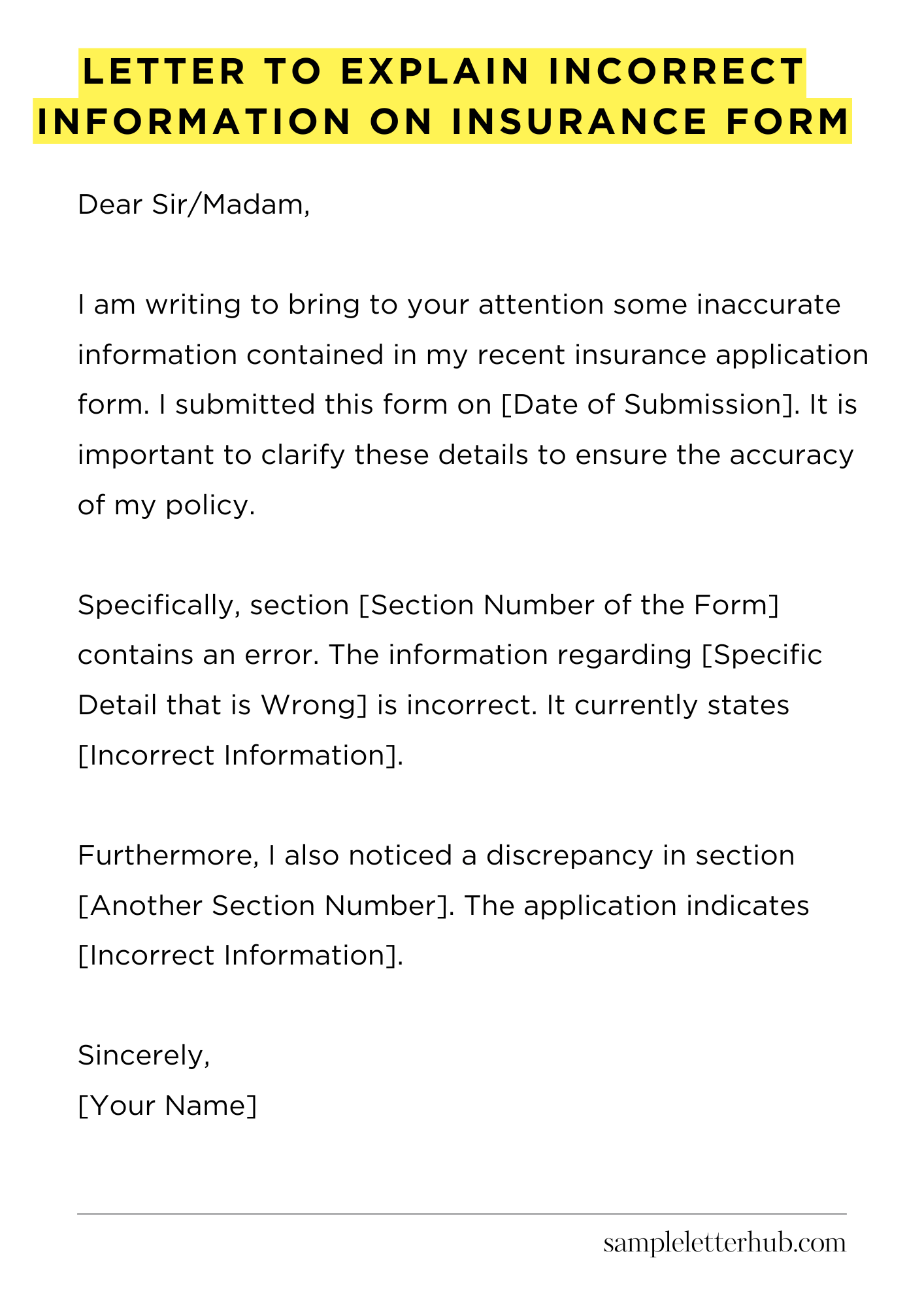
I am writing to bring to your attention some inaccurate information contained in my recent insurance application form. I submitted this form on [Date of Submission]. It is important to clarify these details to ensure the accuracy of my policy.
Specifically, section [Section Number of the Form] contains an error. The information regarding [Specific Detail that is Wrong] is incorrect. It currently states [Incorrect Information]. However, the correct information should be [Correct Information]. This is a very important detail.
Furthermore, I also noticed a discrepancy in section [Another Section Number]. The application indicates [Incorrect Information]. The actual facts are [Correct Information]. These details are important for the purpose of the insurance policy.
I have attached copies of [Supporting Documents, e.g., driver’s license, proof of address] to support these corrections. These documents should help to verify the accurate details. I hope this helps.
Please update my records accordingly. I would appreciate it if you could confirm the changes have been made. I look forward to your prompt response and confirmation.
Thank you for your time and attention to this matter. I am always available for further discussion.
Sincerely,
[Your Name]
How to Write Letter to Explain Incorrect Information on Insurance Form
Encountering discrepancies on an insurance form is an undeniably frustrating experience. It is not uncommon to find errors. However, these oversights, no matter how minute, can have profound implications, potentially jeopardizing your coverage or leading to claim denials. To circumvent such problems, a well-crafted letter is an essential tool.
This comprehensive guide outlines the process of composing a persuasive and effective letter to rectify erroneous information on your insurance forms.
1. Commence with Meticulous Identification
Begin by meticulously identifying the incorrect data points. Scrutinize the form with the acuity of a seasoned auditor. Pinpoint every inaccuracy; whether it’s a typographical error in your address, a misstated date of birth, or an incorrect policy number, every blemish warrants attention. List all inaccuracies separately for easy reference.
2. Gather Pertinent Documentary Evidence
Your assertions must be fortified with irrefutable proof. Accumulate all supporting documentation that validates the correct information. This might include copies of your driver’s license, passport, utility bills, or any other documents that corroborate the true facts. The more evidence you can provide, the stronger your case will be.
3. Structuring Your Correspondence: A Paradigm of Clarity
The letter’s format is critical. Use formal business letter format: your address and the date at the top, followed by the insurance company’s address. Open with a polite salutation, such as “Dear Claims Department” or the name of the recipient if known. Be direct and avoid convoluted phrasing. State the purpose of your letter immediately.
4. Deconstructing the Errors: A Sectional Approach
In the body of your letter, systematically address each error you’ve identified. Employ numbered or bulleted lists for clarity. State the incorrect information as it appears on the form, and then, immediately following, present the correct information, along with the supporting documentation you’re providing as evidence. For instance: “Item 3: Incorrect Information: Policyholder’s Date of Birth – 01/01/1990. Correct Information: Policyholder’s Date of Birth – 01/01/1980 (See attached copy of driver’s license).”
5. The Art of Persuasive Advocacy
While maintaining a professional tone, make it unequivocally clear why the correction is crucial. If the error could potentially affect your coverage or claims processing, state it explicitly.
For example, “The incorrect date of birth on the form could potentially lead to delays in claim processing, which would be detrimental during a time of need.” Always be polite, but assertive.
6. The Concluding Salutation: A Formal Farewell
Conclude your letter with a polite closing, such as “Sincerely,” or “Respectfully.” Below your typed name, leave space for your signature. Reiterate any attachments you are including and consider adding a phrase like, “I look forward to receiving confirmation that these corrections have been made.” This demonstrates your proactive approach.
7. Polishing and Dissemination: The Final Scrutiny
Before mailing the letter, meticulously proofread it. Check for any grammatical errors or typos that could undermine your credibility. It is highly important to make the information as readable as possible.
Make sure to keep a copy of the letter and all attachments for your records. Send the letter via certified mail with return receipt requested. This ensures delivery verification and provides tangible proof of your communication.
FAQs about Letter to Explain Incorrect Information on Insurance Form
What is the primary purpose of a letter explaining incorrect information on an insurance form?
The primary purpose is to provide a clear and concise explanation of the errors found on an insurance form. This letter aims to correct the inaccurate information, ensuring the insurance company has the correct details for processing claims, coverage, and premiums. It helps to prevent potential delays or denials of claims due to discrepancies.
What specific information should be included in the letter?
The letter should include the policyholder’s full name, policy number, the specific incorrect information as it appears on the form, the correct information, and supporting documentation.
Supporting documentation could be a birth certificate, marriage certificate, or other relevant documents that validate the correction. Include the date and a clear statement about the reason for the correction.
What is the best format for writing this type of letter?
The best format is a formal business letter. Begin with your contact information, the date, and the insurance company’s contact information. Clearly state the purpose of the letter in the opening paragraph.
Each incorrect piece of information should be clearly identified and its correction provided. Maintain a professional tone throughout the letter, and conclude with a polite closing, expressing your willingness to assist with any further questions or needs. Enclose all supporting documents and keep a copy of the letter for your records.
Who should the letter be addressed to, and where should it be sent?
The letter should be addressed to the specific department or individual at the insurance company responsible for handling policy changes or claims.
This information can usually be found on the insurance policy documents or the insurance company’s website. You should send the letter to the address specified by your insurance company. Sending it via certified mail with return receipt requested provides proof that the letter was received.
What are the potential consequences of not correcting incorrect information on an insurance form?
Failing to correct inaccuracies can lead to a variety of issues, including delayed claim processing, denial of claims, incorrect premium calculations, and, in severe cases, the cancellation of your insurance policy. It’s crucial to address these errors promptly to protect your financial interests and ensure you receive the appropriate coverage you are entitled to.
Related:
Resignation letter due to rude boss
Resignation letter moving to another state
Resignation letter due to illness of family member
Resignation letter due to study