

Dealing with an ” excessive claim amount”? It can be stressful. A “Letter to Explain Excessive Claim Amount” helps. Its purpose? To provide clarity. You’re explaining why a claim might seem high. It gives context and supports the claim. It protects your interests.
We understand. Writing these letters is tricky. That’s why we’re here. We’ve got you covered. We’ve prepared several “letter to explain excessive claim amount” templates. Need a sample letter explaining claim amount? We have it. Explore these “letter examples” to ease your burden.
Our goal is simple. We aim to help. Use these “excessive claim” letter samples. They’re user-friendly. Adapt them to fit your specific needs. Easily draft your own. Write your “explanation of claim amount” with confidence.
[Your Name/Company Name]
[Your Address]
[Your Phone Number]
[Your Email Address]
[Date]
[Insurance Company Name/Recipient Name]
[Recipient Address]
Subject: Explanation Regarding Claim [Claim Number] – Excessive Claim Amount
Dear [Recipient Name],
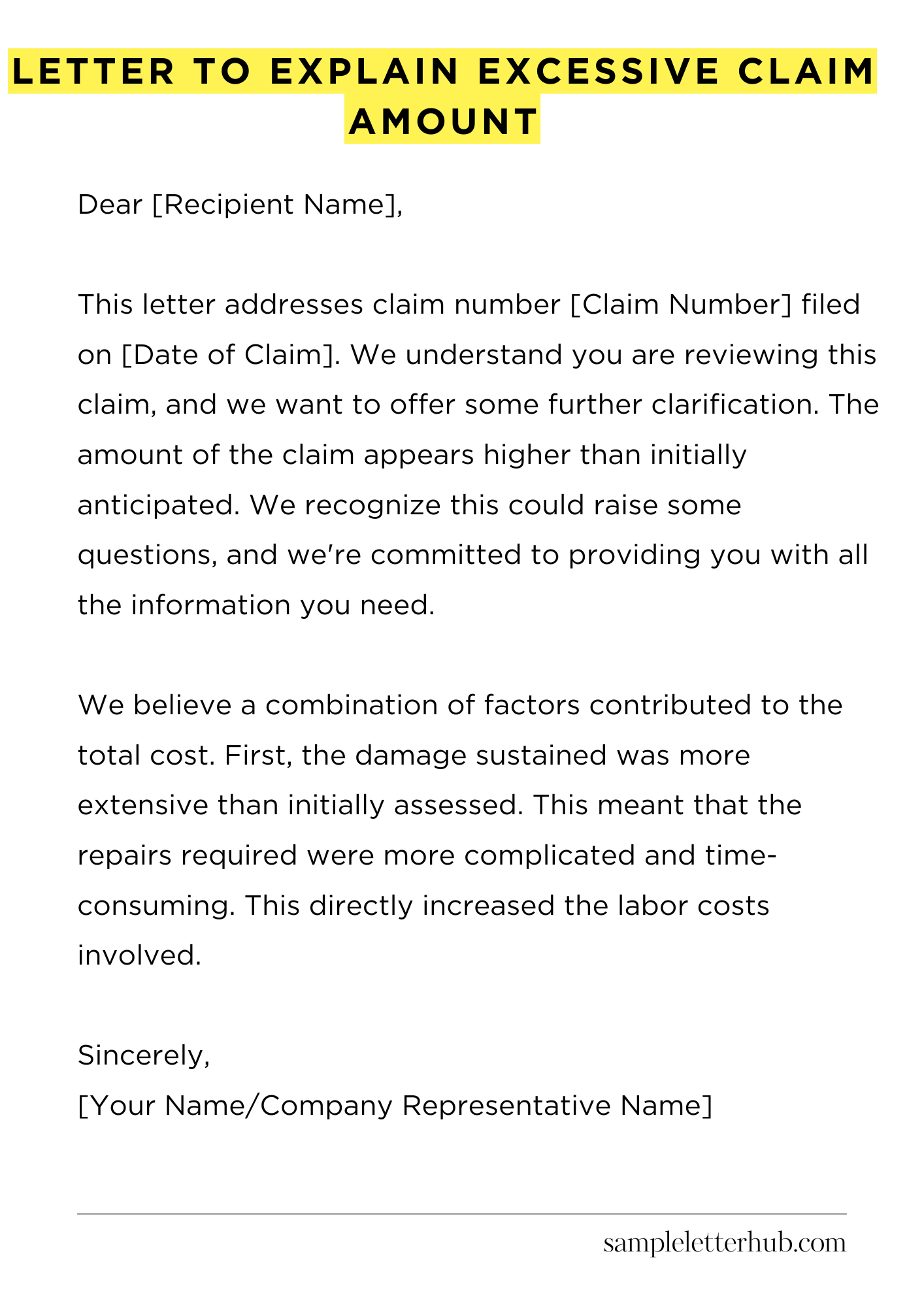
This letter addresses claim number [Claim Number] filed on [Date of Claim]. We understand you are reviewing this claim, and we want to offer some further clarification. The amount of the claim appears higher than initially anticipated. We recognize this could raise some questions, and we’re committed to providing you with all the information you need.
We believe a combination of factors contributed to the total cost. First, the damage sustained was more extensive than initially assessed. This meant that the repairs required were more complicated and time-consuming. This directly increased the labor costs involved.
Secondly, sourcing the necessary replacement parts proved to be a challenge. Certain parts were either specialized or had a longer lead time for delivery. This unfortunately led to increased costs for expedited shipping. We have included copies of all relevant invoices and receipts, showcasing the pricing for all materials.
Thirdly, we took the decision to use only qualified and certified professionals for the repairs. This was critical for ensuring the highest quality work and meeting all necessary safety standards. The decision to use these professionals, while increasing the total cost, guarantees the longevity and proper functioning of the repaired items.
Finally, unexpected issues were discovered during the repair process, which added to the overall cost. This necessitated some adjustments to the original scope of the work. For example, [ Briefly and concisely explain the specific unforeseen issue]. This information can be found in the attached detailed report.
We hope this explanation clarifies the details of the claim. We have attached all supporting documentation to this letter. We would be happy to answer any further questions you may have. Please feel free to contact us at your convenience.
Thank you for your time and consideration.
Sincerely,
[Your Name/Company Representative Name]
How to Write Letter to Explain Excessive Claim Amount
Receiving an insurance claim rejection can be a disconcerting experience. However, disputing the amount cited as excessive, by meticulously crafting a compelling letter, may reverse the decision. A well-constructed letter serves as your formal conduit to communicate, clarify, and advocate for a fair assessment. Here’s a pragmatic guide to help you navigate this intricate process:
1. Commence with a Cogent Introduction
Initiate your letter with a formal salutation, precisely addressing the intended recipient and their designated role within the insurance company. Briefly introduce yourself, explicitly stating your policy number and the specific claim in question.
Maintain a professional tone, avoiding any emotive language that could undermine your credibility. State the purpose of your missive: to contest the declared excessive claim amount.
2. Detail the Devolved Claim and Its Discrepancies
Provide an exhaustive chronological narrative of the events leading to the claim. The crux of this section resides in highlighting the perceived discrepancies or inaccuracies in the insurance provider’s assessment.
Scrutinize the calculations, citing specific examples where the valuation deviates from your own documentation. This necessitates a meticulous review of the claim’s breakdown, comparing it against the original documents, invoices, or estimates.
3. Furnish Substantiating Evidence
This is where your case gains substantial leverage. Accompany your letter with irrefutable evidence. This may encompass photographs, original receipts, expert appraisals, or independent repair quotes.
Ensure the presented evidence is organized, clearly labeled, and directly pertinent to the contested claim elements. The inclusion of corroborating documentation strengthens your position and reinforces the validity of your claims.
4. Articulate Your Rationale for Disagreement
Beyond simply presenting data, elucidate *why* you believe the amount is excessive. Offer a persuasive rationale supported by the facts.
Perhaps the insurer used depreciated values, neglected to account for specific damages, or overlooked vital aspects of the incident. This is your chance to offer a counter-argument and meticulously justify your position, making certain your objections are well-grounded.
5. Present a Calculated Counter-Proposal
Instead of just contesting the given figure, propose a reasonable counter-offer. Calculate a revised claim amount, substantiated by the evidence you’ve presented. Justify this revised valuation, referencing specific line items from the original assessment.
This demonstrates a proactive approach, signifying you have thoroughly considered the matter, and have a clear, justifiable alternative.
6. Conclude with a Call to Action and a Professional Demeanor
Reiterate your position clearly and concisely. Request a reconsideration of the claim based on the evidence provided. State your desired outcome—a revised payment reflective of the presented valuation. Maintain a respectful tone throughout the letter, avoid any aggressive language that may adversely affect the outcome.
Provide your contact details, and specify a timeframe for a response. End with a formal closing, such as “Sincerely” or “Respectfully,” followed by your full name and signature.
7. Polishing and Perfection: Proofreading and Submission
Before dispatching your letter, subject it to a rigorous process of meticulous proofreading. Scrutinize for grammatical errors, spelling blunders, and inconsistencies in data or phrasing.
Ensure the letter is logically structured, lucid, and readily comprehensible. Make a copy for your personal records, then dispatch the letter via certified mail with a return receipt requested. This ensures verifiable proof of delivery, which can prove extremely beneficial if the matter escalates.
FAQs about Letter to Explain Excessive Claim Amount
What is the purpose of a letter to explain an excessive claim amount?
The primary purpose of a letter explaining an excessive claim amount is to provide clarification and justification to the insurance provider regarding the billed charges. It aims to explain why the billed amount is higher than what the insurance company typically expects, and usually includes supporting documentation to substantiate the charges.
This helps prevent claim denial, expedite processing, and maintain a good relationship with the insurance provider.
What information should be included in a letter to explain an excessive claim amount?
A well-crafted letter should include several key components. This encompasses a detailed explanation of the services or items provided, a breakdown of the specific charges, and an explanation of why those charges are necessary.
You should also include supporting documentation such as medical records, invoices, itemized bills, and any relevant contracts or agreements. The letter should also identify the patient/policy holder, the provider, and the insurance claim information to correlate the explanation to the claim in question.
Who should write a letter to explain an excessive claim amount?
Typically, a healthcare provider, such as a doctor, hospital, or clinic, will write the letter to explain the excessive claim amount. In some cases, especially if it relates to a specific item or service and with the right supporting documentation, a patient or policyholder might write the letter.
What are some common reasons for excessive claim amounts?
There are several reasons why a claim amount might be considered excessive. These may include the complexity of the services rendered, the use of specialized equipment or procedures, the need for extended care, or the geographical location of the healthcare facility.
What are the consequences of not providing a letter to explain an excessive claim amount?
Failing to provide a letter explaining an excessive claim amount can lead to several negative outcomes. The insurance company may deny the claim or reduce the payment.
It could also result in delays in processing the claim, causing financial strain for both the patient and the provider. Repeated failures to provide explanations could damage the relationship between the provider and the insurance company, and in some situations, could lead to audits or investigations.
Related:
Resignation letter due to rude boss
Resignation letter moving to another state
Resignation letter due to illness of family member
Resignation letter due to study