


A “Letter to Explain Disability or Chronic Condition” is exactly what it sounds like. It’s a written document. Its purpose is to clearly describe your health situation. It helps others understand your limitations. This is helpful in many situations.
Sometimes you need to explain your condition. Maybe to an employer or a school. Or perhaps to a potential landlord or a service provider. Writing this type of letter to explain disability can be tough. Don’t worry.
We’ve got you covered. We’ll share letter to explain chronic condition samples. We have many letter to explain disability samples. Find templates. Use our examples to easily write your own letter to explain medical condition. Simplify your writing. Get started now.
[Your Name]
[Your Address]
[Your Phone Number]
[Your Email Address]
[Date]
[Recipient’s Name]
[Recipient’s Title]
[Recipient’s Company/Organization]
[Recipient’s Address]
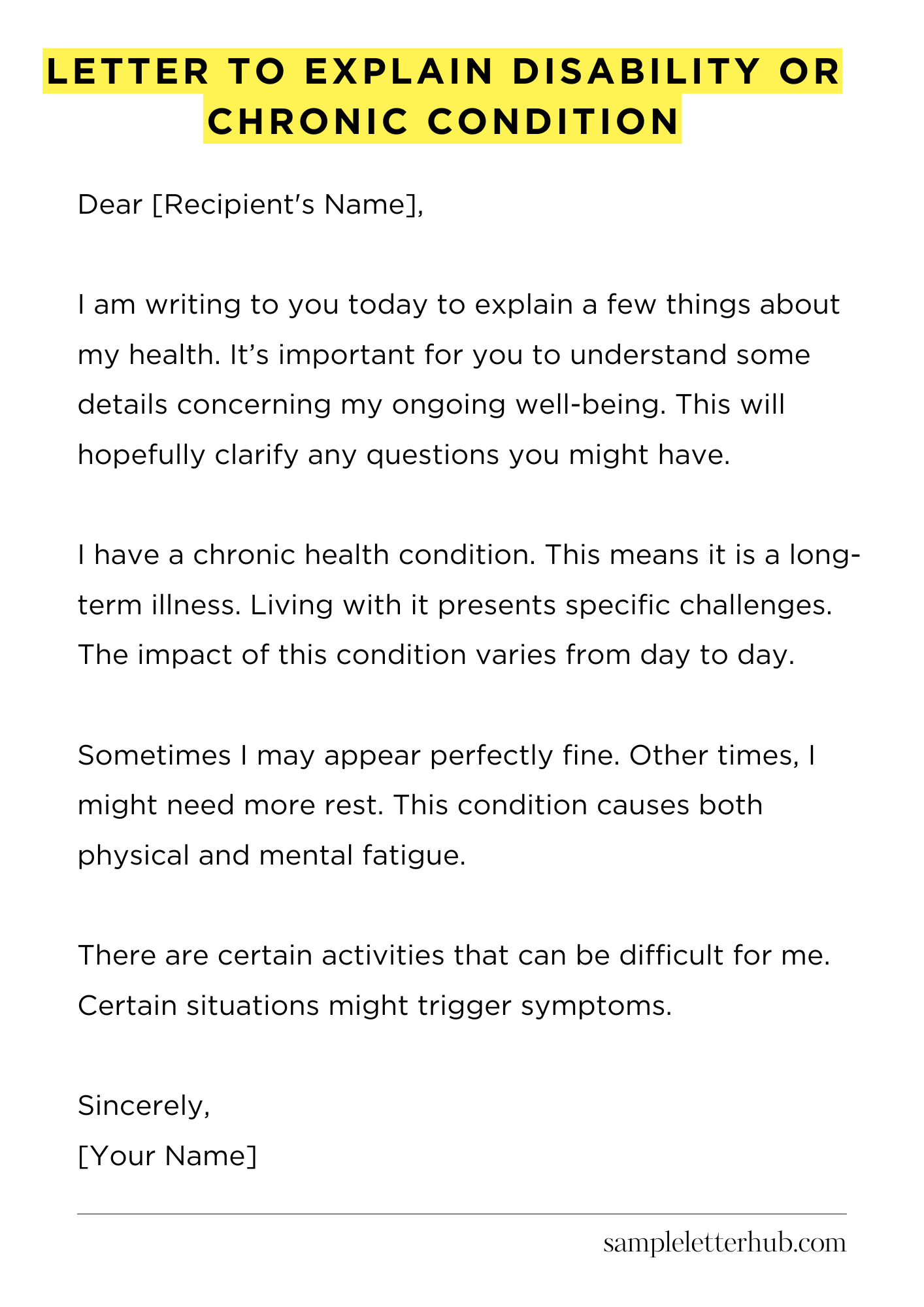
Dear [Recipient’s Name],
I am writing to you today to explain a few things about my health. It’s important for you to understand some details concerning my ongoing well-being. This will hopefully clarify any questions you might have.
I have a chronic health condition. This means it is a long-term illness. Living with it presents specific challenges. The impact of this condition varies from day to day.
Sometimes I may appear perfectly fine. Other times, I might need more rest. This condition causes both physical and mental fatigue. This can affect my energy levels significantly.
There are certain activities that can be difficult for me. Certain situations might trigger symptoms. Understanding this helps me manage my condition. It also helps me participate more fully when possible.
I am committed to my [work/studies/other commitments]. I consistently strive to meet all expectations. I manage my condition through medication and regular medical care. This also involves lifestyle adjustments.
I have consulted with my doctor. They have provided me with the necessary support. I am happy to discuss any specific needs I may have. However, I am also mindful of my privacy.
Thank you for your understanding and consideration. Your flexibility is greatly appreciated. I look forward to continuing our professional relationship.
Sincerely,
[Your Name]
How to Write Letter to Explain Disability or Chronic Condition
1. Preambles and Purpose: Crystallizing Your Intent
Before you even pen a single word, meticulously consider the objective of your missive. What do you aim to achieve? Are you seeking accommodations, requesting time off, or simply informing someone about your condition? This initial introspection is crucial. Deliberate on your audience. Who will be reading this correspondence?
Tailor your lexicon and level of detail accordingly. Your preliminary considerations form the foundation for a cogent and impactful letter. Ensure your purpose is unequivocally stated; ambiguity will only obfuscate your aims.
2. Exordial Elegance: Crafting the Salutation
The salutation is the ceremonial opening of your letter, the first point of contact. It sets the tone. Use a formal salutation unless you have an existing rapport with the recipient.
“Dear Mr./Ms./Mx. [Last Name]” is generally prudent. If you’re addressing a panel or committee, “To Whom It May Concern” is acceptable, albeit less personal. Avoid overly casual greetings. Accuracy in spelling and titles is paramount; it reflects your professionalism.
3. Self-Identification and the Genesis of Your Ailment
In a concise and perspicuous manner, introduce yourself. Then, plainly state your disability or chronic condition. Avoid circumlocution. Be specific without being overly verbose.
For example, “I am writing to you today to inform you of my diagnosis of Crohn’s disease.” Briefly mention the origin of your condition if it’s relevant or pertinent. The focus, however, should remain on the present impact of the condition.
4. Manifesting the Functional Impediments: Detailing the Impact
This is the crux of your letter; here, you illuminate the daily challenges posed by your condition. Avoid abstract pronouncements; instead, employ concrete examples.
Describe how your disability or chronic ailment affects your ability to perform certain tasks. Be as forthright and candid as you feel comfortable, but maintain professional decorum. For instance, “The unpredictable nature of my migraines can severely impede my ability to work during periods of intense pain.”
5. Requests and Stipulations: Articulating Your Needs
Clearly articulate the accommodations or adjustments you are requesting. This is where you translate your needs into actionable stipulations. Be explicit.
If you require flexible work hours, state it explicitly. If you need a specific type of equipment, enumerate it. The clearer your requests, the higher the likelihood of their being granted. Consider providing suggestions, not just demands. Offer multiple options if possible, showing flexibility.
6. Ancillary Documentation and Supporting Evidence
If possible, include documentation that validates your claims. This might involve a doctor’s note, medical records, or other supporting evidence. Never feel obliged to reveal more than necessary, however, and always abide by privacy protocols.
If you’re submitting medical records, redact any information that isn’t germane to your request. Reference any attachments within the body of your letter; this reinforces their significance.
7. Concluding Courtesies and the Art of Closure
Conclude your letter with a polite expression of gratitude and anticipation. Thank the recipient for their time and consideration. Reiterate your contact information for any follow-up inquiries.
A simple closing like, “Sincerely,” or “Respectfully,” followed by your full name, is customary. Ensure you proofread your letter meticulously before submitting it; grammatical errors or typos can undermine your credibility. Remember, a well-crafted letter speaks volumes.
FAQs about Letter to Explain Disability or Chronic Condition
What is the primary purpose of a letter explaining a disability or chronic condition?
The main purpose of this type of letter is to provide a clear and concise explanation of a medical condition and its impact on an individual’s daily life, work, or other activities.
It serves as a means of informing others (employers, educational institutions, etc.) about the condition and the accommodations that may be needed.
Who typically needs to write a letter explaining a disability or chronic condition?
Individuals with disabilities or chronic conditions often need to write these letters. In some cases, a medical professional (doctor, specialist) might write the letter on behalf of the individual.
The specific need for the letter varies based on the context, such as seeking workplace accommodations, applying for benefits, or requesting special considerations in educational settings.
What key information should be included in a letter explaining a disability or chronic condition?
A well-written letter should include a clear statement of the diagnosis, a description of the condition’s symptoms and limitations, and an explanation of how the condition affects daily activities.
It may also include a statement of any required accommodations or support and a medical professional’s contact information for verification purposes.
How should a letter explaining a disability or chronic condition be formatted?
The letter should be professional in tone and format. It should be typed, dated, and addressed to the appropriate recipient. Information should be presented clearly and concisely.
It’s advisable to keep the letter brief and focused on the essential details. A medical professional’s letterhead and signature can add credibility.
What are the legal considerations related to writing or receiving a letter explaining a disability or chronic condition?
In many jurisdictions, there are laws protecting the privacy of an individual’s medical information. When writing the letter, it’s essential to only include information directly relevant to the purpose of the letter.
Recipients of these letters are legally obligated to maintain confidentiality. Laws like the Americans with Disabilities Act (ADA) in the United States may require employers to provide reasonable accommodations.
Related:
Resignation letter due to rude boss
Resignation letter moving to another state
Resignation letter due to illness of family member
Resignation letter due to study