


Sometimes, life throws curveballs. You discover damage you didn’t notice before. A letter to explain damage not mentioned earlier is your way of clarifying things. It’s a formal way of informing someone about new issues. Its purpose is to maintain transparency and fairness.
We understand navigating this situation can be tricky. This article provides helpful tools. We’ll share letter to explain damage templates. You’ll find examples and samples too. Our goal is to simplify the writing process.
Need to write a damage explanation letter? We’ve got you covered. This resource is designed to make it easy. We provide ready-to-use letter samples. You can adapt them to your specific needs. Hopefully, these letter templates will assist you.
[Your Name/Company Name]
[Your Address]
[Your Phone Number]
[Your Email Address]
[Date]
[Recipient’s Name/Company Name]
[Recipient’s Address]
Dear [Recipient’s Name],
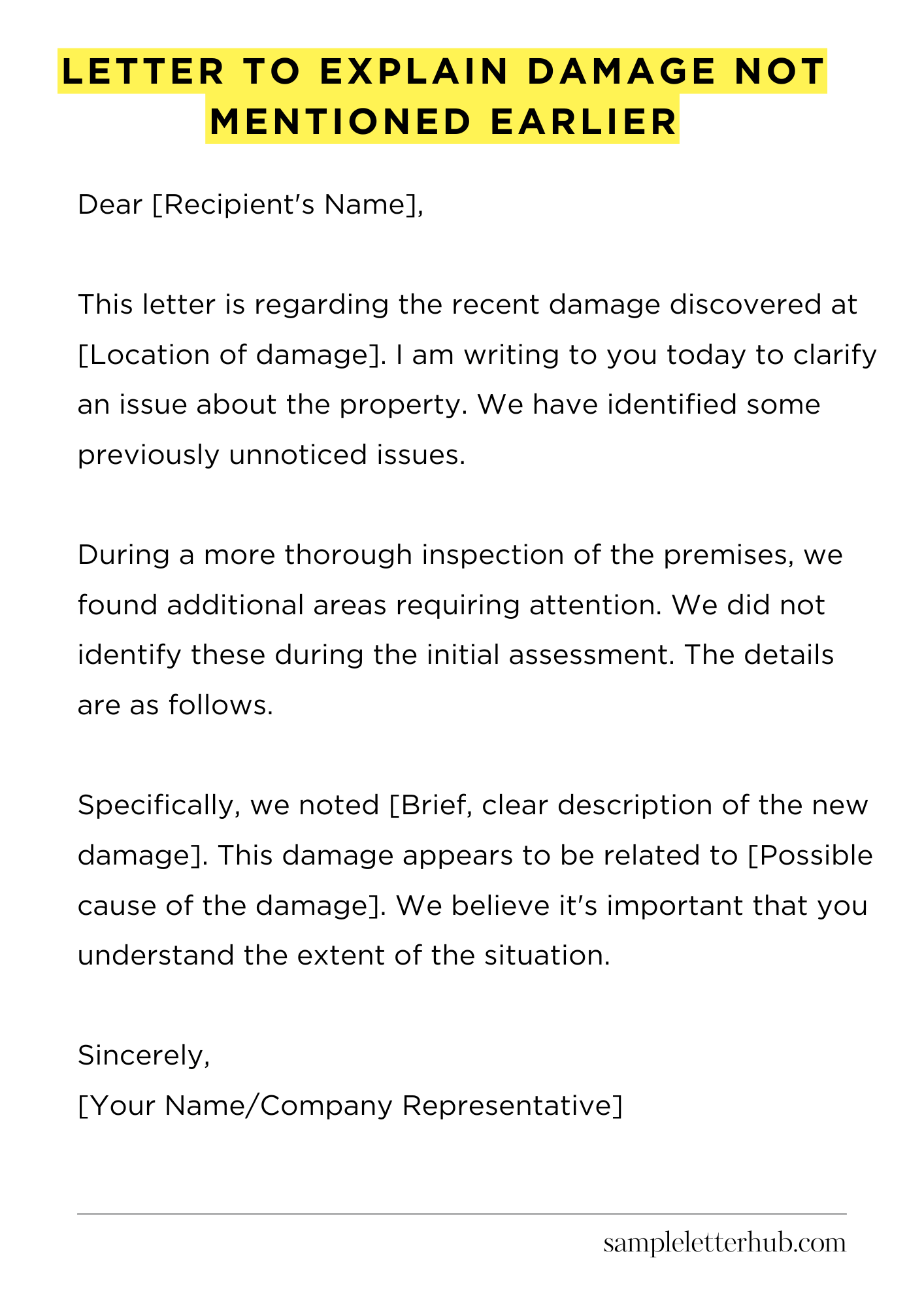
This letter is regarding the recent damage discovered at [Location of damage]. I am writing to you today to clarify an issue about the property. We have identified some previously unnoticed issues.
During a more thorough inspection of the premises, we found additional areas requiring attention. We did not identify these during the initial assessment. The details are as follows.
Specifically, we noted [Brief, clear description of the new damage]. This damage appears to be related to [Possible cause of the damage]. We believe it’s important that you understand the extent of the situation.
We apologize for any inconvenience this may cause. We are committed to resolving this as quickly and efficiently as possible. We are taking steps to address this matter immediately.
We have already [Action taken, e.g., contacted a contractor, obtained an estimate]. The estimated cost of repair is [Estimated cost, if available]. We will keep you informed of our progress. We also plan to follow up with you.
We would appreciate it if you could [Request for action, e.g., provide access to the property, approve the repair estimate]. Please do not hesitate to contact us if you have any questions. We are available to discuss this further. We appreciate your understanding and cooperation in this matter.
Sincerely,
[Your Name/Company Representative]
How to Write Letter to Explain Damage Not Mentioned Earlier
Discovering damage after an initial assessment is a vexing experience. You need to communicate the specifics effectively. This letter serves as your formal conduit to articulate the newfound issue. It is more than just a recitation of problems. It’s a vital instrument for clear communication.
1. Commence with a Cogent Salutation
Begin with a formal greeting, tailored to your audience. “Dear [Recipient Name],” or a title followed by the name, is an appropriate approach. If unsure of a specific name, “To Whom It May Concern” is acceptable, though less personal. Avoid informal greetings to retain the letter’s professional timbre.
2. Explicitly Reference the Prior Correspondence
Establish context immediately. Briefly allude to the original claim or inspection. Specify the date of the initial communication and reference any relevant claim numbers or policy identifiers. This anchors the new information within the existing framework.
3. Detail the Newly Discovered Damage
The core of your letter should center on the unreported damage. Provide a meticulous description, encompassing the nature of the damage. Use exact language: “structural compromise,” “water infiltration,” or “mechanical malfunction.” Include its location and any visible manifestations. If possible, add date of occurrence and any actions taken to mitigate further deterioration.
4. Include Substantiating Documentation
Support your claims with tangible evidence. Append photographs or videos as supplementary materials. Include any repair estimates, expert opinions or other pertinent documentation. These annexations strengthen your case, solidifying the credibility of your report.
5. Articulate the Rationale for the Omission
Address the reason the damage was initially overlooked. Provide an explanation that is both truthful and succinct. Possible reasons might include that the damage was concealed, or difficult to ascertain in the initial evaluation. Be transparent in your explanation, averting any impression of deliberate obfuscation.
6. Formulate a Clear Request and Course of Action
Explicitly state the desired outcome. Request a reevaluation, additional coverage, or specific repairs. Detail your expectation in a clear, unambiguous way. If applicable, specify a deadline for a response.
7. Conclude with a Professional Demeanor
End the letter with a professional closing, such as “Sincerely,” or “Respectfully,” followed by your full name, contact information, and your signature (if submitting a physical copy). Double-check the letter for grammatical errors and inconsistencies. Proofread it assiduously, before the final submission.
FAQs about Letter to Explain Damage Not Mentioned Earlier
What is a letter to explain damage not mentioned earlier?
A letter to explain damage not mentioned earlier is a formal written communication sent to a relevant party (e.g., insurance company, landlord, contractor) to provide details about damage that was not initially disclosed or identified.
This type of letter serves to clarify the extent of the damage, provide context for its discovery, and explain why it wasn’t reported sooner. It aims to justify the claim and provide supporting documentation.
What should be included in a letter to explain damage not mentioned earlier?
A comprehensive letter should include the date the damage was discovered, a clear description of the damage, when the initial inspection or report occurred (if applicable), and any relevant documentation like photographs or repair estimates.
Additionally, it should provide a reasonable explanation for the delay in reporting the damage. The letter should also specify the desired outcome or action from the recipient, such as claim approval or repair authorization.
What are some acceptable reasons for not mentioning the damage earlier?
Acceptable reasons often revolve around the nature of the damage itself. These can include damage that was initially hidden, such as structural issues discovered after opening a wall or damage that worsened over time and was initially considered insignificant.
Other valid reasons might be that the damage was only recently discovered after an event, a change in circumstances or that damage was not immediately apparent, required expert assessment, or the damage was only a symptom of a larger problem. It’s also important to consider the complexity of the inspection process.
How should the tone of the letter be presented?
The tone of the letter should be professional, factual, and polite. Avoid accusatory language or excessive emotion. Clearly state the facts, provide supporting evidence, and maintain a respectful tone throughout the communication. Demonstrate a willingness to cooperate and provide any additional information requested by the recipient.
What supporting documentation should be included with the letter?
Supporting documentation is crucial for strengthening the claim. This may include photographs of the damage, repair estimates from qualified professionals, reports from inspectors, and any previous documentation related to the situation.
It’s beneficial to organize the documentation clearly and reference it within the letter to support the claims made.
Related:
Resignation letter due to rude boss
Resignation letter moving to another state
Resignation letter due to illness of family member
Resignation letter due to study