


Dealing with an insurance claim denial can be frustrating. You might disagree with the insurance company’s decision. A “Letter to Dispute Insurance Claim Decision” allows you to formally challenge their ruling. Its purpose is to present your case and hopefully overturn the denial.
Writing these letters can feel overwhelming. We’ve got you covered! This article provides letter to dispute insurance claim templates. You’ll find examples and samples of dispute insurance claim letters. Need a sample letter disputing insurance claim? We will guide you. Writing a letter to insurance company disputing decision is now easier.
Our goal is to simplify this process for you. We provide various formats and examples. Use these insurance claim dispute letter samples to craft your own. Learn how to dispute insurance claim decisions effectively. Let’s get started.
[Your Name]
[Your Address]
[Your Phone Number]
[Your Email Address]
[Date]
[Insurance Company Name]
[Insurance Company Address]
Subject: Dispute of Claim Decision – Policy Number [Your Policy Number]
Dear [Claims Adjuster Name or “Claims Department”],
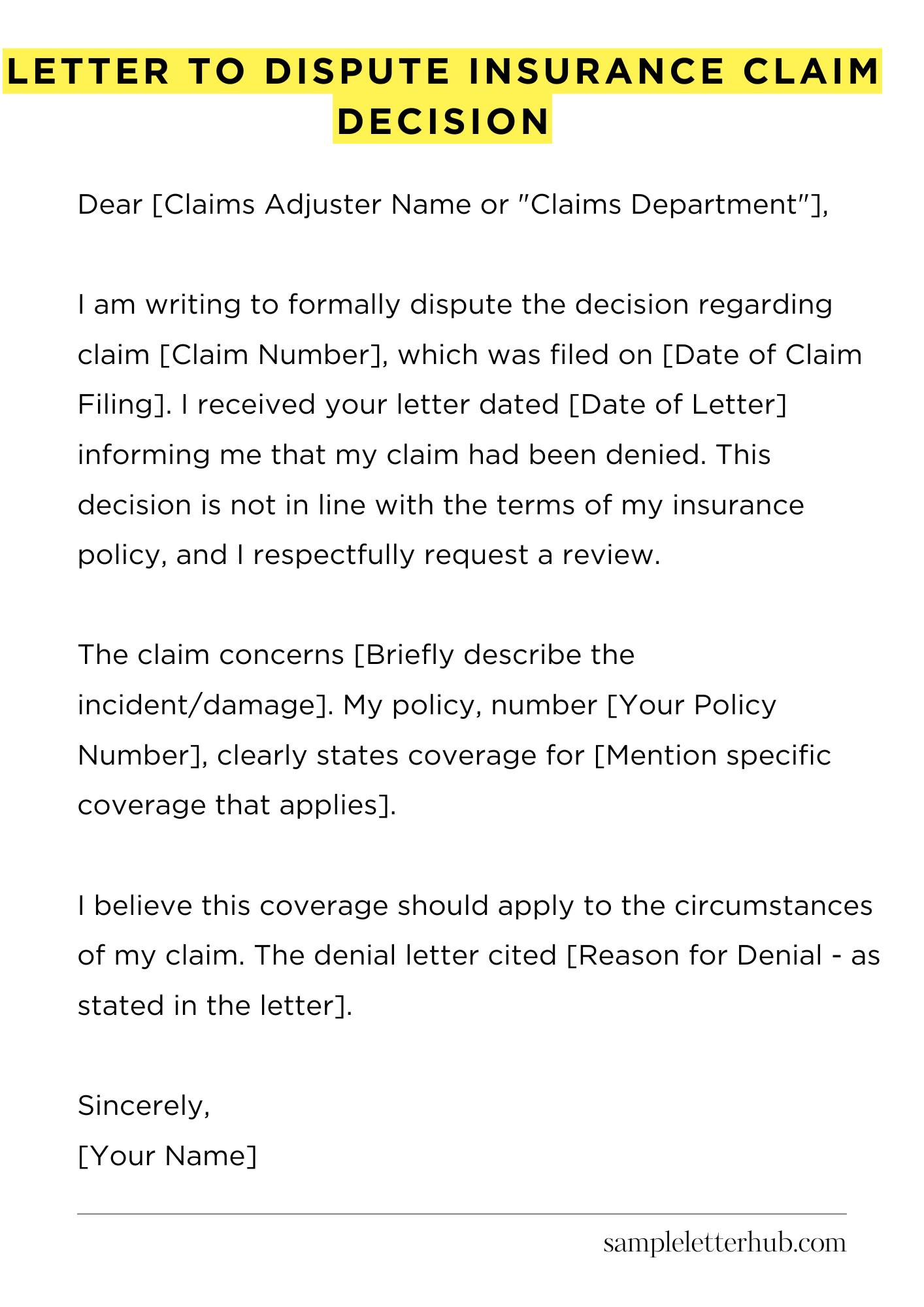
I am writing to formally dispute the decision regarding claim [Claim Number], which was filed on [Date of Claim Filing]. I received your letter dated [Date of Letter] informing me that my claim had been denied. This decision is not in line with the terms of my insurance policy, and I respectfully request a review.
The claim concerns [Briefly describe the incident/damage]. My policy, number [Your Policy Number], clearly states coverage for [Mention specific coverage that applies].
I believe this coverage should apply to the circumstances of my claim. The denial letter cited [Reason for Denial – as stated in the letter]. However, I believe the provided reason does not accurately reflect the events that took place.
Supporting documentation, which was previously submitted with my initial claim, includes [List key documents – e.g., photos, police report, repair estimates].
These documents clearly demonstrate [Explain how the documents support your claim]. I have attached copies of these documents again for your convenience, along with [Mention any new supporting documents you’re including]. These should provide a clear picture.
I have maintained my insurance policy with your company for [Number] years and have always adhered to the terms and conditions outlined within it. I have never made any fraudulent claims. I am confident that upon further review, you will find that my claim is valid and should be approved.
I kindly request that you reconsider the denial of my claim. Please investigate this matter thoroughly. I would appreciate it if you could contact me at your earliest convenience to discuss this further or to inform me of the outcome of your review. I look forward to hearing from you soon.
Thank you for your time and attention to this important matter.
Sincerely,
[Your Name]
How to Write Letter to Dispute Insurance Claim Decision
Receiving a denial for your insurance claim can be a frustrating experience. It is crucial to remember you have the right to contest that decision. A well-crafted letter can often overturn the initial denial and secure the compensation you deserve. Below are the steps to follow to write a letter that effectively conveys your case.
1. Commence with an Impeccable Introduction
Your opening gambit sets the tone. Start with a formal salutation, using the adjuster’s name (if known) or a professional title like “Claims Department.”
Clearly state the purpose of your letter: to dispute the denial of your claim. Provide essential details such as the policy number, claim number, and the date of the denial letter. Be succinct and professional. Don’t waste time with unnecessary pleasantries; get straight to the point.
2. Explicate the Insurance Company’s Stance
Before you offer your counterarguments, explicitly outline the reason the insurer provided for denying your claim. Reference the specific clauses or policy provisions the insurance company cited in their denial letter.
This demonstrates that you have comprehensively read the denial and understand the insurer’s viewpoint. Quoting their rationale verbatim strengthens your position and shows you are prepared to address their concerns head-on. Don’t misrepresent their argument. Accurate representation is essential.
3. Present Your Persuasive Counterarguments
This is where you make your case. Systematically challenge the reasons provided for the denial. Assemble your evidence meticulously. Support your position with factual information, documentation, and pertinent details that directly contradict the insurer’s reasoning.
This may include photographs, witness statements, repair estimates, medical records, or any other relevant evidence. Focus your counterarguments on specific details to ensure clarity, persuasiveness, and irrefutable merit.
4. Deploy Pertinent Evidence Effectively
Evidence is the cornerstone of your rebuttal. Make it easy for the insurer to understand how your evidence supports your claim. Consider including copies of supporting documentation, but never send original documents unless requested.
Refer to each piece of evidence explicitly in your letter (e.g., “As demonstrated by Exhibit A, the repair estimate from ABC Repair shop…”). A well-organized, logically presented array of evidence fortifies your argument and mitigates the chances of confusion.
5. Cite Relevant Policy Provisions and Precedents
Knowing your insurance policy is indispensable. Pinpoint the specific clauses that support your claim. Explain how the language in the policy aligns with your circumstances. If possible, cite legal precedents or case law that bolster your position.
Demonstrating that you have researched the legal framework and understand the implications of the policy will often shift the balance in your favour. Your informed stance will significantly influence the adjuster.
6. Articulate Your Desired Resolution
Clearly state what outcome you are seeking. Do you want the insurance company to reconsider their decision? Are you requesting a specific amount of compensation? Be specific and avoid ambiguity.
This gives the adjuster a concrete understanding of your expectations and streamlines the review process. Outline your desired result and ensure it aligns with your covered losses.
7. Finalize with a Professional Conclusion
Conclude your letter with a polite but firm request for a review of your claim. Reiterate your contact information, including your phone number and email address. Offer to provide any additional information the insurance company may require.
Thank the adjuster for their time and consideration. End with a professional closing, such as “Sincerely” or “Respectfully,” followed by your full name. Proofread your letter meticulously before sending it to ensure there are no errors.
FAQs about Letter to Dispute Insurance Claim Decision
What information should I include in the letter to dispute an insurance claim decision?
Your letter should include your policy number, the claim number, a clear statement that you are disputing the decision, the specific reasons for your dispute (supported by evidence if possible), the specific outcome you are seeking (e.g., payment for a specific amount, reconsideration of the denial), and copies of any relevant supporting documentation.
What are the common reasons for disputing an insurance claim decision?
Common reasons include denial based on policy exclusions (e.g., pre-existing conditions), denial based on the insurance company’s interpretation of policy terms, insufficient evidence considered by the insurer, the claim was not properly investigated, or the denial of medical necessity or coverage.
How do I know if my dispute letter was received by the insurance company?
Send your dispute letter via certified mail with return receipt requested to confirm the insurance company received it. You should also retain a copy of the letter and the receipt for your records. Some insurance companies also provide email addresses to send disputes, but consider calling to confirm receipt.
How long does the insurance company have to respond to my dispute letter?
The time frame for an insurance company to respond varies depending on the state and the type of insurance. Many states have specific regulations that mandate a response within a certain period, which may range from 15 to 45 days. Check your state’s insurance regulations, or contact your state’s insurance regulatory agency, to find out the time requirements.
What if the insurance company denies my dispute?
If your dispute is denied, you may have several options. These can include pursuing an internal appeal with the insurance company, filing a complaint with your state’s insurance regulatory agency, seeking mediation or arbitration, or, as a last resort, filing a lawsuit. Research the best next steps depending on your specific policy and jurisdiction.
Related:
Resignation letter due to rude boss
Resignation letter moving to another state
Resignation letter due to illness of family member
Resignation letter due to study