

Dealing with incorrect deductions can be frustrating. A “Letter to Correct Wrong Premium Deduction” is a formal written communication. Its goal? To inform an insurance provider or employer about an error. It aims to have the premium deduction fixed. This letter is crucial for financial accuracy.
We understand. Writing these letters can be tricky. Don’t worry, we’ve got you covered. This article features several Letter to Correct Wrong Premium Deduction samples. We provide ready-to-use templates. These are tailored to various scenarios.
Our goal? To simplify the process. Use our letter sample and letter template examples. It makes it easier to write your own premium correction letter. You can quickly and effectively address any deduction issues. Get your money back.
[Your Name/Address]
[Your Email]
[Your Phone Number]
[Date]
[Insurance Company Name/Address]
Subject: Correction of Premium Deduction – Policy Number [Your Policy Number]
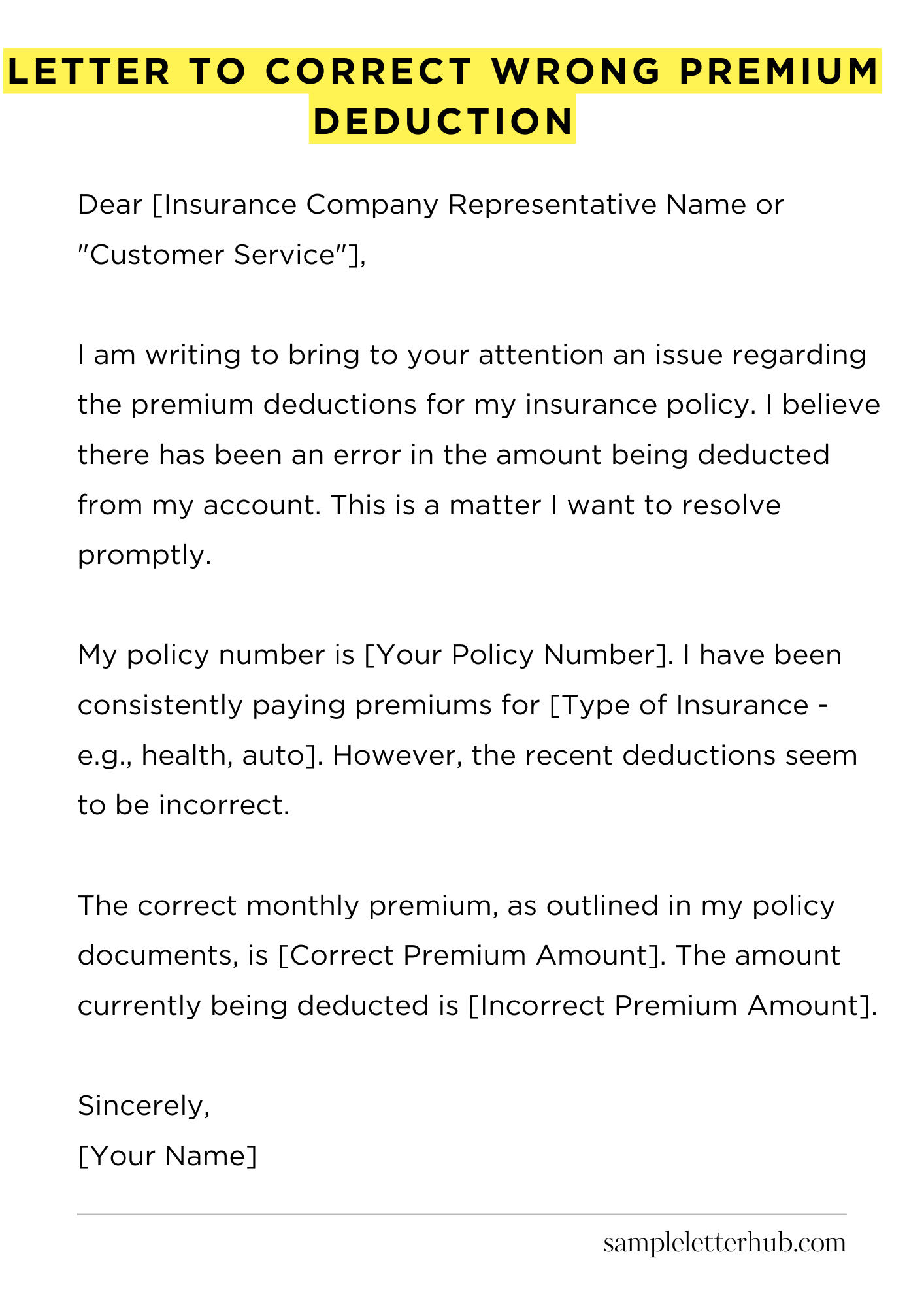
Dear [Insurance Company Representative Name or “Customer Service”],
I am writing to bring to your attention an issue regarding the premium deductions for my insurance policy. I believe there has been an error in the amount being deducted from my account. This is a matter I want to resolve promptly.
My policy number is [Your Policy Number]. I have been consistently paying premiums for [Type of Insurance – e.g., health, auto]. However, the recent deductions seem to be incorrect. The amount being debited is higher than the agreed-upon premium stated in my policy documents. This discrepancy is causing me some concern.
The correct monthly premium, as outlined in my policy documents, is [Correct Premium Amount]. The amount currently being deducted is [Incorrect Premium Amount]. This difference is significant. I have attached copies of my policy and recent bank statements as supporting documentation. These should clarify the situation.
Could you please investigate this matter at your earliest convenience? I would appreciate it if you could review my account and confirm the correct premium amount. Please let me know the reason for the incorrect deductions. Further, I would like to understand what actions you will take to rectify this error.
I request a refund for the overcharged amount, if applicable. Please inform me of the procedure to receive the reimbursement. I am eager to have this resolved swiftly. I look forward to hearing from you soon.
Thank you for your time and attention to this important matter. Please contact me at your convenience. I am available by phone or email.
Sincerely,
[Your Name]
How to Write a Letter to Correct Wrong Premium Deduction
Encountering a misapplied premium deduction can be a frustrating experience. It is very essential to address the matter with meticulousness. This guide provides a meticulous roadmap for drafting a letter to rectify an erroneous premium deduction. Follow these pragmatic steps to ensure a cogent and impactful communication.
1. Initiate with Precision: The Salutation and Recipient
Begin your letter with a formal salutation. Employ a professional tone from the outset. If known, directly address the letter to the individual or department responsible for processing premium deductions.
Use their full title for enhanced gravitas. For instance, “Dear Ms. Evelyn Reed, Head of Payroll Department,” demonstrates clarity and respect. If the recipient is unknown, a generic but respectful salutation like “Dear Sir/Madam” is acceptable, but always strive for a specific contact whenever possible.
2. The Precise Articulation: State Your Purpose Clearly
Immediately declare the intent of your missive. This is where you state why you are writing. Begin by stating the issue concisely. This creates a foundation for your subsequent statements.
For instance, “I am writing to bring to your attention an incorrect deduction of [amount] from my premium for [Month, Year].” Keep it short and keep it simple. Avoid convoluted phrasing; directness is key to achieving the desired outcome.
3. Data-Driven Discourse: Provide Crucial Details
Furnish the essential particulars that support your claim. Include your full name, employee identification number, and any relevant policy numbers or reference codes. Specify the dates during which the incorrect deductions occurred.
Also, provide the exact amount of each erroneous deduction. For greater accuracy, attach copies of your pay stubs or any documentation that substantiates your claim. This data-driven approach strengthens your case and mitigates any ambiguity.
4. Delving into the Genesis: Explain the Discrepancy
Provide a clear and concise explanation of the error. Elaborate on the reasons you believe the deduction is inaccurate. If a specific agreement, policy, or calculation error is involved, explicitly reference it.
The more context you provide, the easier it is for the recipient to understand the issue. Avoid speculative language; rely on verifiable facts and present a well-supported argument for the sake of clarity.
5. The Desideratum: State Your Desired Action
Explicitly request the actions you want the recipient to take. Do you want a refund, an adjustment to future deductions, or a clarification of the policy? State your request with absolute clarity.
For example, “I request that you promptly correct the error and reimburse the incorrect deduction of [amount] in my next paycheck.” Be specific and unambiguous in your requests; this will ensure that your expectations are clear.
6. The Formal Closure: Express Gratitude and Include Contact Information
Close your letter with a formal valediction, such as “Sincerely” or “Respectfully.” Express gratitude for their time and consideration. Reinforce your commitment to a resolution. Include your full contact information, including your phone number and email address, for seamless communication. This enables the recipient to contact you easily if there are any issues.
7. Scrutiny and Dissemination: Proofread and Submit
Before dispatching your letter, thoroughly proofread it for any grammatical errors or typos. Ensure all the information is accurate and well-organized. Double-check the recipient’s address.
Make a copy of the letter and any attachments for your records. Consider sending the letter via certified mail with return receipt requested to confirm delivery. This meticulousness underscores your professionalism and ensures accountability.
FAQs about Letter to Correct Wrong Premium Deduction
What information should I include in a letter to correct a wrong premium deduction?
Your letter should clearly state your name, address, policy number, and the specific details of the incorrect deduction. Include the amount deducted, the date of the deduction, and any supporting documentation, such as bank statements or pay stubs, that proves the error. Briefly explain why you believe the deduction is incorrect.
Always include your contact information for the insurer to reach you for clarification.
Who should I send the letter to regarding a wrong premium deduction?
The letter should be sent to your insurance provider. You can find the appropriate contact details (such as a specific department or mailing address) in your policy documents or on the insurer’s website.
If there’s a specific claims or customer service department, direct the letter there. Ensure you keep a copy of the letter and any proof of mailing (e.g., certified mail receipt) for your records.
What happens after I send the letter to correct a wrong premium deduction?
Once the insurer receives your letter, they will typically investigate the issue. This may involve reviewing your policy details, payment history, and any supporting documents you provided.
They should contact you to acknowledge receipt of the letter and update you on the status of their investigation. If the deduction was indeed incorrect, they will issue a correction, which could include a refund.
How long does it typically take to resolve a wrong premium deduction after sending a letter?
The resolution time can vary. However, insurers are usually expected to respond within a reasonable timeframe, often within 30 to 60 days. The complexity of the issue, the volume of claims, and the need for further investigation can all influence this timeline. If you haven’t received a response after a reasonable period, it’s wise to follow up with the insurer to check the status.
What if the insurance company doesn’t acknowledge or correct the wrong premium deduction?
If the insurance company doesn’t respond or refuses to correct the error after you’ve sent the letter, you can escalate the issue. Start by contacting their customer service department again, sometimes a phone call can help. If you’re still unsatisfied, you may consider filing a formal complaint with the insurance company’s internal dispute resolution process.
If necessary, you can also contact your state’s insurance regulatory agency to file a complaint or seek assistance. Depending on the amount and complexity, you might also consider legal options, consulting with an attorney may be beneficial.
Related:
Resignation letter due to rude boss
Resignation letter moving to another state
Resignation letter due to illness of family member
Resignation letter due to study