


Facing an unfair insurance settlement offer? You’re not alone. A letter to challenge an insurance settlement offer is a powerful tool. It formally disputes the amount. Its purpose is to negotiate a better payout. You’re aiming to get what you deserve.
Ready to fight for fair compensation? We’ve got your back. We will provide you with letter to challenge insurance settlement offer samples. We’re talking templates and examples. These resources will simplify the process. Insurance claim negotiations just got easier.
Crafting the perfect insurance settlement challenge is key. Our guide offers help. Access ready-to-use letter samples. Write with confidence. Get the settlement you deserve.
[Your Name]
[Your Address]
[Your Phone Number]
[Your Email Address]
[Date]
[Insurance Company Name]
[Insurance Company Address]
Subject: Challenge to Settlement Offer – Policy Number [Your Policy Number] – Claim Number [Your Claim Number]
Dear [Claims Adjuster Name],
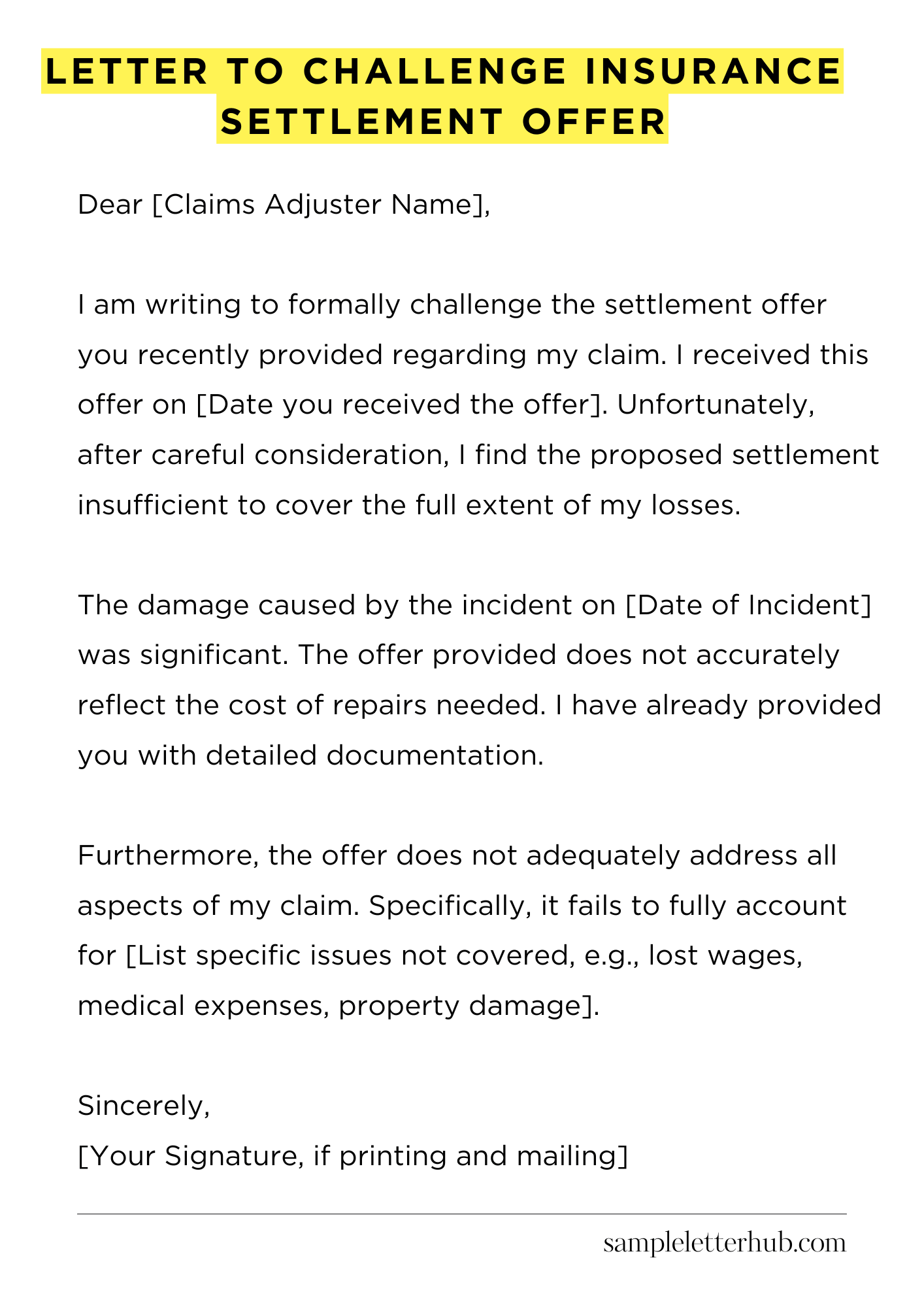
I am writing to formally challenge the settlement offer you recently provided regarding my claim. I received this offer on [Date you received the offer]. Unfortunately, after careful consideration, I find the proposed settlement insufficient to cover the full extent of my losses.
The damage caused by the incident on [Date of Incident] was significant. The offer provided does not accurately reflect the cost of repairs needed. I have already provided you with detailed documentation. This documentation includes estimates from reputable contractors.
Furthermore, the offer does not adequately address all aspects of my claim. Specifically, it fails to fully account for [List specific issues not covered, e.g., lost wages, medical expenses, property damage]. I believe these are legitimate and necessary expenses. These are a direct result of the incident.
I have attached updated supporting documentation. The documentation further illustrates the discrepancy between the offer and the actual damages. This includes [List attachments, e.g., revised repair estimates, medical bills, wage loss documentation]. It paints a clearer picture.
I kindly request that you review my claim and the attached materials again. I am requesting a revised settlement that fairly compensates me for all losses related to this claim. I am confident that, upon review, you will see the merit of my request.
I look forward to your prompt response and a resolution to this matter. Please contact me at your earliest convenience to discuss this further. I hope we can find an agreement.
Sincerely,
[Your Signature, if printing and mailing]
How to Write Letter to Challenge Insurance Settlement Offer
Receiving an insurance settlement offer that feels inadequate? You have the right to challenge it. However, you must execute the challenge correctly. A well-crafted letter is your primary weapon. Let’s delve into the intricacies of composing a persuasive missive to advocate for your rightful compensation.
1. Commence with a Formal Salutation
Begin your letter with a formal salutation. Address the claims adjuster or the specific individual handling your claim. Always use their name, if available. Avoid generic greetings. For instance, “Dear Mr./Ms. [Last Name]” is preferable. It demonstrates respect and attention to detail. This initial courtesy sets a professional tone.
2. Clearly State the Purpose of Your Correspondence
Immediately declare the intent of your letter. This is your opening gambit. Be explicit and direct. State that you are writing to dispute the settlement offer. It’s an assertion. Make it clear you are seeking a revised offer. Briefly introduce the claim number and the subject matter (e.g., “Regarding Claim Number 123456 – Personal Injury Claim”).
3. Recapitulate the Facts and the Incident
Provide a concise and factual narrative of the incident. This section functions as your evidentiary foundation. Avoid emotional language. Stick to the essential details of what happened. Include dates, times, and locations. Describe the circumstances that led to the damages or injuries.
This step helps the recipient understand the context and strengthens your case. Be as precise as possible. Omitting crucial data could weaken your argument.
4. Articulate the Damages Incurred and Losses Suffered
Detail all your damages. This is a crucial section. Itemize your losses comprehensively. Include medical expenses, lost wages, property damage, and any other relevant financial impacts.
Back up your claims with supporting documentation. This can include medical bills, pay stubs, repair estimates, and photographs. Explain how the insurance settlement offer fails to adequately cover these incurred costs. Demonstrate why the current offer is deficient.
5. Highlight the Offer’s Deficiencies and Point Out the Flaws
This is where you directly challenge the offer. Scrutinize the insurer’s rationale for the offered amount. Analyze its valuation methods. Identify the specific areas where the settlement offer falls short.
For instance, point out if they’ve underestimated medical costs or ignored certain aspects of your damages. Provide specific reasons. Use data to support your claims. Refer to any applicable policy provisions, local regulations, or legal precedents.
6. Present Your Counteroffer and Justification
Clearly state the amount you are seeking. This is your counteroffer. Back up this figure with a detailed justification. Provide a comprehensive explanation of how you arrived at this figure.
Break down the components of your proposed settlement. Show how it fairly reflects the damages and losses you have experienced. Consider including a timeline for a response. This demonstrates your proactive approach. This also establishes a framework for negotiation. It also keeps the process moving forward.
7. Conclude with a Professional Closing and Contact Information
End your letter professionally. Restate your expectation for a fair resolution. Express your willingness to negotiate further. Include your full name, address, phone number, and email address.
Sign the letter. Always keep a copy of the letter for your records. This ensures you have a reference throughout the settlement process. Ensure that you have the evidence to back it up.
FAQs about Letter to Challenge Insurance Settlement Offer
What is the purpose of a letter to challenge an insurance settlement offer?
The primary purpose of a letter to challenge an insurance settlement offer is to formally dispute the insurer’s initial offer, which you believe is inadequate to cover your losses or damages.
This letter serves as a crucial piece of documentation in the negotiation process, outlining the reasons why you disagree with the offer and providing justification for a higher settlement.
What information should be included in a letter to challenge an insurance settlement offer?
A comprehensive letter should include specific details. Start by clearly identifying the policy, the incident, and the initial offer. Then, you must state your counteroffer with a clear reasoning.
Present evidence supporting your claim, such as medical records, repair estimates, and lost wage documentation. Finally, articulate why the initial offer is insufficient, referencing specific elements of your damages that were overlooked or undervalued.
When should I send a letter to challenge an insurance settlement offer?
You should send the letter as soon as possible after receiving the initial offer, ideally within the timeframe stipulated by the insurer or any applicable deadlines. Prompt action allows you to initiate the negotiation process effectively and preserve your rights. Always retain a copy for your records and send the letter via certified mail with return receipt requested to ensure proof of delivery.
What are the potential outcomes after sending a letter to challenge an insurance settlement offer?
Following the submission of your letter, the insurer may respond in several ways. They might increase their offer, deny your claim, or request additional information to support your position. Negotiation and communication will ensue.
It is possible they might request a mediation. If you cannot reach a mutually acceptable settlement, you may need to consider further actions, such as filing a lawsuit to pursue your claim.
Do I need an attorney to write a letter to challenge an insurance settlement offer?
While it’s possible to write the letter yourself, consulting with an attorney is always advisable. An attorney specializing in insurance claims can provide valuable assistance in assessing the strength of your claim, crafting a compelling letter, and navigating the negotiation process.
They can also represent you in court if necessary, and would know the specific legal requirements and best practices for your jurisdiction. An attorney’s assistance can improve the chances of a favorable outcome.
Related:
Resignation letter due to rude boss
Resignation letter moving to another state
Resignation letter due to illness of family member
Resignation letter due to study