


A “Letter To Airline For Travel Insurance Claim” is a formal request. It seeks information from an airline. This information supports your travel insurance claim. You might need it after a flight disruption. Think delays, cancellations, or lost baggage.
Need help writing this letter? You’re in the right place. We’ve got you covered. We will share letter templates.
These templates will simplify the process. Tailor them to your situation. Make your claim process smoother.
Letter To Airline For Travel Insurance Claim
[Your Name]
[Your Address]
[Your Phone Number]
[Your Email Address]
[Date]
[Airline’s Insurance Department Address]
Subject: Travel Insurance Claim – [Your Name] – Flight [Flight Number]
Dear Sir/Madam,
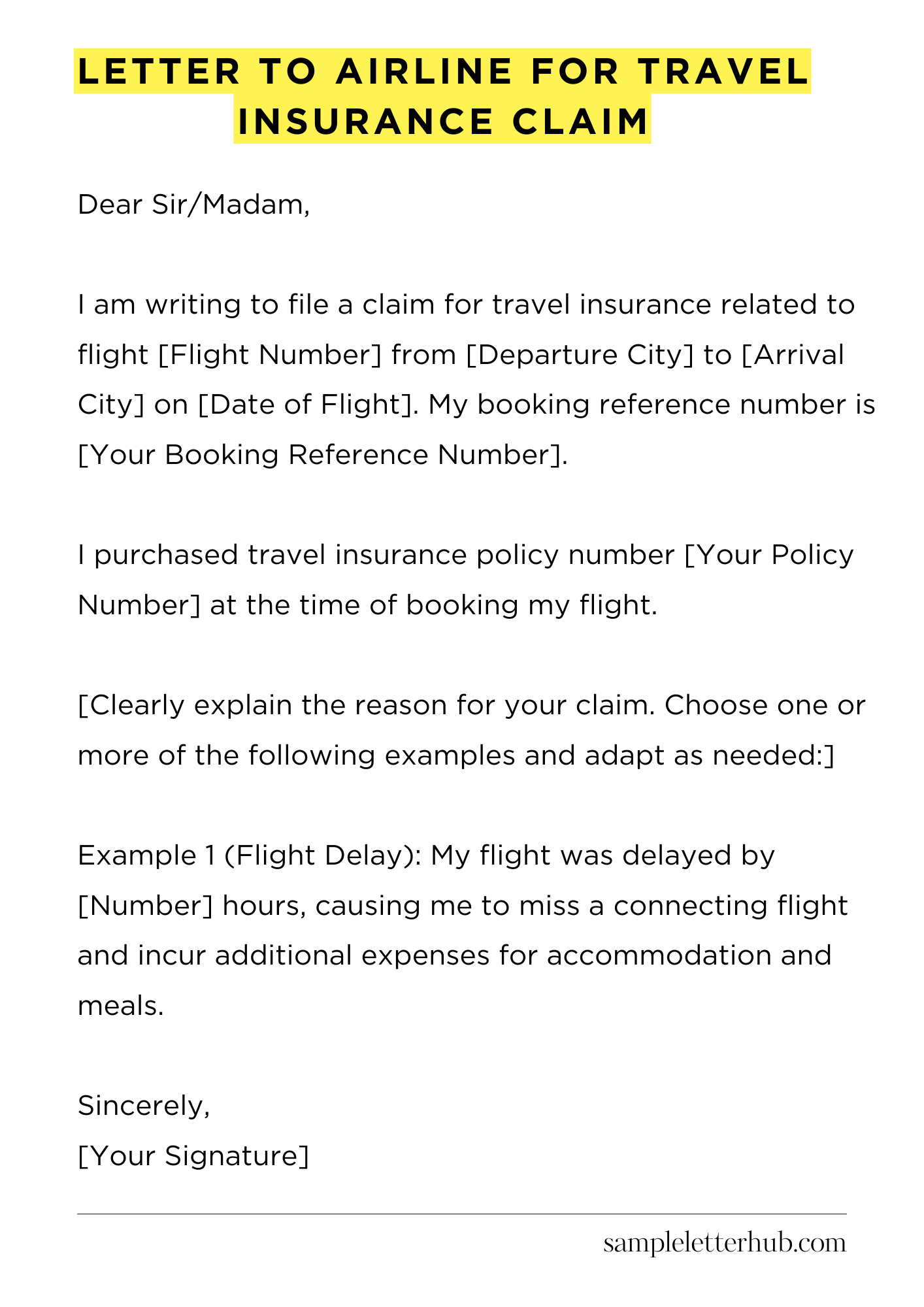
I am writing to file a claim for travel insurance related to flight [Flight Number] from [Departure City] to [Arrival City] on [Date of Flight]. My booking reference number is [Your Booking Reference Number].
I purchased travel insurance policy number [Your Policy Number] at the time of booking my flight.
[Clearly explain the reason for your claim. Choose one or more of the following examples and adapt as needed:]
Example 1 (Flight Delay): My flight was delayed by [Number] hours, causing me to miss a connecting flight and incur additional expenses for accommodation and meals.
Example 2 (Lost Baggage): My baggage was lost during the flight. I have attached a copy of the baggage claim report. The baggage contained [Briefly list essential items].
Example 3 (Medical Emergency): I experienced a medical emergency during my trip and required medical treatment. I have attached copies of my medical bills and reports.
Example 4 (Trip Cancellation): I had to cancel my trip due to [State Reason – e.g., illness, family emergency]. I have attached supporting documentation, such as a doctor’s note.
I have attached copies of the following documents to support my claim:
- Flight ticket/boarding pass
- Travel insurance policy
- [List other relevant documents – e.g., Baggage claim report, Medical bills, Doctor’s note, Receipts for expenses]
I request you to process my claim as soon as possible. Please let me know if you require any further information.
Thank you for your time and attention to this matter.
Sincerely,
[Your Signature]
How to Write Letter To Airline For Travel Insurance Claim
Subject Line: Clarity is Key
- Keep it succinct and directly indicative of the letter’s purpose.
- Example: “Travel Insurance Claim – Flight Delay – [Your Name] – [Flight Number]”
- A well-crafted subject line ensures prompt attention from the airline’s claim department.
Salutation: Addressing the Right Person
- If possible, address a specific individual. Research the claims department contact.
- If a name is unavailable, use a professional generic salutation.
- Examples: “Dear Claims Department,” or “To Whom It May Concern,”
- Avoid overly casual greetings.
Introduction: Setting the Stage
- Begin by clearly stating the purpose of your letter.
- Identify yourself, your flight number, and the dates of travel.
- Briefly describe the incident that triggered the insurance claim (e.g., flight cancellation, lost baggage).
- Example: “I am writing to file a claim for travel insurance benefits due to a flight cancellation on flight [Flight Number] from [Departure City] to [Arrival City] on [Date].”
Body Paragraphs: Substantiating Your Claim
- Provide a detailed account of the incident. Be chronological and precise.
- Include all relevant information: times, dates, locations, and personnel involved.
- Explain how the incident resulted in financial losses or other damages covered by your insurance policy.
- Reference specific clauses or sections of your travel insurance policy, if applicable.
- Attach copies of supporting documentation: boarding passes, baggage claim tickets, receipts, and any correspondence with the airline.
Quantifying Your Losses: The Nitty-Gritty
- Clearly itemize all expenses incurred as a result of the incident.
- Provide receipts and documentation for each expense.
- Include costs for accommodation, meals, transportation, and any other consequential losses.
- Be meticulous and avoid exaggerating your claims. Honesty is paramount.
Call to Action: What You Expect
- State clearly what you expect from the airline.
- Request a prompt review of your claim and subsequent reimbursement.
- Specify your preferred method of payment (e.g., check, bank transfer).
- Provide your bank details if requesting a bank transfer, ensuring accuracy.
Closing: A Cordial Farewell
- End the letter with a professional and courteous closing.
- Express your anticipation of a favorable resolution.
- Include your full name, address, phone number, and email address.
- Examples: “Sincerely,” “Yours faithfully,” followed by your name.
Frequently Asked Questions: Travel Insurance Claim Letters to Airlines
Navigating travel insurance claims can be complex, especially when dealing with airlines. This FAQ section addresses common queries regarding letters to airlines for travel insurance purposes, offering clarity and guidance.
1. Why do I need to write a letter to the airline for my travel insurance claim?
Your insurance provider often requires documentation from the airline confirming the reason for the disruption (e.g., flight cancellation, delay, or lost baggage) to validate your claim.
2. What information should I include in my letter to the airline?
Include your flight details (flight number, date, and route), booking reference, passenger names, and a clear explanation of the incident that caused the disruption.
3. How should I address the letter to the airline?
Address the letter to the airline’s customer service or claims department. If possible, find a specific contact person to ensure a more direct response.
4. What kind of response should I expect from the airline?
You should expect a written confirmation of the incident, detailing the cause and duration of the disruption. This document is crucial for your insurance claim.
5. What if the airline does not respond to my letter?
Follow up with the airline via phone or email. Keep records of all communication attempts. If unsuccessful, inform your insurance provider, as they may have alternative methods for obtaining the necessary information.
Related:
Resignation letter due to rude boss
Resignation letter moving to another state
Resignation letter due to illness of family member
Resignation letter due to study