

A “Letter To Airline For Safety Concern Report” is a formal way to tell an airline about a safety issue. You might write it after seeing a problem on a flight. This could be anything from broken equipment to risky behavior by staff. It’s used when you want the airline to know about the issue.
We know writing this letter can feel daunting. You want to be clear and professional. But you also want to make sure your concern is taken seriously. That’s why we’re here to help.
In this article, we’ll share letter templates. These are examples to make writing your own letter easy. Think of them as starting points. You can tweak them to fit your specific situation.
Letter To Airline For Safety Concern Report
[Your Name]
[Your Address]
[Your Phone Number]
[Your Email Address]
[Date]
[Airline Name]
[Airline Address]
Subject: Safety Concern Report – Flight [Flight Number] – [Date of Flight]
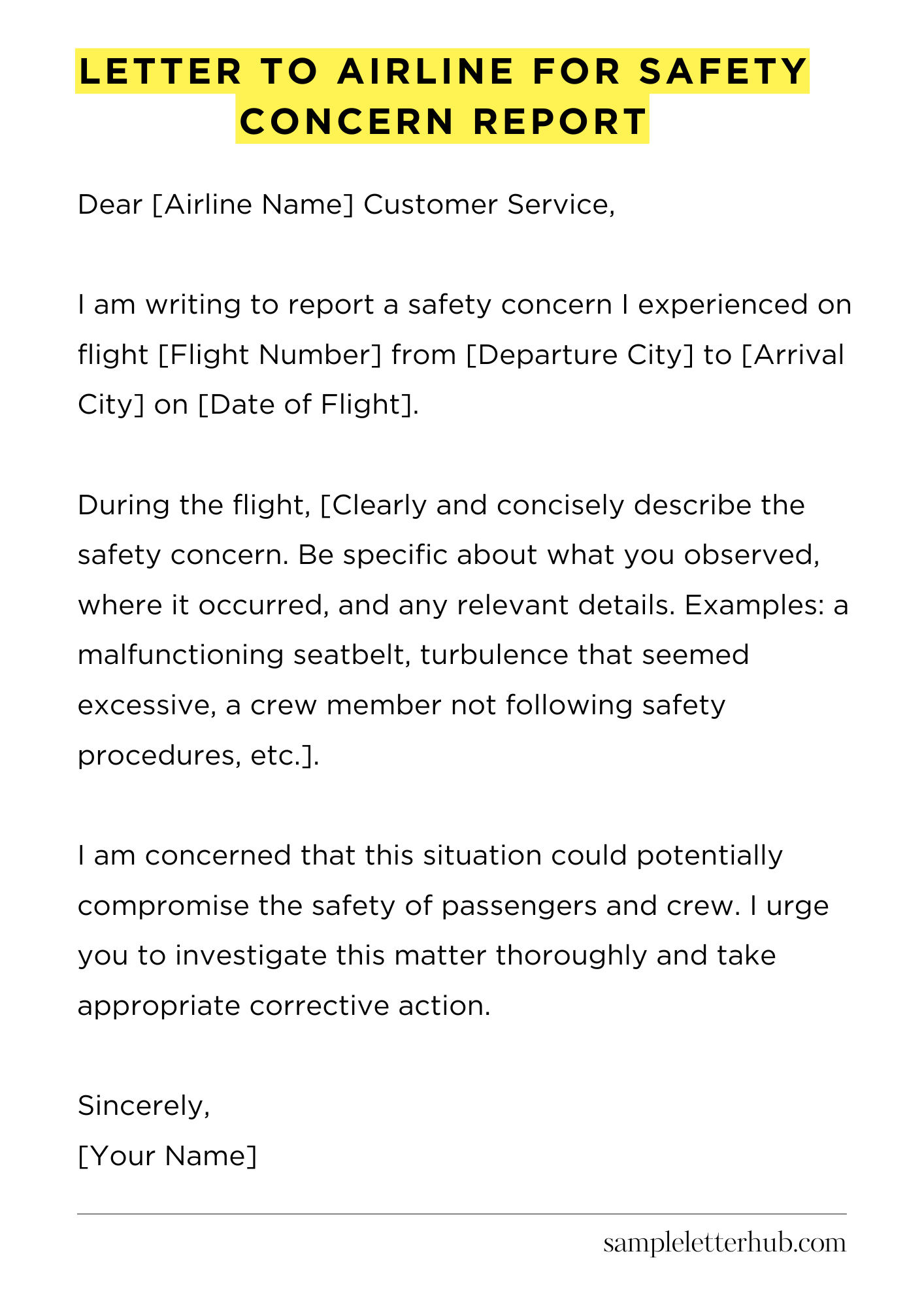
Dear [Airline Name] Customer Service,
I am writing to report a safety concern I experienced on flight [Flight Number] from [Departure City] to [Arrival City] on [Date of Flight].
During the flight, [Clearly and concisely describe the safety concern. Be specific about what you observed, where it occurred, and any relevant details. Examples: a malfunctioning seatbelt, turbulence that seemed excessive, a crew member not following safety procedures, etc.].
I am concerned that this situation could potentially compromise the safety of passengers and crew. I urge you to investigate this matter thoroughly and take appropriate corrective action to prevent similar incidents from occurring in the future.
Thank you for your attention to this important issue. I look forward to hearing from you regarding the steps you will take to address my concern.
Sincerely,
[Your Name]
How to Write Letter To Airline For Safety Concern Report
Subject Line: Articulating Your Unease
- Keep it succinct and direct. For example: “Safety Concern Report – Flight [Flight Number] – [Date]”
- Use keywords that immediately convey the gravity of your concern.
- Avoid ambiguity; clarity is paramount.
Salutation: Addressing the Right Ears
- If possible, address the letter to a specific individual, such as the Head of Safety or Customer Relations Manager. A little reconnaissance can unearth this information.
- If a name is elusive, “Dear Airline Safety Department” is a perfectly acceptable alternative.
- Maintain a formal tone.
Introduction: Setting the Stage
- Clearly state your purpose: you are reporting a safety concern.
- Provide context: include the flight number, date, and route.
- Briefly allude to the nature of the concern; pique their interest without divulging all details upfront.
Body Paragraphs: Detailing the Incident
- Chronologically narrate the events as they transpired.
- Be specific. Instead of saying “the crew was unprofessional,” delineate the exact behaviors that caused alarm.
- Include objective observations, avoiding hyperbole or conjecture. Stick to the facts.
- If possible, mention any corroborating witnesses. Their accounts can lend credence to your report.
- Articulate the potential ramifications of the safety lapse. Explain why it warrants immediate attention.
Supporting Evidence: Fortifying Your Claims
- If you have photographic or video evidence, mention its availability.
- Include copies of relevant documents, such as boarding passes or baggage claim tickets.
- Clearly label and organize any attachments to facilitate easy review.
Desired Resolution: Charting a Course of Action
- State what you expect the airline to do. Are you seeking an investigation? A policy change? Compensation?
- Be realistic in your expectations. Demanding the impossible will undermine your credibility.
- Suggest potential remedies that could prevent similar incidents in the future.
Closing: Leaving a Lasting Impression
- Reiterate your concern for passenger safety and the importance of addressing the issue promptly.
- Provide your contact information, including phone number and email address.
- Close with a formal sign-off, such as “Sincerely” or “Respectfully.”
- Proofread meticulously before sending. Grammatical errors can detract from the seriousness of your message.
Frequently Asked Questions: Reporting Airline Safety Concerns
This section addresses common inquiries regarding the process of submitting a formal safety concern report to an airline. Understanding the proper channels and procedures ensures your concerns are effectively addressed.
How do I formally report a safety concern to an airline?
You should submit a written report, ideally via email or registered mail, detailing the specific safety concern, including date, time, location, flight number (if applicable), and a clear description of the issue.
What information should I include in my safety concern report?
Provide a thorough account of the incident, including specific details, objective observations, and any supporting evidence such as photos or witness contact information. Avoid speculation or emotional language.
To whom should I address my safety concern report?
Address your report to the airline’s safety department or customer relations department. Contact information can usually be found on the airline’s website or by calling their customer service line.
What happens after I submit my safety concern report?
The airline should acknowledge receipt of your report and initiate an investigation. The timeline for resolution may vary depending on the complexity of the issue.
What if I am not satisfied with the airline’s response to my safety concern?
If you are dissatisfied, you can escalate your concern to the relevant aviation regulatory authority in your country, such as the FAA in the United States.
Related:
Resignation letter due to rude boss
Resignation letter moving to another state
Resignation letter due to illness of family member
Resignation letter due to study