


A “Letter To Airline For Lost Item On Plane” is a formal request. You write it when you’ve left something on an airplane. It helps you report the lost item to the airline.
Need to write such a letter? We’ve got you covered. This article provides templates, examples, and samples.
Use our resources to easily draft your letter. We aim to simplify the process. Get your lost item back.
Letter To Airline For Lost Item On Plane
[Your Name]
[Your Address]
[Your Phone Number]
[Your Email Address]
[Date]
Customer Service Department
[Airline Name]
[Airline Address]
Subject: Lost Item on Flight [Flight Number] – [Date of Flight]
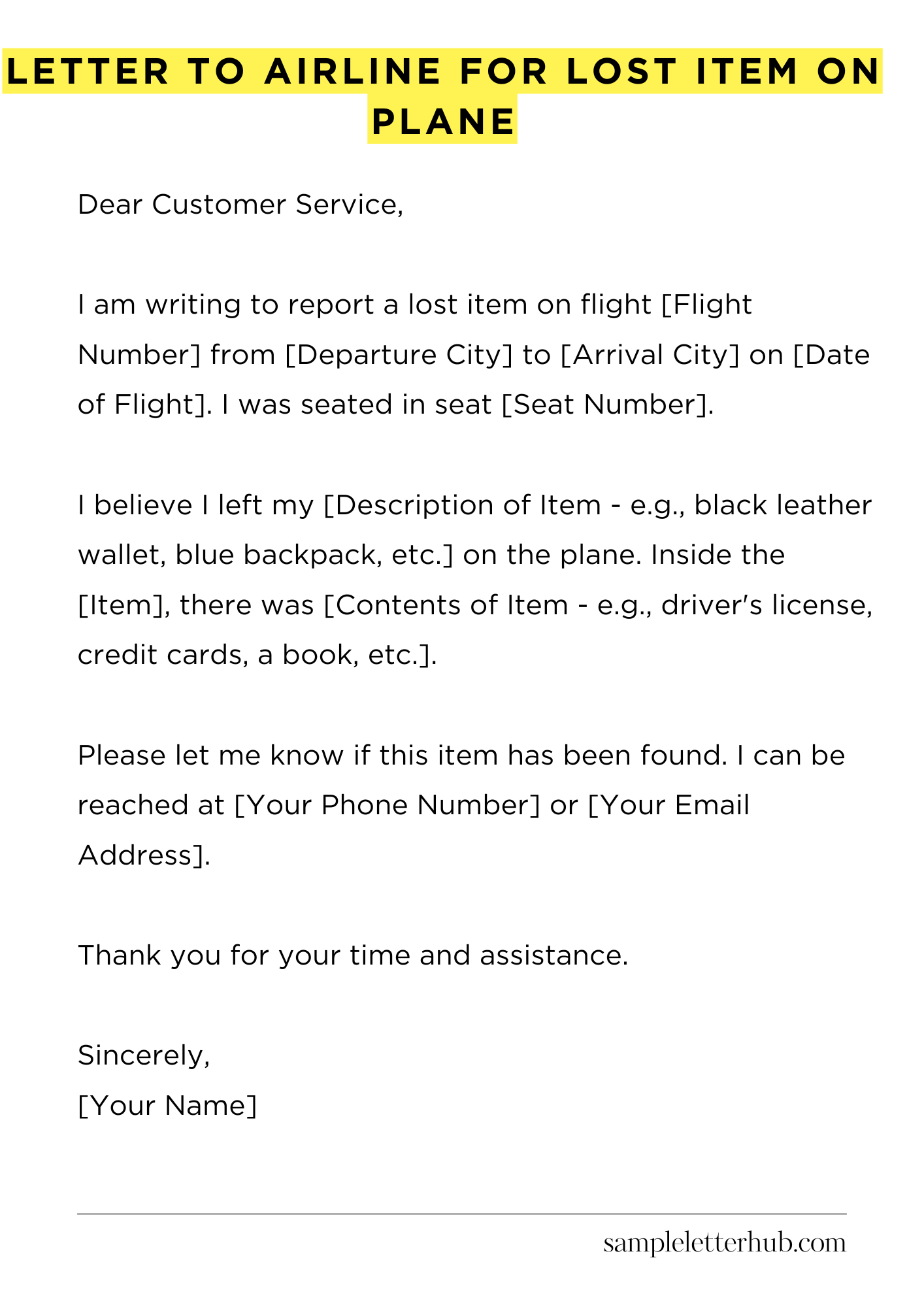
Dear Customer Service,
I am writing to report a lost item on flight [Flight Number] from [Departure City] to [Arrival City] on [Date of Flight]. I was seated in seat [Seat Number].
I believe I left my [Description of Item – e.g., black leather wallet, blue backpack, etc.] on the plane. Inside the [Item], there was [Contents of Item – e.g., driver’s license, credit cards, a book, etc.].
Please let me know if this item has been found. I can be reached at [Your Phone Number] or [Your Email Address].
Thank you for your time and assistance.
Sincerely,
[Your Name]
How to Write Letter To Airline For Lost Item On Plane
Subject Line: Capturing Attention Immediately
- Be succinct and direct. A subject line like “Lost Item on Flight [Airline Code] [Flight Number] – [Your Name]” is generally efficacious.
- Avoid ambiguity. Clarity is paramount; the airline needs to understand the letter’s purpose at a mere glance.
- For example: “Missing Laptop – Flight AA123 – John Doe”
Salutation: Initiating Formal Communication
- Opt for a professional salutation. “Dear [Airline Name] Lost and Found Department” is a safe bet.
- If you have a contact person, using their name adds a personal touch. “Dear Mr./Ms. [Last Name]” is appropriate.
- Avoid overly casual greetings like “Hey” or “Hello.”
Body: Detailing the Incident
- Start by identifying yourself and your flight details. Include your name, address, phone number, email, flight number, and date of travel.
- Provide a meticulous description of the lost item. Include brand, color, size, any distinguishing marks, and its approximate value.
- Specify where you believe you lost the item. Was it in the overhead bin, under the seat, or in the seat pocket?
- Example: “I am writing to report a lost black leather briefcase, approximately 16×12 inches, with a silver clasp and the initials ‘JD’ engraved on the front. I believe I left it in the overhead bin on flight UA456 from Chicago to Denver on July 12, 2024.”
Expressing Expectations: Articulating Your Desired Outcome
- Clearly state what you expect the airline to do. Are you expecting them to search for the item, contact you if found, or initiate a claim process?
- Be reasonable in your demands. Airlines are more likely to cooperate if your request is feasible.
- Example: “I kindly request that you initiate a search for the aforementioned briefcase and contact me at your earliest convenience if it is located. I would also appreciate information regarding the process for filing a claim should the item remain unrecovered.”
Providing Supporting Documentation: Bolstering Your Claim
- Mention any supporting documents you are including, such as a copy of your boarding pass, baggage claim ticket, or a photograph of the lost item.
- These documents lend credence to your claim and expedite the search process.
- Example: “Please find attached a copy of my boarding pass and a photograph of the briefcase for your reference.”
Closing: Maintaining Professionalism
- Use a formal closing such as “Sincerely” or “Respectfully.”
- Include your full name, phone number, and email address below your signature.
- This ensures the airline can easily contact you with updates.
Postscript (P.S.): Adding a Final Touch
- A P.S. can be used to reiterate the importance of the lost item or to offer a reward for its return (optional).
- Example: “P.S. The briefcase contains irreplaceable personal documents. Any assistance in its recovery would be greatly appreciated.”
Frequently Asked Questions: Lost Items on Airlines
Losing an item on a flight can be a stressful experience. This FAQ section provides guidance on how to effectively communicate with airlines to recover your lost belongings.
What information should I include in my letter to the airline?
Your letter should include your full name, contact information, flight number, date of travel, a detailed description of the lost item, and the last known location of the item on the plane.
Who should I address the letter to?
Address your letter to the airline’s Lost and Found department or Customer Service department. You can usually find the appropriate contact information on the airline’s website.
How long should I wait before contacting the airline about my lost item?
It is best to contact the airline as soon as you realize you have lost an item. The sooner you report it, the higher the chances of recovery.
What if I don’t receive a response from the airline?
If you haven’t received a response within a reasonable timeframe (e.g., one week), follow up with the airline by phone or email, referencing your initial communication.
What if the airline finds my item but I live far away?
Most airlines will ship recovered items to your address, but you may be responsible for covering the shipping costs. Confirm the shipping arrangements and associated fees with the airline.
Related:
Resignation letter due to rude boss
Resignation letter moving to another state
Resignation letter due to illness of family member
Resignation letter due to study