

A “Letter To Airline For Denied Boarding Compensation” is a formal request. You write it when an airline bumps you off a flight. This usually happens due to overbooking. You are entitled to compensation in such cases.
Need to write such a letter? We’ve got you covered. This article provides useful templates. These samples will make writing your letter easy.
Use our examples as a starting point. Tailor them to your specific situation. Get the compensation you deserve quickly.
Letter To Airline For Denied Boarding Compensation
[Your Name]
[Your Address]
[Your Phone Number]
[Your Email Address]
[Date]
[Airline Name]
[Airline Address]
Subject: Claim for Denied Boarding Compensation – Flight [Flight Number] – [Date of Flight]
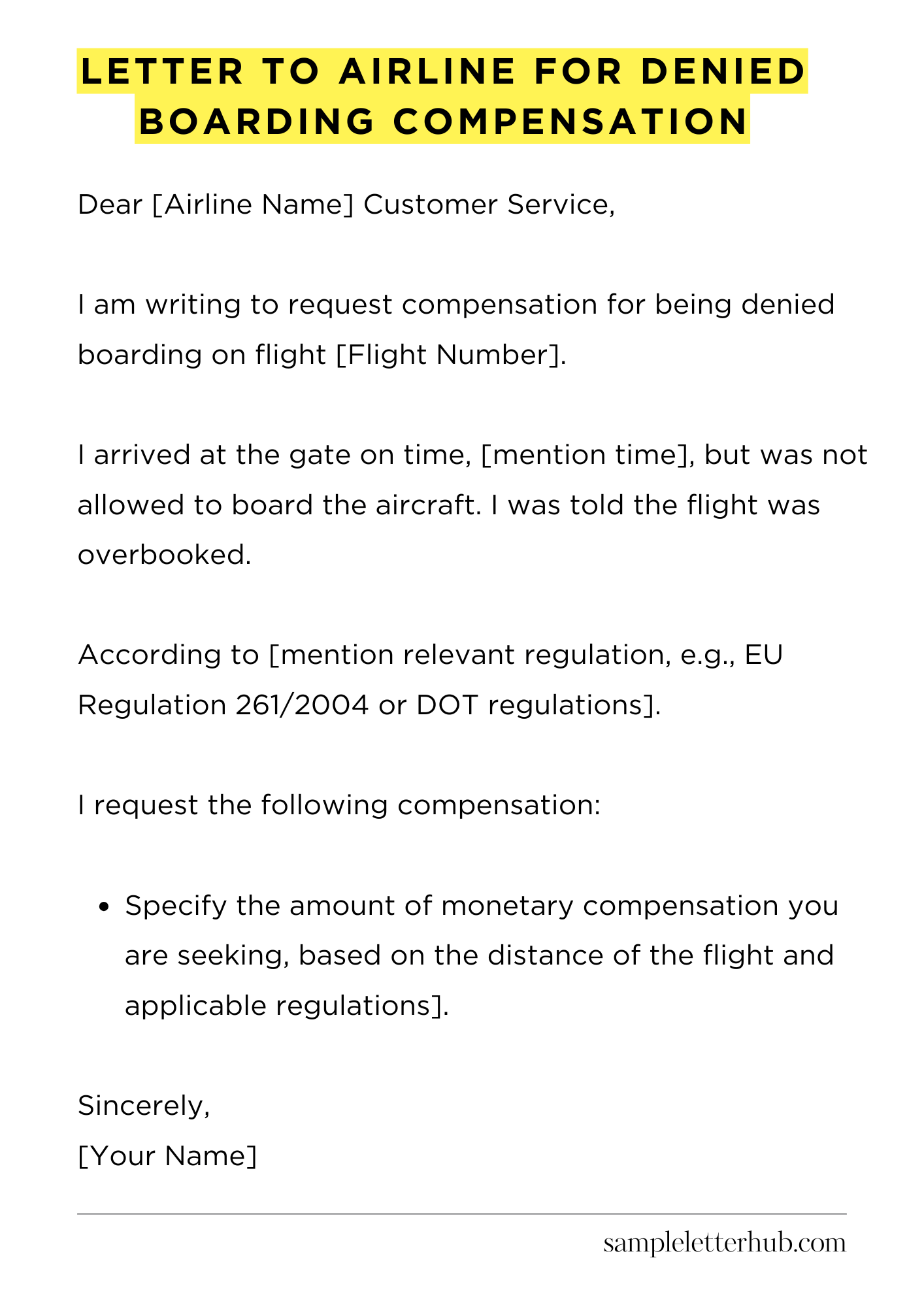
Dear [Airline Name] Customer Service,
I am writing to request compensation for being denied boarding on flight [Flight Number] from [Departure City] to [Arrival City] on [Date of Flight]. My confirmed reservation number was [Reservation Number].
I arrived at the gate on time, [mention time], but was not allowed to board the aircraft. I was told the flight was overbooked.
According to [mention relevant regulation, e.g., EU Regulation 261/2004 or DOT regulations], I am entitled to compensation for this denied boarding.
I request the following compensation:
- Specify the amount of monetary compensation you are seeking, based on the distance of the flight and applicable regulations].
- Reimbursement for any additional expenses incurred as a result of the denied boarding, such as [hotel, meals, transportation – provide receipts].
I look forward to your prompt response and resolution to this matter. Please contact me at [Your Phone Number] or [Your Email Address] to discuss this further.
Sincerely,
[Your Name]
How to Write Letter To Airline For Denied Boarding Compensation
Subject Line: Conveying Urgency and Specificity
The subject line is your initial gambit. Be direct and incorporate keywords. Instead of a generic “Complaint,” try:
- “Denied Boarding Compensation Claim – Flight [Flight Number] – [Date]”
- “Demand for Compensation – Involuntary Denied Boarding – [Your Name]”
A precise subject line expedites the sorting process and signals the gravity of your claim.
Salutation: Maintaining Professionalism
Address your letter to a specific department if possible. Research online for the airline’s customer relations or compensation department. If a name is elusive, opt for:
- “To Whom It May Concern,”
- “Dear Customer Relations Department,”
Avoid overly familiar greetings. Professionalism begets respect, even in complaint.
Introduction: Establishing Context and Intent
The opening paragraph should succinctly outline the situation and your desired outcome. Include:
- Your flight details: airline, flight number, date, and booking reference.
- A concise statement that you were involuntarily denied boarding.
- A clear declaration that you are seeking compensation as per regulations (mention the relevant regulation, e.g., EU 261 if applicable).
Example: “I am writing to formally request compensation for being involuntarily denied boarding on flight [Flight Number] from [Departure City] to [Arrival City] on [Date]. My booking reference is [Booking Reference]. I am entitled to compensation under [Regulation, e.g., EU 261/2004].”
Body Paragraphs: Detailing the Ordeal
This section is where you elaborate on the specifics of your experience. Be factual, avoid emotional hyperbole, and include:
- The time you arrived at the gate and whether you checked in online.
- The reason given for the denied boarding (if any).
- Any inconvenience or consequential damages you suffered (e.g., missed connecting flights, pre-booked accommodations, lost wages).
- Attach copies of your boarding pass, flight confirmation, and any receipts related to expenses incurred due to the denied boarding.
Quantify your losses where possible. Instead of “I missed an important meeting,” state, “I missed a meeting that resulted in a loss of [Amount] in potential revenue.”
Compensation Request: Specifying Your Entitlement
Clearly state the amount of compensation you are seeking. Research the compensation amounts stipulated by the relevant regulations. For example, under EU 261, compensation ranges from €250 to €600 depending on the flight distance.
- “Based on the distance of my flight, I am entitled to €[Amount] in compensation.”
- “I request reimbursement for the additional expenses incurred as a result of the denied boarding, totaling [Amount], supported by the attached receipts.”
Be assertive but reasonable. Inflated claims can undermine your credibility.
Call to Action: Setting a Deadline
Conclude your letter with a clear call to action, specifying a reasonable timeframe for a response. This demonstrates your seriousness and encourages prompt attention.
- “I expect a response to this letter within [Number] days, outlining the steps you will take to process my compensation claim.”
- “If I do not receive a satisfactory response within this timeframe, I will consider escalating this matter to the appropriate regulatory bodies.”
A deadline instills a sense of urgency.
Closing: Maintaining a Professional Demeanor
End your letter with a formal closing:
- “Sincerely,”
- “Yours faithfully,” (if you addressed the letter to a specific person)
Followed by your full name and contact information (phone number and email address). A professional closing reinforces the seriousness of your claim.
Frequently Asked Questions: Denied Boarding Compensation Letters
This section addresses common queries regarding letters requesting compensation for denied boarding. Understanding your rights and the proper procedures can help ensure a fair resolution.
1. When should I send a letter to the airline?
You should send a letter to the airline after you have been involuntarily denied boarding and believe you are entitled to compensation but have not received a satisfactory offer at the airport.
2. What information should I include in my letter?
Your letter should include your flight details (date, flight number, origin, and destination), booking reference, a clear explanation of the incident, the compensation you are seeking, and copies of relevant documents like your boarding pass.
3. What type of compensation am I entitled to?
Compensation may include monetary payment, a substitute flight, or reimbursement of expenses incurred due to the denied boarding, depending on the length of the delay and applicable regulations.
4. How long does the airline have to respond to my letter?
Airlines are generally expected to respond to complaints within a reasonable timeframe, often within 30 days, although this can vary depending on the airline and the complexity of the issue.
5. What if the airline denies my compensation claim?
If the airline denies your claim, you can escalate the matter by filing a complaint with the relevant consumer protection agency or transportation authority in the country where the flight originated.
Related:
Resignation letter due to rude boss
Resignation letter moving to another state
Resignation letter due to illness of family member
Resignation letter due to study